QUESTION IMAGE
Question
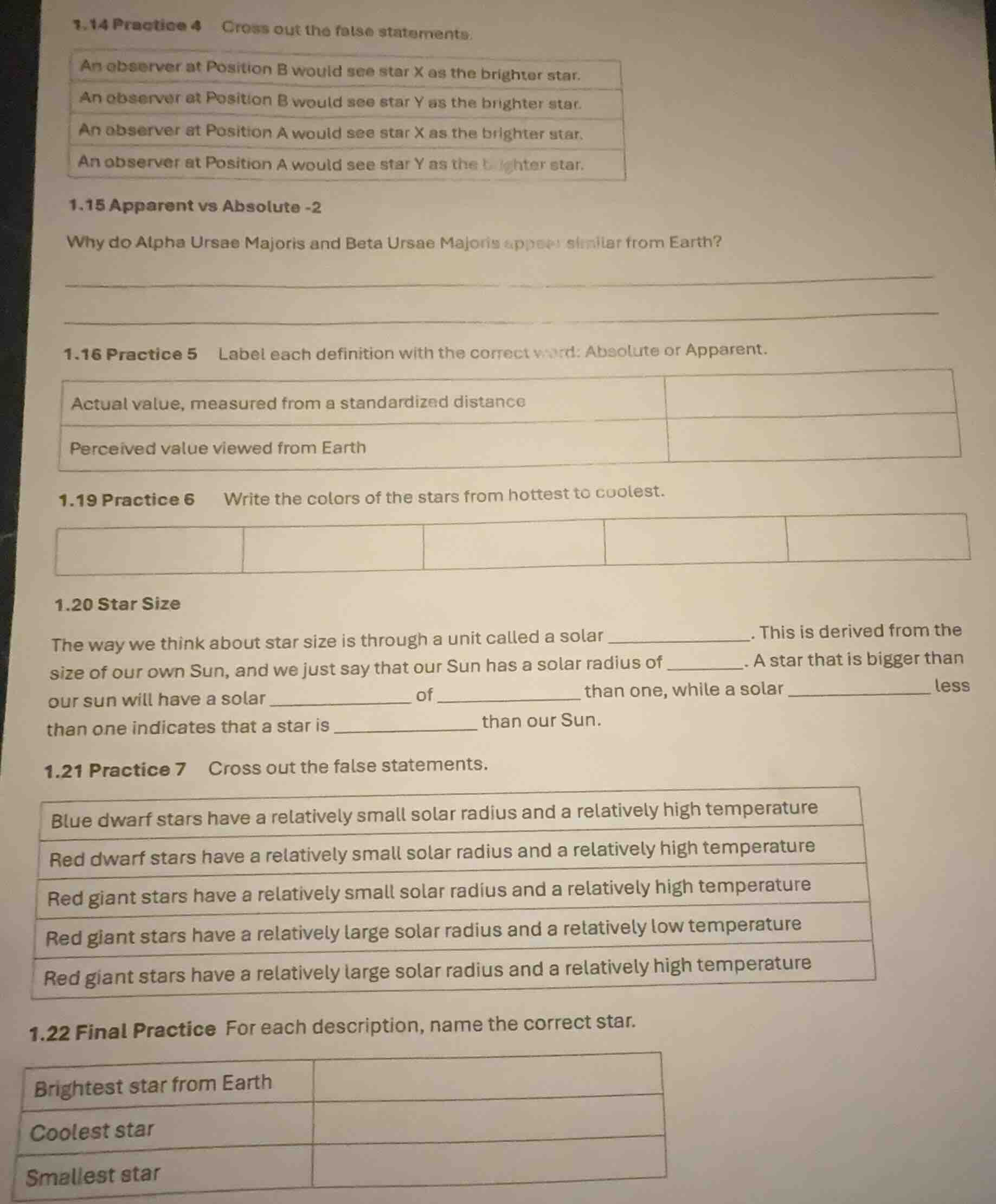
1.14 practice 4 cross out the false statements.
an observer at position b would see star x as the brighter star.
an observer at position b would see star y as the brighter star.
an observer at position a would see star x as the brighter star.
an observer at position a would see star y as the brighter star.
1.15 apparent vs absolute -2
why do alpha ursae majoris and beta ursae majoris appear similar from earth?
1.16 practice 5 label each definition with the correct word: absolute or apparent.
actual value, measured from a standardized distance
perceived value viewed from earth
1.19 practice 6 write the colors of the stars from hottest to coolest.
1.20 star size
the way we think about star size is through a unit called a solar __________. this is derived from the
size of our own sun, and we just say that our sun has a solar radius of _______. a star that is bigger than
our sun will have a solar ________ of ______ than one, while a solar ________ less
than one indicates that a star is __________ than our sun.
1.21 practice 7 cross out the false statements.
blue dwarf stars have a relatively small solar radius and a relatively high temperature
red dwarf stars have a relatively small solar radius and a relatively high temperature
red giant stars have a relatively small solar radius and a relatively high temperature
red giant stars have a relatively large solar radius and a relatively low temperature
red giant stars have a relatively large solar radius and a relatively high temperature
1.22 final practice for each description, name the correct star.
brightest star from earth
coolest star
smallest star
1.14 Practice 4
To determine false statements, we analyze star brightness from positions (assuming distance/intrinsic brightness logic):
- False 1: "An observer at Position B would see star X as the brighter star." (If Y is closer or more intrinsic, X isn’t brighter at B.)
- False 3: "An observer at Position A would see star X as the brighter star." (If Y is brighter at A.)
- False 4: "An observer at Position A would see star Y as the lighter star." (Likely typo, "brighter"—if Y is brighter, this is false.)
(Note: Without diagram, we use typical brightness logic: apparent brightness depends on distance/intrinsic. Assume Y is closer or more luminous at B, X not at A, etc.)
1.15 Apparent vs Absolute - 2
Alpha Ursae Majoris (Dubhe) and Beta Ursae Majoris (Merak) appear similar from Earth because their apparent magnitude (perceived brightness) is similar, even if absolute magnitude (actual brightness at 10 pc) differs. Their distances from Earth and intrinsic brightness combine to make them look equally bright.
1.16 Practice 5
- "Actual value, measured from a standardized distance" → Absolute (e.g., absolute magnitude, measured at 10 parsecs).
- "Perceived value viewed from Earth" → Apparent (e.g., apparent magnitude, as seen from Earth’s perspective).
1.19 Practice 6
Star colors from hottest to coolest: Blue, White, Yellow, Orange, Red (based on stellar temperature: hotter stars emit bluer light, cooler redder).
1.20 Star Size
The unit for star size is solar radius (derived from the Sun’s size). The Sun has a solar radius of \( \boldsymbol{1} \). A star bigger than the Sun has a solar radius greater than 1; a solar radius less than 1 means the star is smaller than the Sun.
Filled blanks:
- "solar \(\boldsymbol{\text{radius}}\)"
- "solar radius of \(\boldsymbol{1}\)"
- "solar \(\boldsymbol{\text{radius}}\) of \(\boldsymbol{\text{greater}}\) than one"
- "solar \(\boldsymbol{\text{radius}}\) less than one indicates... \(\boldsymbol{\text{smaller}}\) than our Sun"
1.21 Practice 7
False statements (cross out):
- "Red dwarf stars have a relatively small solar radius and a relatively high temperature" (Red dwarfs are cool, low temp).
- "Red giant stars have a relatively small solar radius and a relatively high temperature" (Red giants are large radius, low temp).
- "Red giant stars have a relatively large solar radius and a relatively high temperature" (Red giants are cool, low temp).
1.22 Final Practice
- Brightest star from Earth: Sirius (Sirius A is the brightest apparent magnitude).
- Coolest star: Red dwarfs (e.g., Proxima Centauri) or red giants (cooler than yellow/white/blue stars).
- Smallest star: Neutron stars (or red dwarfs, but neutron stars are ~10 km, smallest known stellar remnants; red dwarfs are ~0.1–0.5 solar radii, but neutron stars are smaller).
Final Answers (Key Sections)
1.14: Cross out "An observer at Position B would see star X...", "An observer at Position A would see star X...", "An observer at Position A would see star Y...".
1.15: They appear similar because their apparent brightness (from Earth) is similar.
1.16: Absolute; Apparent.
1.19: Blue, White, Yellow, Orange, Red.
1.20: radius; 1; radius; greater; radius; smaller.
1.21: Cross out "Red dwarf...high temperature", "Red giant...small radius...high temp", "Red giant...large radius...high temp".
1.22: Brightest: Sirius; Coolest: Red Dwarf (e.g., Proxima Centauri); Smallest: Neutron Star (or Red Dwarf).

Snap & solve any problem in the app
Get step-by-step solutions on Sovi AI
Photo-based solutions with guided steps
Explore more problems and detailed explanations
1.14 Practice 4
To determine false statements, we analyze star brightness from positions (assuming distance/intrinsic brightness logic):
- False 1: "An observer at Position B would see star X as the brighter star." (If Y is closer or more intrinsic, X isn’t brighter at B.)
- False 3: "An observer at Position A would see star X as the brighter star." (If Y is brighter at A.)
- False 4: "An observer at Position A would see star Y as the lighter star." (Likely typo, "brighter"—if Y is brighter, this is false.)
(Note: Without diagram, we use typical brightness logic: apparent brightness depends on distance/intrinsic. Assume Y is closer or more luminous at B, X not at A, etc.)
1.15 Apparent vs Absolute - 2
Alpha Ursae Majoris (Dubhe) and Beta Ursae Majoris (Merak) appear similar from Earth because their apparent magnitude (perceived brightness) is similar, even if absolute magnitude (actual brightness at 10 pc) differs. Their distances from Earth and intrinsic brightness combine to make them look equally bright.
1.16 Practice 5
- "Actual value, measured from a standardized distance" → Absolute (e.g., absolute magnitude, measured at 10 parsecs).
- "Perceived value viewed from Earth" → Apparent (e.g., apparent magnitude, as seen from Earth’s perspective).
1.19 Practice 6
Star colors from hottest to coolest: Blue, White, Yellow, Orange, Red (based on stellar temperature: hotter stars emit bluer light, cooler redder).
1.20 Star Size
The unit for star size is solar radius (derived from the Sun’s size). The Sun has a solar radius of \( \boldsymbol{1} \). A star bigger than the Sun has a solar radius greater than 1; a solar radius less than 1 means the star is smaller than the Sun.
Filled blanks:
- "solar \(\boldsymbol{\text{radius}}\)"
- "solar radius of \(\boldsymbol{1}\)"
- "solar \(\boldsymbol{\text{radius}}\) of \(\boldsymbol{\text{greater}}\) than one"
- "solar \(\boldsymbol{\text{radius}}\) less than one indicates... \(\boldsymbol{\text{smaller}}\) than our Sun"
1.21 Practice 7
False statements (cross out):
- "Red dwarf stars have a relatively small solar radius and a relatively high temperature" (Red dwarfs are cool, low temp).
- "Red giant stars have a relatively small solar radius and a relatively high temperature" (Red giants are large radius, low temp).
- "Red giant stars have a relatively large solar radius and a relatively high temperature" (Red giants are cool, low temp).
1.22 Final Practice
- Brightest star from Earth: Sirius (Sirius A is the brightest apparent magnitude).
- Coolest star: Red dwarfs (e.g., Proxima Centauri) or red giants (cooler than yellow/white/blue stars).
- Smallest star: Neutron stars (or red dwarfs, but neutron stars are ~10 km, smallest known stellar remnants; red dwarfs are ~0.1–0.5 solar radii, but neutron stars are smaller).
Final Answers (Key Sections)
1.14: Cross out "An observer at Position B would see star X...", "An observer at Position A would see star X...", "An observer at Position A would see star Y...".
1.15: They appear similar because their apparent brightness (from Earth) is similar.
1.16: Absolute; Apparent.
1.19: Blue, White, Yellow, Orange, Red.
1.20: radius; 1; radius; greater; radius; smaller.
1.21: Cross out "Red dwarf...high temperature", "Red giant...small radius...high temp", "Red giant...large radius...high temp".
1.22: Brightest: Sirius; Coolest: Red Dwarf (e.g., Proxima Centauri); Smallest: Neutron Star (or Red Dwarf).