QUESTION IMAGE
Question
1/14 - show solution/reason. (5 pts)
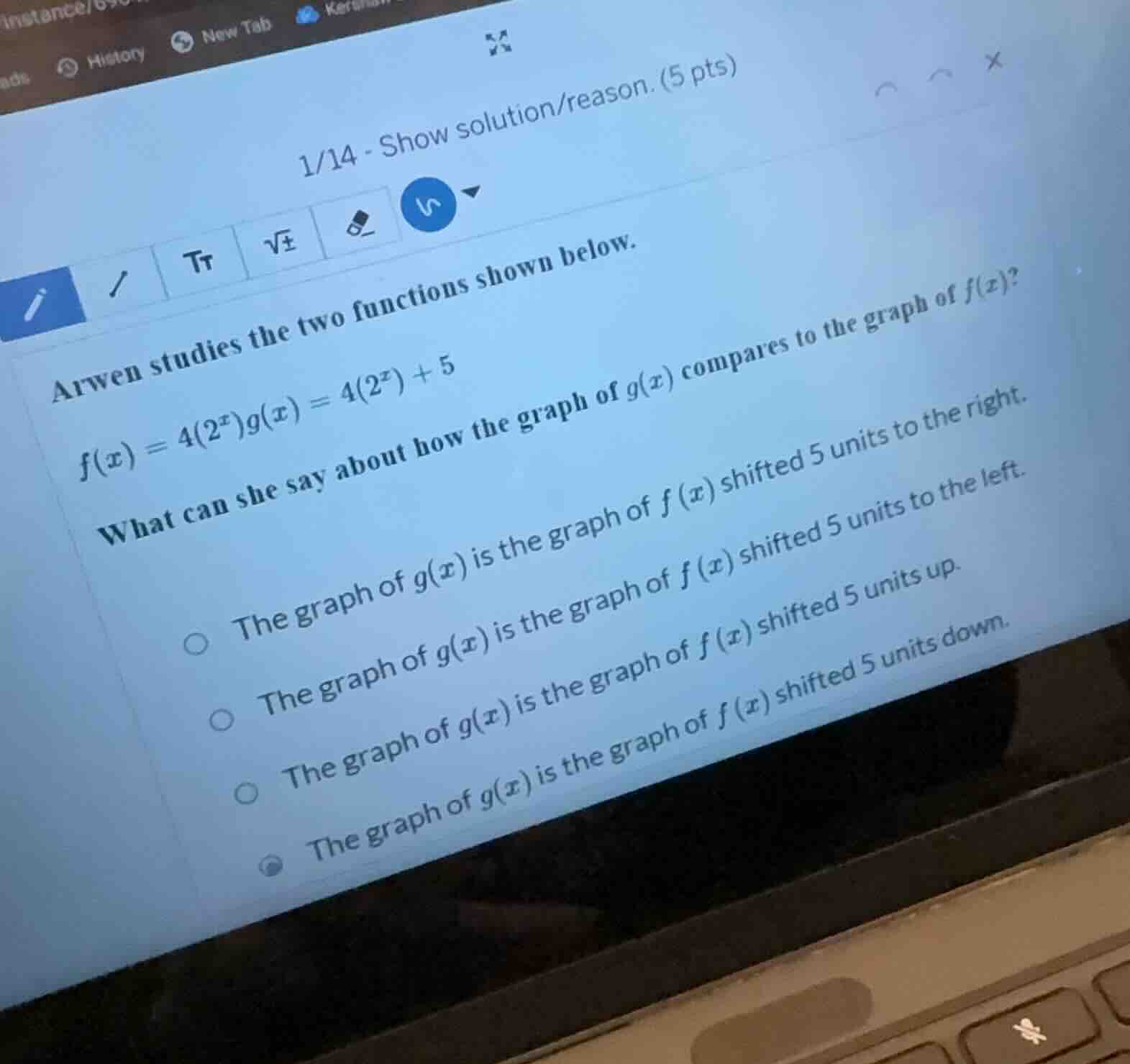
arwen studies the two functions shown below.
$f(x) = 4(2^x)$ $g(x) = 4(2^x) + 5$
what can she say about how the graph of $g(x)$ compares to the graph of $f(x)$?
the graph of $g(x)$ is the graph of $f(x)$ shifted 5 units to the right.
the graph of $g(x)$ is the graph of $f(x)$ shifted 5 units to the left.
the graph of $g(x)$ is the graph of $f(x)$ shifted 5 units up.
the graph of $g(x)$ is the graph of $f(x)$ shifted 5 units down.
Step1: Recall function transformation rules
For a function \( y = f(x) \), the transformation \( y = f(x)+k \) shifts the graph of \( f(x) \) up by \( k \) units if \( k>0 \) and down by \( |k| \) units if \( k < 0 \). The transformation \( y=f(x - h) \) shifts the graph of \( f(x) \) right by \( h \) units if \( h>0 \) and left by \( |h| \) units if \( h < 0 \).
Step2: Compare \( f(x) \) and \( g(x) \)
Given \( f(x)=4(2^{x}) \) and \( g(x)=4(2^{x}) + 5 \). We can see that \( g(x)=f(x)+5 \).
Step3: Determine the transformation
Using the function transformation rule for vertical shifts, since we are adding 5 to \( f(x) \) to get \( g(x) \), the graph of \( g(x) \) is the graph of \( f(x) \) shifted 5 units up.

Snap & solve any problem in the app
Get step-by-step solutions on Sovi AI
Photo-based solutions with guided steps
Explore more problems and detailed explanations
The graph of \( g(x) \) is the graph of \( f(x) \) shifted 5 units up. (The corresponding option should be selected, for example, if the option "The graph of \( g(x) \) is the graph of \( f(x) \) shifted 5 units up." is present, that is the correct option.)