QUESTION IMAGE
Question
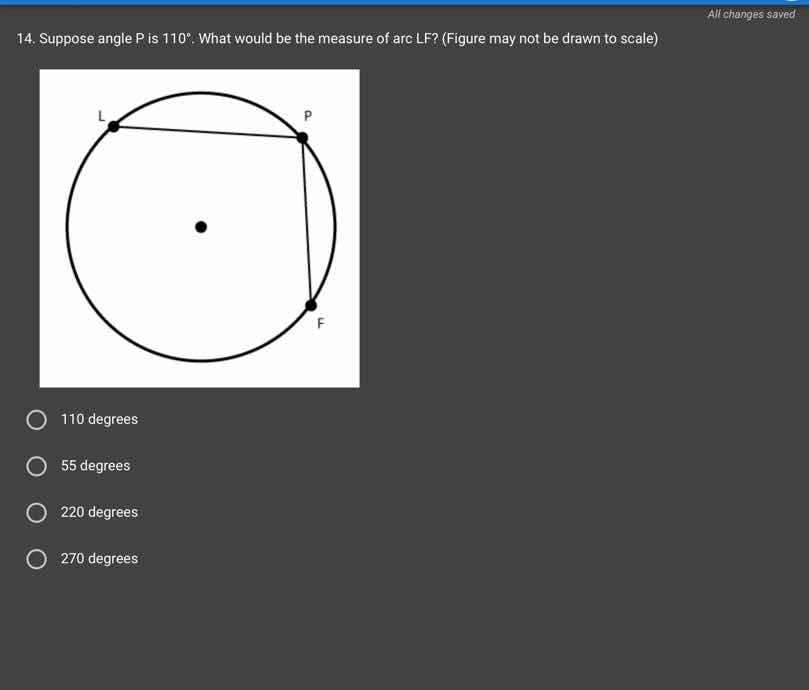
- suppose angle p is 110°. what would be the measure of arc lf? (figure may not be drawn to scale)
options: 110 degrees, 55 degrees, 220 degrees, 270 degrees
Step1: Recall the property of a cyclic quadrilateral or inscribed angle? Wait, no, here angle at P is a tangent-chord? Wait, no, points L, P, F: Wait, actually, if we consider that LP and FP are chords, but wait, the angle at P is an inscribed angle? Wait, no, maybe it's a quadrilateral? Wait, no, the figure is a circle with center, and points L, P, F on the circle? Wait, no, P is a point on the circle, L and F are also on the circle. So angle at P (∠LPF) is 110°, and we need to find arc LF. Wait, the measure of an inscribed angle is half the measure of its intercepted arc. Wait, no, if angle at P is 110°, then the arc opposite to it (the major arc LF) would be related? Wait, no, the sum of an inscribed angle and its opposite arc? Wait, no, in a circle, the measure of an inscribed angle is half the measure of its intercepted arc. Wait, but if angle at P is 110°, then the arc LF that it intercepts (the minor arc) would be? Wait, no, maybe it's a tangent? Wait, no, the figure shows a circle with center, and points L, P, F on the circumference. So ∠LPF is an inscribed angle. Wait, no, the inscribed angle theorem: the measure of an inscribed angle is half the measure of its intercepted arc. But if ∠LPF is 110°, then the intercepted arc would be the arc that's not between L and F. Wait, the total circumference is 360°, so the major arc LF and minor arc LF add up to 360°. Wait, no, maybe I got it wrong. Wait, actually, if angle at P is 110°, then the arc LF (the major arc) would be 220°, because the inscribed angle is half the measure of the arc it intercepts. Wait, no, let's think again. The inscribed angle theorem: the measure of an inscribed angle is half the measure of its intercepted arc. So if ∠LPF is 110°, then the arc that it intercepts (the arc that's opposite to it, the major arc LF) would be 2110°=220°? Wait, no, that can't be. Wait, no, the inscribed angle intercepts the arc that's between the two sides of the angle. So if angle at P is between PL and PF, then the intercepted arc is LF. But if angle at P is 110°, then the arc LF (minor arc) would be 2110°? No, that would be 220°, which is a major arc. Wait, no, the inscribed angle is half the arc. So if the angle is 110°, then the arc it intercepts is 220°, which is the major arc LF. So the minor arc LF would be 360° - 220° = 140°? Wait, that's not one of the options. Wait, the options are 110, 55, 220, 270. Wait, maybe I made a mistake. Wait, maybe angle at P is a tangent angle? No, the figure shows P on the circle. Wait, maybe it's a quadrilateral with two sides as chords and P as a vertex. Wait, another approach: the sum of an inscribed angle and the arc it subtends (the opposite arc) – no, maybe it's a cyclic quadrilateral? Wait, no, the circle has center, so maybe it's a triangle? Wait, no, the problem says "arc LF". Let's check the options. The options include 220 degrees. Let's see: if angle at P is 110°, then the arc LF (major arc) is 220°, because the inscribed angle is half the measure of the arc it intercepts. Wait, no, the inscribed angle is half the arc. So if angle P is 110°, then the arc LF (the arc that's not between L and F, the major arc) is 2*110°=220°, because the angle is an inscribed angle intercepting the major arc LF. So the measure of arc LF (major arc) is 220 degrees. So the answer is 220 degrees.
Step2: Confirm the calculation. The inscribed angle theorem: measure of inscribed angle = 1/2 measure of intercepted arc. So if ∠LPF = 110°, then the intercepted arc (major arc LF) is 2 * 110° = 220°. So arc LF (major arc) is 220 degrees.

Snap & solve any problem in the app
Get step-by-step solutions on Sovi AI
Photo-based solutions with guided steps
Explore more problems and detailed explanations
220 degrees (the option with 220 degrees)