QUESTION IMAGE
Question
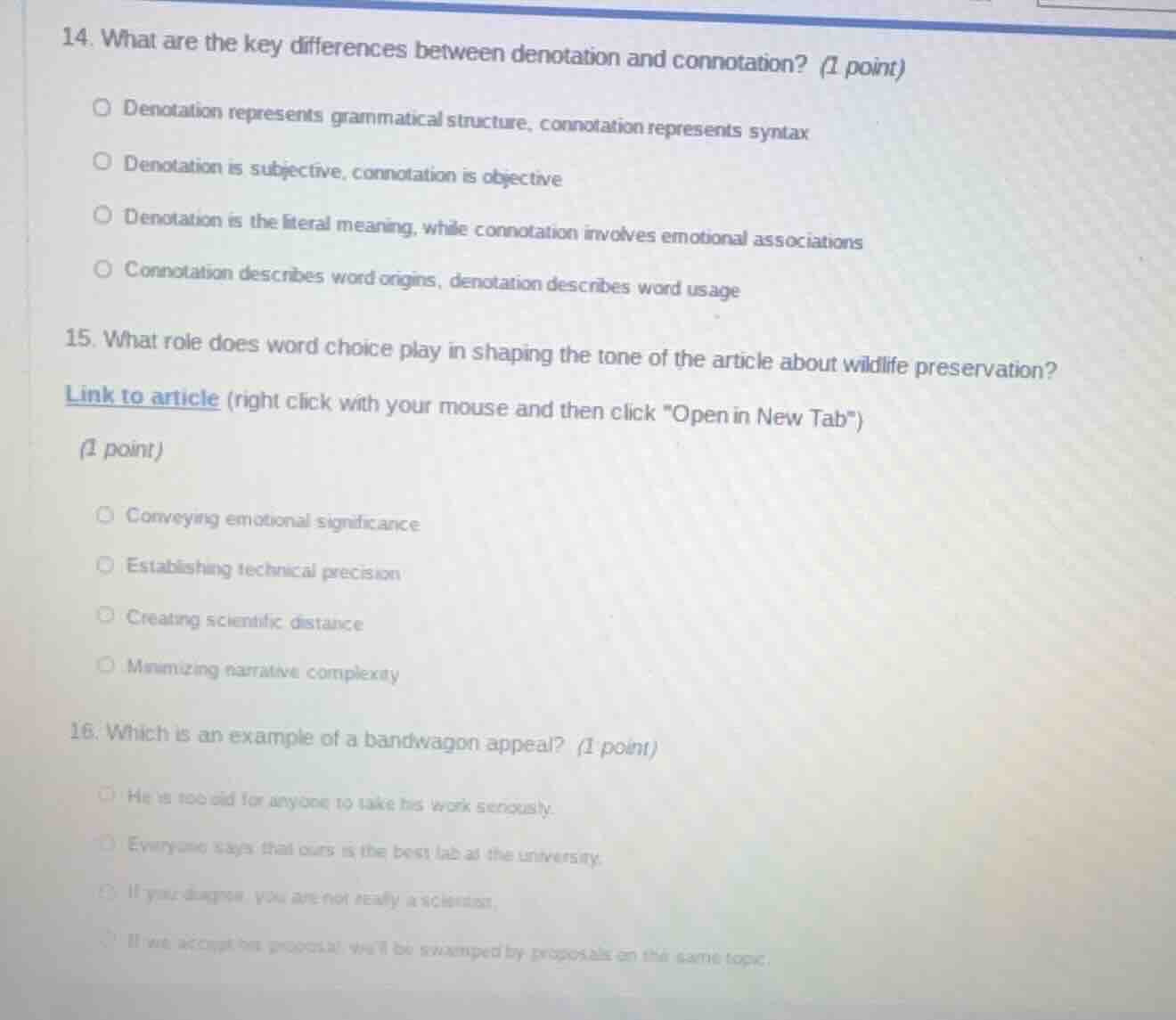
- what are the key differences between denotation and connotation? (1 point)
denotation represents grammatical structure, connotation represents syntax
denotation is subjective, connotation is objective
denotation is the literal meaning, while connotation involves emotional associations
connotation describes word origins, denotation describes word usage
- what role does word choice play in shaping the tone of the article about wildlife preservation?
link to article (right click with your mouse and then click \open in new tab\)
(1 point)
conveying emotional significance
establishing technical precision
creating scientific distance
minimizing narrative complexity
- which is an example of a bandwagon appeal? (1 point)
he is too old for anyone to take his work seriously.
everyone says that ours is the best lab at the university.
if you disagree, you are not really a scientist.
if we accept his proposal, well be swamped by proposals on the same topic.
Question 14
To determine the key differences between denotation and connotation, we analyze each option:
- The first option is incorrect as denotation and connotation are not about grammatical structure or syntax.
- The second option is wrong because denotation is objective (literal meaning) and connotation is subjective (emotional associations).
- The third option is correct: Denotation refers to the literal, dictionary - defined meaning of a word, while connotation refers to the emotional, cultural, or associative meanings that a word carries.
- The fourth option is incorrect as etymology (word origins) and word usage are not related to denotation and connotation in this way.
When considering the role of word choice in shaping the tone of an article about wildlife preservation:
- "Conveying emotional significance" is correct. Word choice can be used to evoke emotions in the reader, for example, using words like "endangered", "precious", "vital" can create a sense of urgency or care about wildlife preservation, thus shaping the tone.
- "Establishing technical precision" is more related to using specific jargon in a scientific or technical context, not directly about tone.
- "Creating scientific distance" would be more about using detached, impersonal language, which is not the main role of word choice in shaping tone for a wildlife preservation article (which likely aims to engage readers emotionally).
- "Minimizing narrative complexity" is about simplifying the story, not about tone.
A bandwagon appeal is a persuasive technique that argues that something is good or should be done because "everyone" is doing it or believes it.
- "He is too old for anyone to take his work seriously" is an ad hominem attack (attacking the person, not the argument).
- "Everyone says that ours is the best lab at the university" uses the idea that because everyone says it, it must be true, which is a bandwagon appeal.
- "If you disagree, you are not really a scientist" is an appeal to force or a false dichotomy (implying only one way to be a scientist).
- "If we accept his proposal, we'll be swamped by proposals on the same topic" is a slippery slope fallacy (arguing that one action will lead to a series of negative consequences without sufficient evidence).

Snap & solve any problem in the app
Get step-by-step solutions on Sovi AI
Photo-based solutions with guided steps
Explore more problems and detailed explanations
Denotation is the literal meaning, while connotation involves emotional associations