QUESTION IMAGE
Question
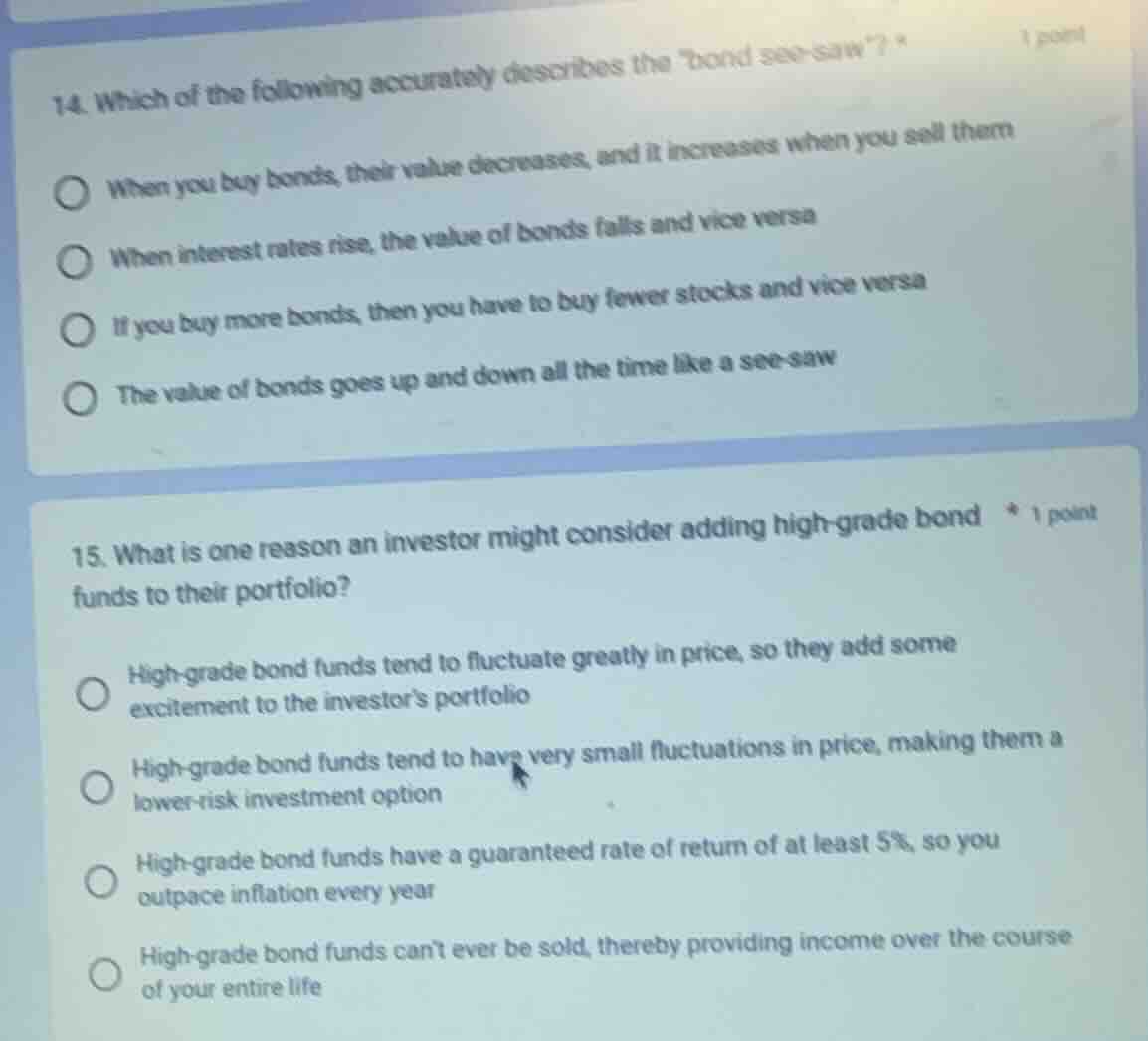
- which of the following accurately describes the \bond see - saw\?
when you buy bonds, their value decreases, and it increases when you sell them
when interest rates rise, the value of bonds falls and vice versa
if you buy more bonds, then you have to buy fewer stocks and vice versa
the value of bonds goes up and down all the time like a see - saw
- what is one reason an investor might consider adding high - grade bond funds to their portfolio?
high - grade bond funds tend to fluctuate greatly in price, so they add some excitement to the investors portfolio
high - grade bond funds tend to have very small fluctuations in price, making them a lower - risk investment option
high - grade bond funds have a guaranteed rate of return of at least 5%, so you outpace inflation every year
high - grade bond funds cant ever be sold, thereby providing income over the course of your entire life
Step1: Identify bond see-saw logic
The "bond see-saw" refers to the inverse relationship between bond values and market interest rates. When rates rise, existing bonds with lower fixed rates become less valuable, so their price falls, and when rates fall, existing bonds become more valuable, so their price rises.
Step2: Evaluate high-grade bond benefit
High-grade bonds are issued by highly creditworthy entities, so their prices are stable with minimal fluctuations. This makes them a low-risk asset, which investors add to portfolios to reduce overall risk, balance higher-risk assets, and provide steady returns. The other options are incorrect: high-grade bonds do not fluctuate greatly, have no guaranteed 5% return, and are fully sellable.

Snap & solve any problem in the app
Get step-by-step solutions on Sovi AI
Photo-based solutions with guided steps
Explore more problems and detailed explanations
- When interest rates rise, the value of bonds falls and vice versa
- High-grade bond funds tend to have very small fluctuations in price, making them a lower-risk investment option