QUESTION IMAGE
Question
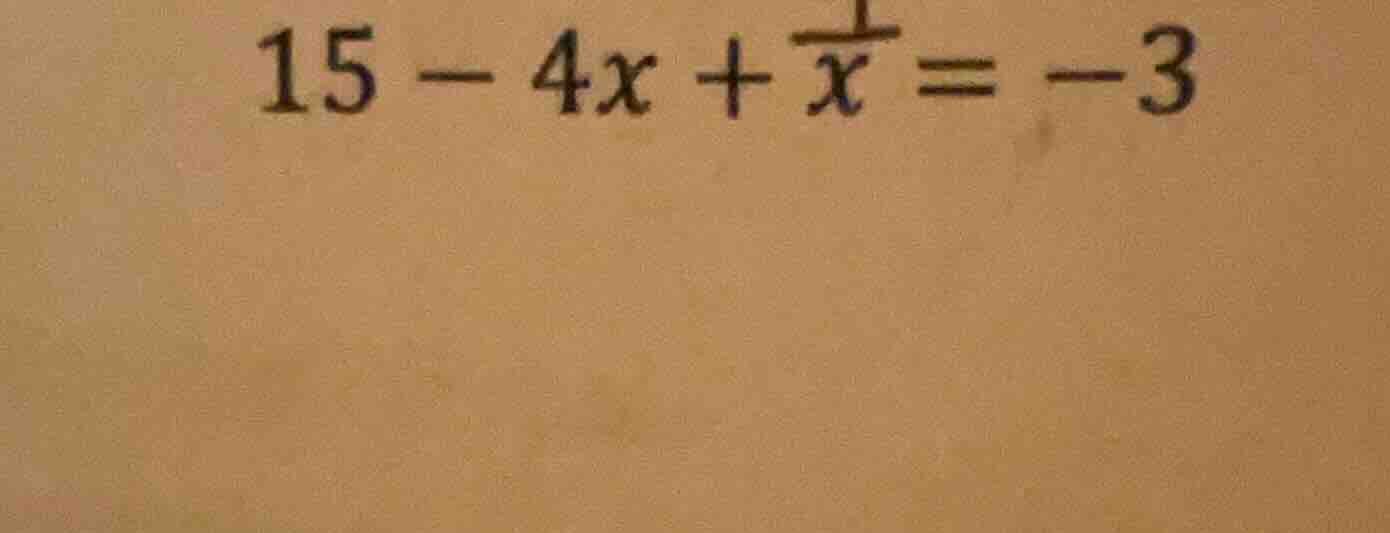
15 - 4x + \frac{1}{x} = -3
Step1: Multiply through by \( x \) ( \( x
eq 0 \)) to eliminate the fraction.
\( x(15 - 4x + \frac{1}{x}) = x(-3) \)
\( 15x - 4x^2 + 1 = -3x \)
Step2: Rearrange into standard quadratic form \( ax^2 + bx + c = 0 \).
\( -4x^2 + 15x + 3x + 1 = 0 \)
\( -4x^2 + 18x + 1 = 0 \)
Multiply both sides by -1 to make the coefficient of \( x^2 \) positive:
\( 4x^2 - 18x - 1 = 0 \)
Step3: Use the quadratic formula \( x = \frac{-b \pm \sqrt{b^2 - 4ac}}{2a} \), where \( a = 4 \), \( b = -18 \), \( c = -1 \).
First, calculate the discriminant \( \Delta = b^2 - 4ac \)
\( \Delta = (-18)^2 - 4(4)(-1) = 324 + 16 = 340 \)
Then, find \( x \):
\( x = \frac{-(-18) \pm \sqrt{340}}{2(4)} = \frac{18 \pm 2\sqrt{85}}{8} = \frac{9 \pm \sqrt{85}}{4} \)

Snap & solve any problem in the app
Get step-by-step solutions on Sovi AI
Photo-based solutions with guided steps
Explore more problems and detailed explanations
\( x = \frac{9 + \sqrt{85}}{4} \) or \( x = \frac{9 - \sqrt{85}}{4} \)