QUESTION IMAGE
Question
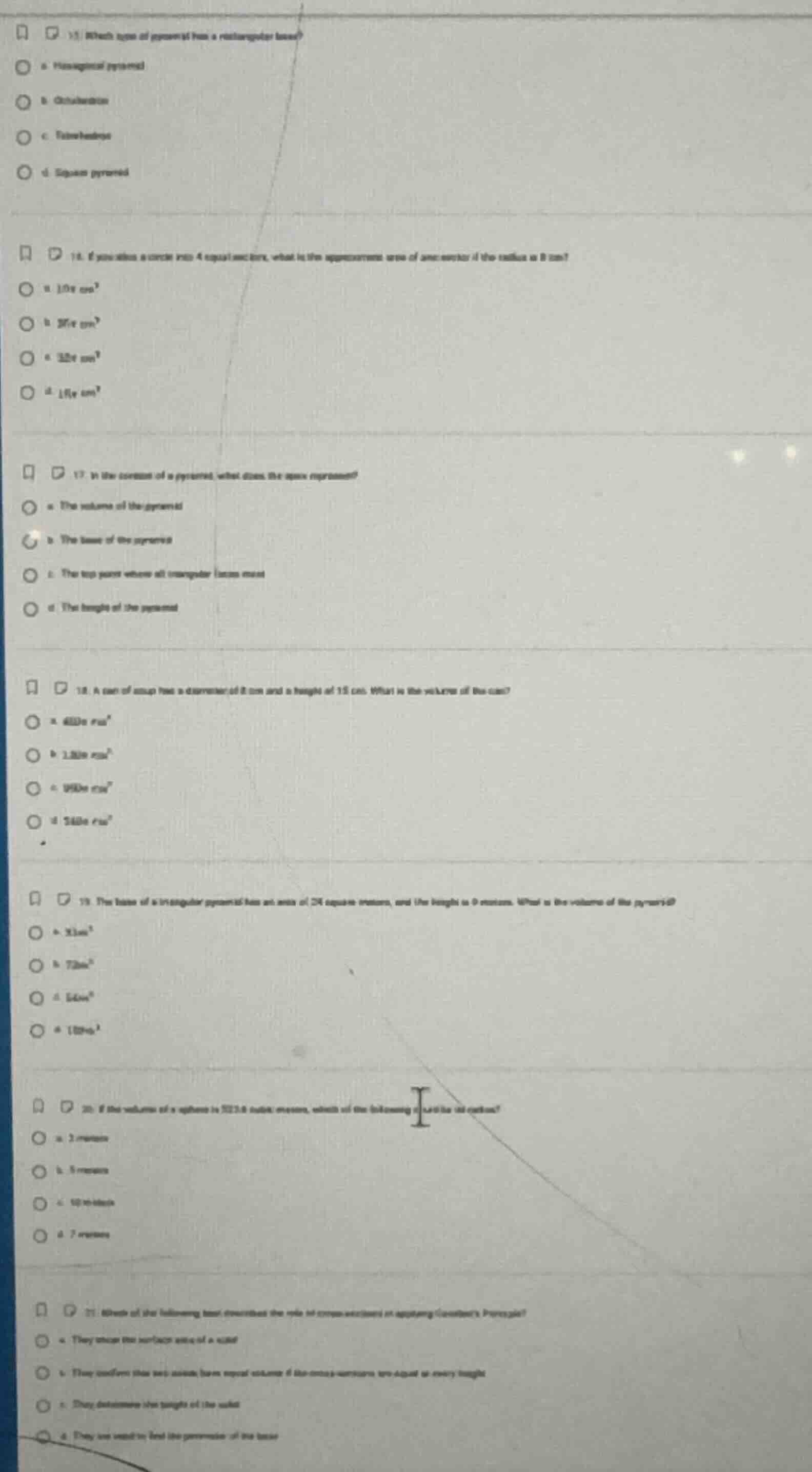
- which type of pyramid has a rectangular base?
a. triangular pyramid
b. cylinder
c. tetrahedron
d. square pyramid
- if you divide a circle into 4 equal sectors, what is the approximate area of one sector if the radius is 8 cm?
a. 10π cm²
b. 20π cm²
c. 32π cm²
d. 16π cm²
- in the context of a pyramid, what does the apex represent?
a. the volume of the pyramid
b. the base of the pyramid
c. the top point where all triangular faces meet
d. the height of the pyramid
- a can of soup has a diameter of 8 cm and a height of 15 cm. what is the volume of the can?
a. 480π cm³
b. 120π cm³
c. 360π cm³
d. 960π cm³
- the base of a triangular pyramid has an area of 24 square meters, and the height is 9 meters. what is the volume of the pyramid?
a. 36m³
b. 72m³
c. 144m³
d. 108m³
- if the volume of a sphere is 523.8 cubic meters, which of the following will be its radius?
a. 3 meters
b. 5 meters
c. 10 meters
d. 7 meters
- which of the following best describes the role of cross-sections in applying cavalieri’s principle?
a. they measure the surface area of a solid
b. they confirm that two solids have equal volume if the cross-sections are equal at every height
c. they determine the height of the solid
d. they are used to find the perimeter of the base
Q15: Identify rectangular base pyramid
A rectangular pyramid has a rectangular base.
Q16: Step1: Find full circle area
$A_{full} = \pi r^2 = \pi (8)^2 = 64\pi \ \text{cm}^2$
Q16: Step2: Divide into 4 sectors
$A_{sector} = \frac{64\pi}{4} = 16\pi \ \text{cm}^2$
Q17: Define apex of a pyramid
The apex is the top vertex where triangular faces meet.
Q18: Step1: Calculate radius from diameter
$r = \frac{d}{2} = \frac{8}{2} = 4 \ \text{cm}$
Q18: Step2: Compute cylinder volume
$V = \pi r^2 h = \pi (4)^2 (15) = 240\pi \ \text{cm}^3$
Q19: Step1: Apply pyramid volume formula
$V = \frac{1}{3} \times \text{base area} \times \text{height}$
Q19: Step2: Substitute values
$V = \frac{1}{3} \times 24 \times 9 = 72 \ \text{cm}^3$
Q20: Step1: Use sphere volume formula
$V = \frac{4}{3}\pi r^3$, so $523.6 = \frac{4}{3}\pi r^3$
Q20: Step2: Solve for radius
$r^3 = \frac{523.6 \times 3}{4\pi} \approx 125$, so $r = 5$
Q21: State Cavalieri's Principle rule
Cavalieri's Principle states that solids with equal cross-sectional areas at every height have equal volume.

Snap & solve any problem in the app
Get step-by-step solutions on Sovi AI
Photo-based solutions with guided steps
Explore more problems and detailed explanations
- a. Rectangular pyramid
- d. $16\pi \ \text{cm}^2$
- c. The top point where all triangular faces meet
- d. $240\pi \ \text{cm}^3$
- b. $72\text{cm}^3$
- b. 5 measures
- b. They confirm that two solids have equal volume if cross-sections are equal at every height