QUESTION IMAGE
Question
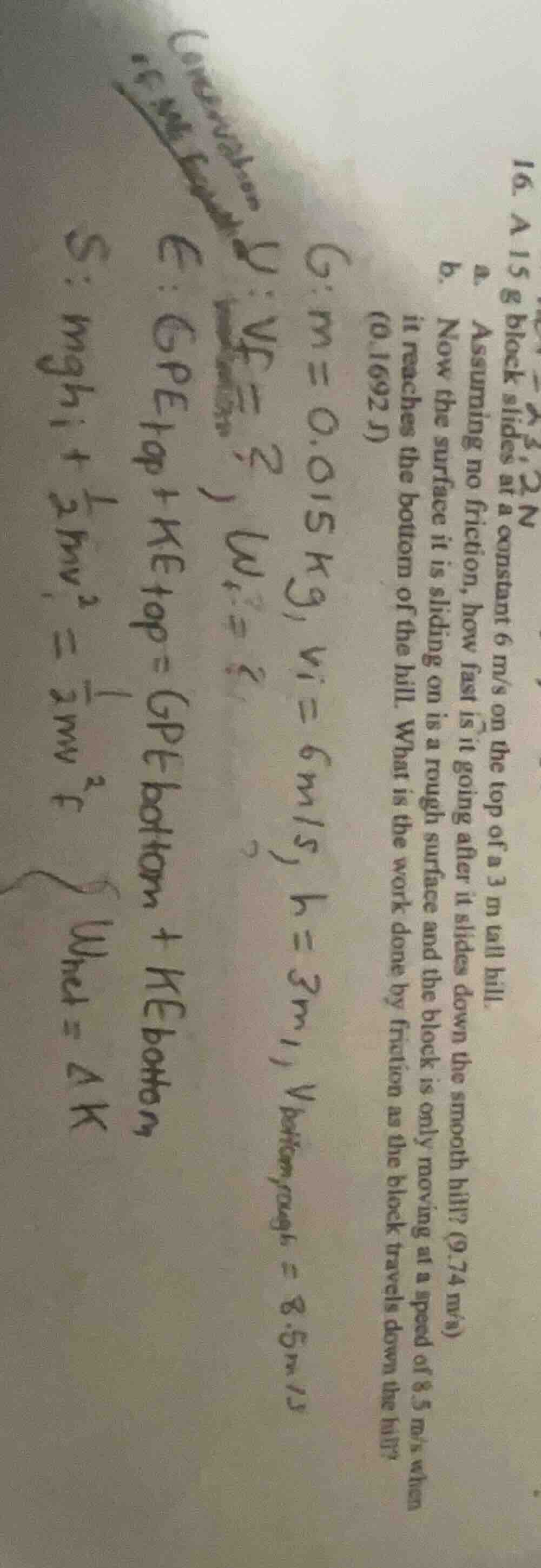
- a 15 g block slides at a constant 6 m/s on the top of a 3 m tall hill.
a. assuming no friction, how fast is it going after it slides down the smooth hill? (9.74 m/s)
b. now the surface it is sliding on is a rough surface and the block is only moving at a speed of 8.5 m/s when it reaches the bottom of the hill. what is the work done by friction as the block travels down the hill? (0.1692 j)
given:
m = 0.015 kg, vi = 6 m/s, h = 3 m, v bottom rough = 8.5 m/s
equation:
gpe top + ke top = gpe bottom + ke bottom
s:
mgh_i + \frac{1}{2}mv_i^2 = \frac{1}{2}mv_f^2
wnet = \delta k
Part a: Speed without friction
Step 1: Identify energy conservation
Use conservation of mechanical energy (GPE + KE) at top and bottom.
\( mgh_i + \frac{1}{2}mv_i^2 = \frac{1}{2}mv_f^2 \)
Given \( m = 0.015 \, \text{kg} \), \( v_i = 6 \, \text{m/s} \), \( h = 3 \, \text{m} \), \( g = 9.8 \, \text{m/s}^2 \).
Step 2: Solve for \( v_f \)
Rearrange the formula:
\( v_f = \sqrt{v_i^2 + 2gh} \)
Substitute values:
\( v_f = \sqrt{6^2 + 2(9.8)(3)} \)
\( v_f = \sqrt{36 + 58.8} = \sqrt{94.8} \approx 9.74 \, \text{m/s} \)
Part b: Work done by friction
Step 1: Use work - energy theorem
\( W_{\text{net}} = \Delta KE \), where \( W_{\text{net}} = W_{\text{gravity}} + W_{\text{friction}} \). But \( W_{\text{gravity}} = mgh \) (from GPE change), so:
\( mgh + W_f = \frac{1}{2}mv_f'^2 - \frac{1}{2}mv_i^2 \)
Given \( v_f' = 8.5 \, \text{m/s} \), solve for \( W_f \).
Step 2: Calculate \( W_f \)
Rearrange:
\( W_f = \frac{1}{2}m(v_f'^2 - v_i^2) - mgh \)
Substitute \( m = 0.015 \), \( v_f' = 8.5 \), \( v_i = 6 \), \( g = 9.8 \), \( h = 3 \):
\( \frac{1}{2}(0.015)(8.5^2 - 6^2) - (0.015)(9.8)(3) \)
\( = 0.0075(72.25 - 36) - 0.441 \)
\( = 0.0075(36.25) - 0.441 \)
\( = 0.271875 - 0.441 = - 0.169125 \approx - 0.1692 \, \text{J} \) (negative sign means friction does work against motion)

Snap & solve any problem in the app
Get step-by-step solutions on Sovi AI
Photo-based solutions with guided steps
Explore more problems and detailed explanations
a. The speed without friction is approximately \(\boldsymbol{9.74 \, \text{m/s}}\).
b. The work done by friction is approximately \(\boldsymbol{- 0.1692 \, \text{J}}\) (the negative sign indicates friction opposes the motion).