QUESTION IMAGE
Question
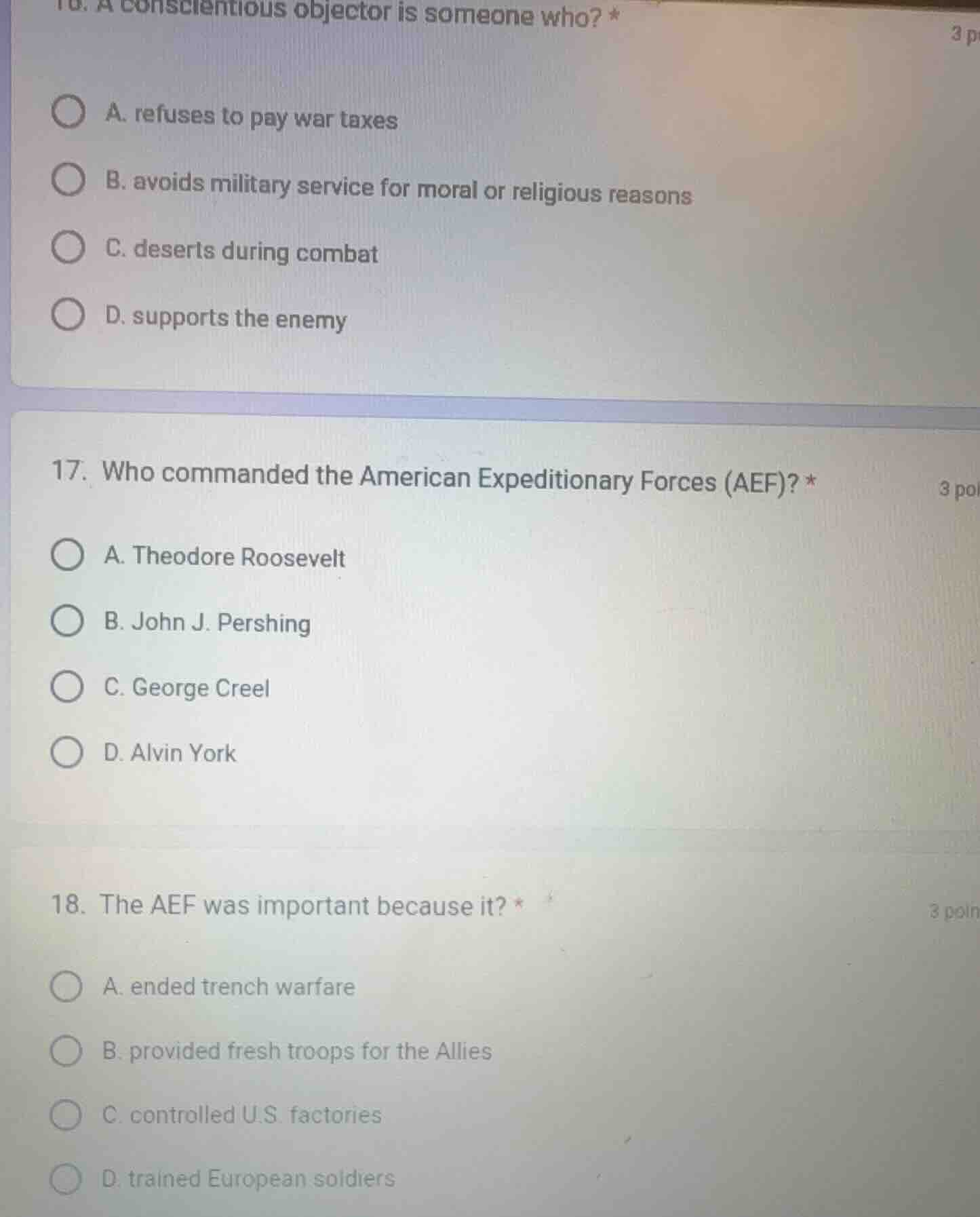
- a conscientious objector is someone who? *
a. refuses to pay war taxes
b. avoids military service for moral or religious reasons
c. deserts during combat
d. supports the enemy
- who commanded the american expeditionary forces (aef)? *
a. theodore roosevelt
b. john j. pershing
c. george creel
d. alvin york
- the aef was important because it? *
a. ended trench warfare
b. provided fresh troops for the allies
c. controlled u.s. factories
d. trained european soldiers
Brief Explanations
- For question 16: A conscientious objector is defined as a person who opposes military service based on moral or religious beliefs, not just refusing war taxes, deserting, or supporting the enemy.
- For question 17: John J. Pershing was the official commander of the American Expeditionary Forces during World War I; the other figures had different roles (Roosevelt was a former president, Creel led propaganda efforts, York was a soldier).
- For question 18: The AEF's key contribution was bringing large numbers of fresh, untired troops to the Allied side in World War I, which shifted the momentum in their favor. Trench warfare ended with the war's conclusion, not solely the AEF; the AEF did not control U.S. factories or primarily train European soldiers.

Snap & solve any problem in the app
Get step-by-step solutions on Sovi AI
Photo-based solutions with guided steps
Explore more problems and detailed explanations
- B. avoids military service for moral or religious reasons
- B. John J. Pershing
- B. provided fresh troops for the Allies