QUESTION IMAGE
Question
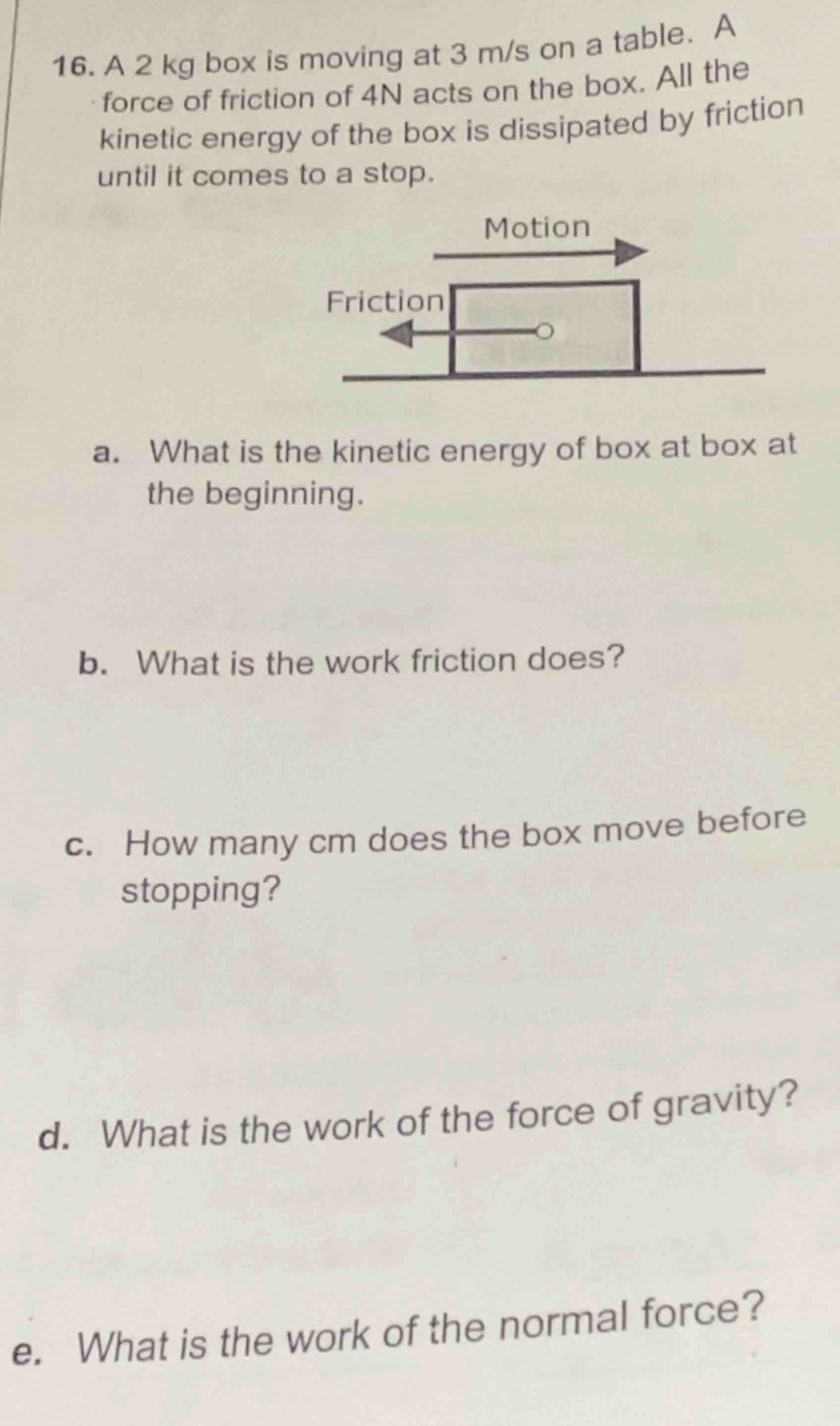
- a 2 kg box is moving at 3 m/s on a table. a force of friction of 4n acts on the box. all the kinetic energy of the box is dissipated by friction until it comes to a stop.
motion
friction
a. what is the kinetic energy of box at box at the beginning.
b. what is the work friction does?
c. how many cm does the box move before stopping?
d. what is the work of the force of gravity?
e. what is the work of the normal force?
Step1: Calculate initial kinetic energy
Use $KE = \frac{1}{2}mv^2$, where $m=2\ \text{kg}$, $v=3\ \text{m/s}$
$\frac{1}{2} \times 2\ \text{kg} \times (3\ \text{m/s})^2 = 9\ \text{J}$
Step2: Find work done by friction
All kinetic energy is dissipated, so work equals $-KE$
$W_f = -9\ \text{J}$
Step3: Calculate stopping distance (in cm)
Use $W = Fd$, solve for $d$: $d = \frac{|W_f|}{F}$, where $F=4\ \text{N}$
$d = \frac{9\ \text{J}}{4\ \text{N}} = 2.25\ \text{m} = 225\ \text{cm}$
Step4: Work done by gravity
Gravity is perpendicular to motion, so $W_g = 0$
$W_g = 0\ \text{J}$
Step5: Work done by normal force
Normal force is perpendicular to motion, so $W_n = 0$
$W_n = 0\ \text{J}$

Snap & solve any problem in the app
Get step-by-step solutions on Sovi AI
Photo-based solutions with guided steps
Explore more problems and detailed explanations
a. $9\ \text{J}$
b. $-9\ \text{J}$
c. $225\ \text{cm}$
d. $0\ \text{J}$
e. $0\ \text{J}$