QUESTION IMAGE
Question
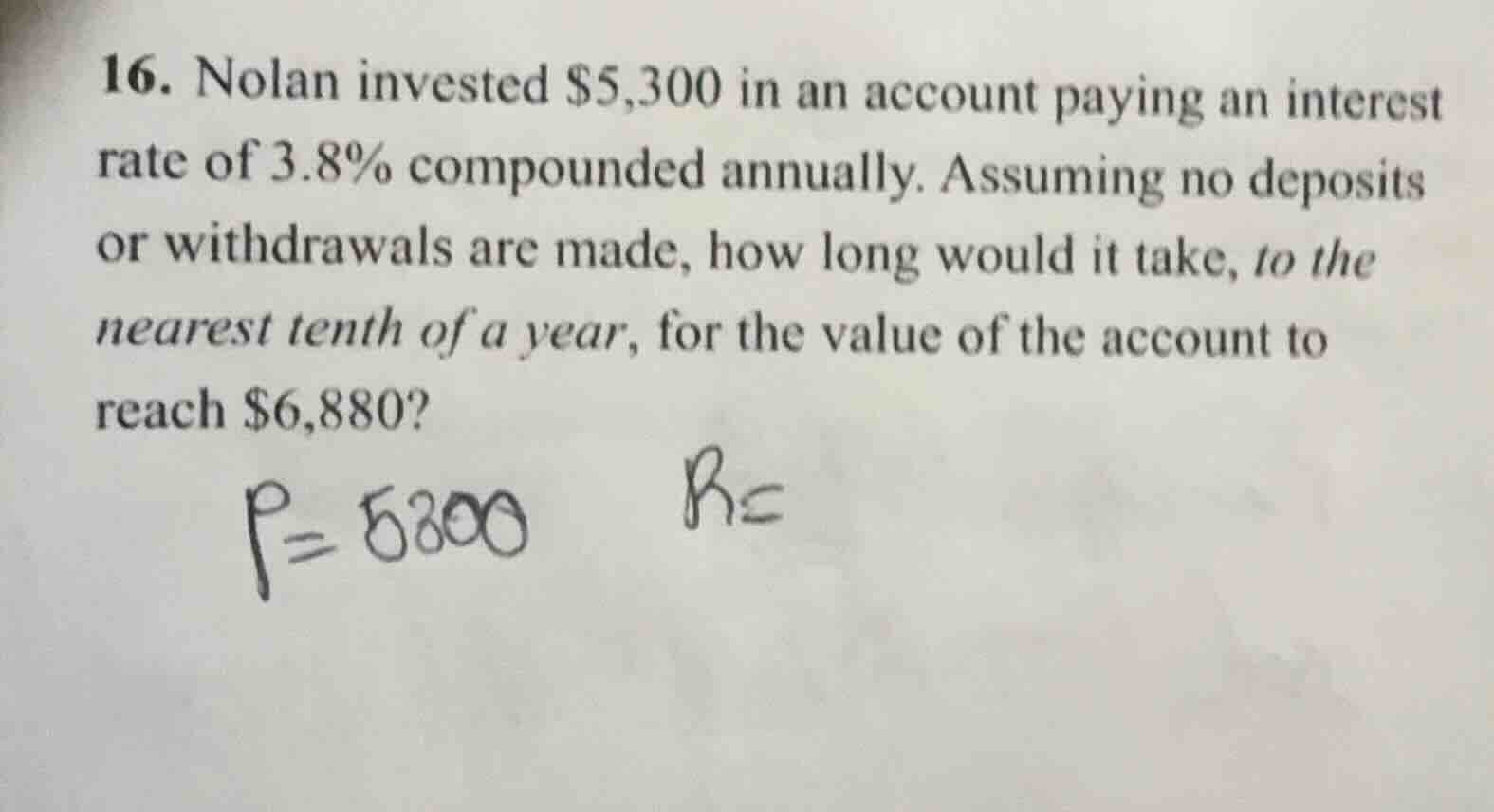
- nolan invested $5,300 in an account paying an interest rate of 3.8% compounded annually. assuming no deposits or withdrawals are made, how long would it take, to the nearest tenth of a year, for the value of the account to reach $6,880?
Step1: Recall compound interest formula
The formula for compound interest is $A = P(1 + r)^t$, where $A$ is the final amount, $P$ is the principal amount, $r$ is the annual interest rate (in decimal), and $t$ is the time in years.
Given $P = 5300$, $r = 0.038$, and $A = 6880$. Substitute these values into the formula:
$$6880 = 5300(1 + 0.038)^t$$
Step2: Simplify the equation
First, divide both sides by 5300:
$$\frac{6880}{5300}=(1.038)^t$$
Simplify $\frac{6880}{5300}\approx1.2981$:
$$1.2981=(1.038)^t$$
Step3: Take natural logarithm of both sides
Take $\ln$ of both sides:
$$\ln(1.2981)=\ln((1.038)^t)$$
Using the logarithm power rule $\ln(a^b)=b\ln(a)$, we get:
$$\ln(1.2981)=t\ln(1.038)$$
Step4: Solve for t
Divide both sides by $\ln(1.038)$:
$$t=\frac{\ln(1.2981)}{\ln(1.038)}$$
Calculate $\ln(1.2981)\approx0.260$ and $\ln(1.038)\approx0.0373$:
$$t=\frac{0.260}{0.0373}\approx6.97$$
Round to the nearest tenth: $t\approx7.0$

Snap & solve any problem in the app
Get step-by-step solutions on Sovi AI
Photo-based solutions with guided steps
Explore more problems and detailed explanations
7.0 years