QUESTION IMAGE
Question
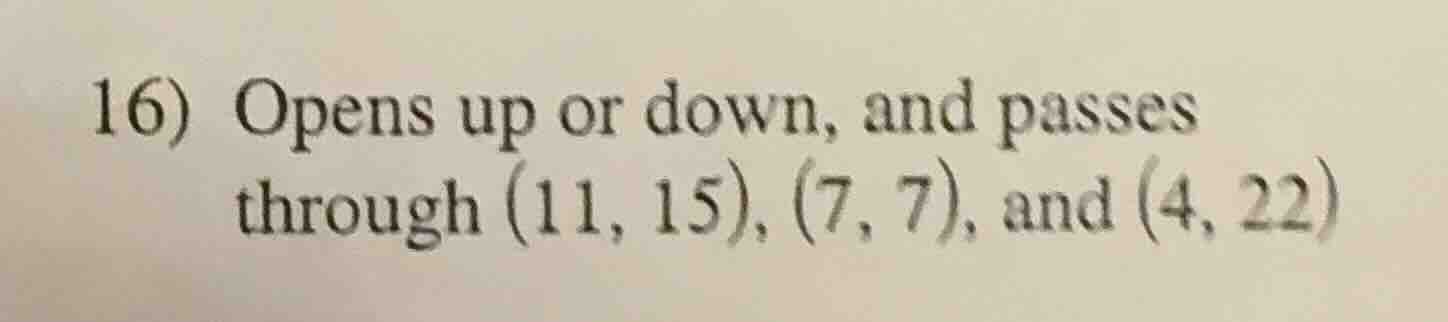
- opens up or down, and passes through (11, 15), (7, 7), and (4, 22)
To determine the quadratic function \( y = ax^2 + bx + c \) that opens up or down and passes through the points \((11, 15)\), \((7, 7)\), and \((4, 22)\), we can set up a system of equations.
Step 1: Substitute the points into the quadratic equation
For the point \((11, 15)\):
\[
15 = a(11)^2 + b(11) + c \implies 121a + 11b + c = 15 \quad (1)
\]
For the point \((7, 7)\):
\[
7 = a(7)^2 + b(7) + c \implies 49a + 7b + c = 7 \quad (2)
\]
For the point \((4, 22)\):
\[
22 = a(4)^2 + b(4) + c \implies 16a + 4b + c = 22 \quad (3)
\]
Step 2: Subtract equations to eliminate \( c \)
Subtract equation \((2)\) from equation \((1)\):
\[
(121a + 11b + c) - (49a + 7b + c) = 15 - 7
\]
\[
72a + 4b = 8 \implies 18a + b = 2 \quad (4)
\]
Subtract equation \((3)\) from equation \((2)\):
\[
(49a + 7b + c) - (16a + 4b + c) = 7 - 22
\]
\[
33a + 3b = -15 \implies 11a + b = -5 \quad (5)
\]
Step 3: Solve the system of linear equations
Subtract equation \((4)\) from equation \((5)\):
\[
(11a + b) - (18a + b) = -5 - 2
\]
\[
-7a = -7 \implies a = 1
\]
Substitute \( a = 1 \) into equation \((4)\):
\[
18(1) + b = 2 \implies 18 + b = 2 \implies b = -16
\]
Step 4: Find \( c \)
Substitute \( a = 1 \) and \( b = -16 \) into equation \((3)\):
\[
16(1) + 4(-16) + c = 22
\]
\[
16 - 64 + c = 22 \implies -48 + c = 22 \implies c = 70
\]
Step 5: Determine the direction the parabola opens
The quadratic function is \( y = x^2 - 16x + 70 \). The coefficient of \( x^2 \) is \( a = 1 \), which is positive. So, the parabola opens up.
Final Answer
The quadratic function is \( y = x^2 - 16x + 70 \) and it opens up.

Snap & solve any problem in the app
Get step-by-step solutions on Sovi AI
Photo-based solutions with guided steps
Explore more problems and detailed explanations
To determine the quadratic function \( y = ax^2 + bx + c \) that opens up or down and passes through the points \((11, 15)\), \((7, 7)\), and \((4, 22)\), we can set up a system of equations.
Step 1: Substitute the points into the quadratic equation
For the point \((11, 15)\):
\[
15 = a(11)^2 + b(11) + c \implies 121a + 11b + c = 15 \quad (1)
\]
For the point \((7, 7)\):
\[
7 = a(7)^2 + b(7) + c \implies 49a + 7b + c = 7 \quad (2)
\]
For the point \((4, 22)\):
\[
22 = a(4)^2 + b(4) + c \implies 16a + 4b + c = 22 \quad (3)
\]
Step 2: Subtract equations to eliminate \( c \)
Subtract equation \((2)\) from equation \((1)\):
\[
(121a + 11b + c) - (49a + 7b + c) = 15 - 7
\]
\[
72a + 4b = 8 \implies 18a + b = 2 \quad (4)
\]
Subtract equation \((3)\) from equation \((2)\):
\[
(49a + 7b + c) - (16a + 4b + c) = 7 - 22
\]
\[
33a + 3b = -15 \implies 11a + b = -5 \quad (5)
\]
Step 3: Solve the system of linear equations
Subtract equation \((4)\) from equation \((5)\):
\[
(11a + b) - (18a + b) = -5 - 2
\]
\[
-7a = -7 \implies a = 1
\]
Substitute \( a = 1 \) into equation \((4)\):
\[
18(1) + b = 2 \implies 18 + b = 2 \implies b = -16
\]
Step 4: Find \( c \)
Substitute \( a = 1 \) and \( b = -16 \) into equation \((3)\):
\[
16(1) + 4(-16) + c = 22
\]
\[
16 - 64 + c = 22 \implies -48 + c = 22 \implies c = 70
\]
Step 5: Determine the direction the parabola opens
The quadratic function is \( y = x^2 - 16x + 70 \). The coefficient of \( x^2 \) is \( a = 1 \), which is positive. So, the parabola opens up.
Final Answer
The quadratic function is \( y = x^2 - 16x + 70 \) and it opens up.