QUESTION IMAGE
Question
16.
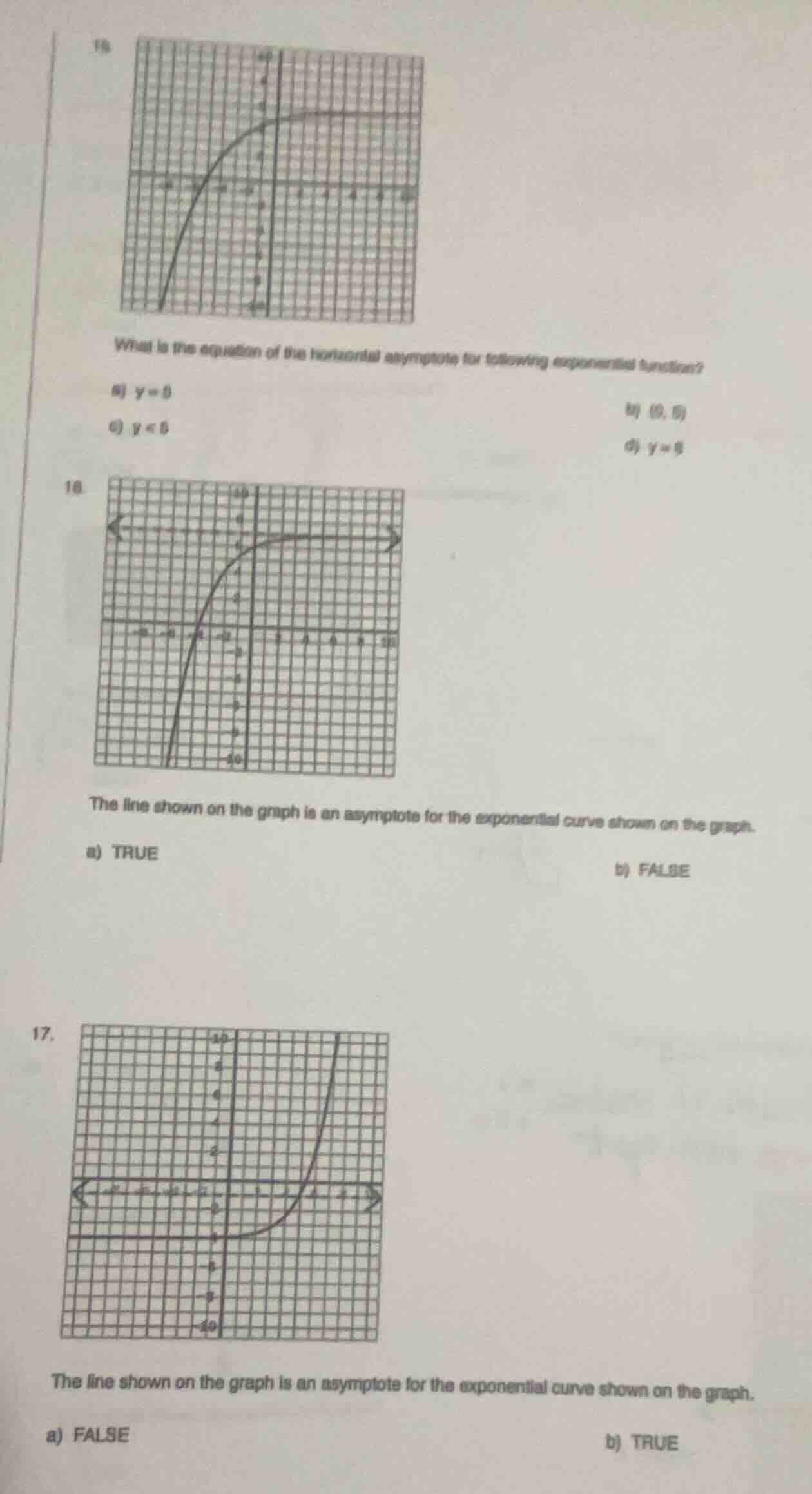
what is the equation of the horizontal asymptote for following exponential function?
a) ( y = 6 )
b)
c) ( y < 6 )
d) ( y = 8 )
18
the line shown on the graph is an asymptote for the exponential curve shown on the graph.
a) true
b) false
17.
the line shown on the graph is an asymptote for the exponential curve shown on the graph.
a) false
b) true
Question 16
Step1: Recall horizontal asymptote of exponential functions
For an exponential function \( y = a^x + k \) (or similar forms), the horizontal asymptote is \( y = k \), which is a horizontal line. The graph of the exponential function approaches this line as \( x \to \pm\infty \) (depending on the function). From the graph, we observe the horizontal asymptote. Looking at the options, asymptotes are equations (lines), so options with inequalities (like \( y < 6 \)) are invalid. The horizontal line here is \( y = 6 \) (assuming the graph's asymptote is at \( y = 6 \), and option a is \( y = 6 \), d is \( y = 8 \) which doesn't match). Wait, maybe the graph's asymptote is \( y = 6 \)? Wait, let's check the options. Option a: \( y = 6 \), b: (maybe typo, but c is \( y < 6 \) (inequality, not an equation of a line), d: \( y = 8 \). So the horizontal asymptote is a horizontal line, so equation is \( y = 6 \) (option a? Wait, maybe the graph in 16 has horizontal asymptote \( y = 6 \). So the correct option is a) \( y = 6 \).
Step2: Eliminate invalid options
- Option c: \( y < 6 \) is an inequality, not the equation of a horizontal line (asymptote is a line, so equation is \( y = k \)), so eliminate c.
- Option d: \( y = 8 \) – if the graph's asymptote is at \( y = 6 \), then d is wrong.
- Option b: (assuming typo, but a is \( y = 6 \), which is a horizontal line equation, so a is correct.
Step1: Recall asymptote definition
An asymptote is a line that a curve approaches as \( x \to \pm\infty \). For the exponential curve in the graph, the horizontal line shown is approached by the curve, so it's a horizontal asymptote. Thus, the statement "The line shown on the graph is an asymptote for the exponential curve" is TRUE.
Step2: Confirm with exponential function properties
Exponential functions \( y = a^x + k \) have horizontal asymptote \( y = k \). The graph here shows the exponential curve approaching the horizontal line, so the line is the asymptote, so the statement is TRUE (option a).
Step1: Recall asymptote of exponential functions
For an exponential function (like \( y = a^x + k \) or \( y = -a^x + k \), but here the graph is an exponential curve (maybe \( y = a^x - 4 \) or similar). The horizontal asymptote is a horizontal line. The line shown is a horizontal line (like \( y = -4 \) or similar). The statement is "The line shown on the graph is an asymptote for the exponential curve". Let's see: exponential curves have horizontal asymptotes. The graph's curve approaches the horizontal line, so the line is an asymptote. So the statement is TRUE (option b).
Step2: Check the graph
The exponential curve (like a parabola? No, exponential function) – the curve approaches the horizontal line, so the line is an asymptote. Thus, the statement is TRUE, so option b) TRUE.

Snap & solve any problem in the app
Get step-by-step solutions on Sovi AI
Photo-based solutions with guided steps
Explore more problems and detailed explanations
a) \( y = 6 \)