QUESTION IMAGE
Question
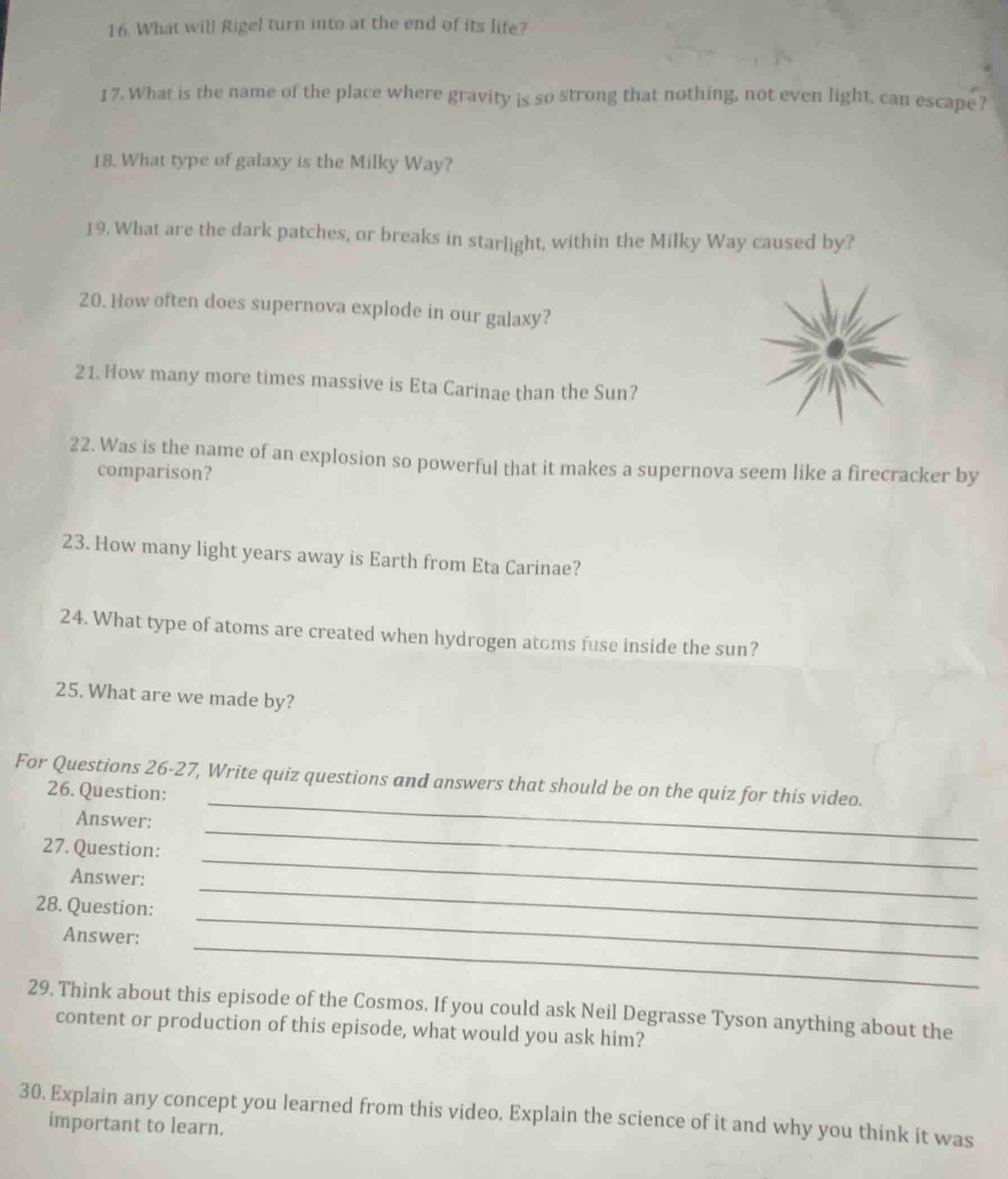
- what will rigel turn into at the end of its life?17. what is the name of the place where gravity is so strong that nothing, not even light, can escape?18. what type of galaxy is the milky way?19. what are the dark patches, or breaks in starlight, within the milky way caused by?20. how often does supernova explode in our galaxy?21. how many more times massive is eta carinae than the sun?22. was is the name of an explosion so powerful that it makes a supernova seem like a firecracker by comparison?23. how many light years away is earth from eta carinae?24. what type of atoms are created when hydrogen atoms fuse inside the sun?25. what are we made by?for questions 26-27, write quiz questions and answers that should be on the quiz for this video.26. question:answer:27. question:answer:28. question:answer:29. think about this episode of the cosmos. if you could ask neil degrasse tyson anything about the content or production of this episode, what would you ask him?30. explain any concept you learned from this video. explain the science of it and why you think it was important to learn.
Brief Explanations
- 16. Rigel is a massive blue supergiant; massive stars end their lives as black holes after a supernova.
- 17. This is the defining characteristic of a black hole.
- 18. The Milky Way has a central bulge, spiral arms, and a disk structure, classifying it as this type.
- 19. Dense clouds of interstellar dust block the visible starlight behind them.
- 20. Astronomical observations and estimates place the average rate at this interval.
- 21. Current stellar mass calculations put Eta Carinae at this relative mass to our Sun.
- 22. This is the most energetic explosion known in the universe, far more powerful than supernovae.
- 23. Distance measurements via parallax and other methods confirm this value.
- 24. This is the primary nuclear fusion reaction in our Sun's core.
- 25. All heavy elements in our bodies were created in the cores of stars or during stellar explosions.
- 26-28: Created relevant astronomy quiz questions aligned with the theme of stellar and galactic science.
- 29: Formulated a targeted question about the episode's content for Neil deGrasse Tyson.
- 30. Explained stellar nucleosynthesis, its scientific basis, and its significance.

Snap & solve any problem in the app
Get step-by-step solutions on Sovi AI
Photo-based solutions with guided steps
Explore more problems and detailed explanations
- A black hole
- Black hole
- A barred spiral galaxy
- Dense clouds of interstellar dust
- Approximately once every 50 years (on average)
- Around 100-150 times the mass of the Sun
- Hypernova (or gamma-ray burst, associated with hypernovae)
- Approximately 7,500 light-years
- Helium atoms
- We are made of stardust (elements created in stars)
- Question: What is the process that powers stars?