QUESTION IMAGE
Question
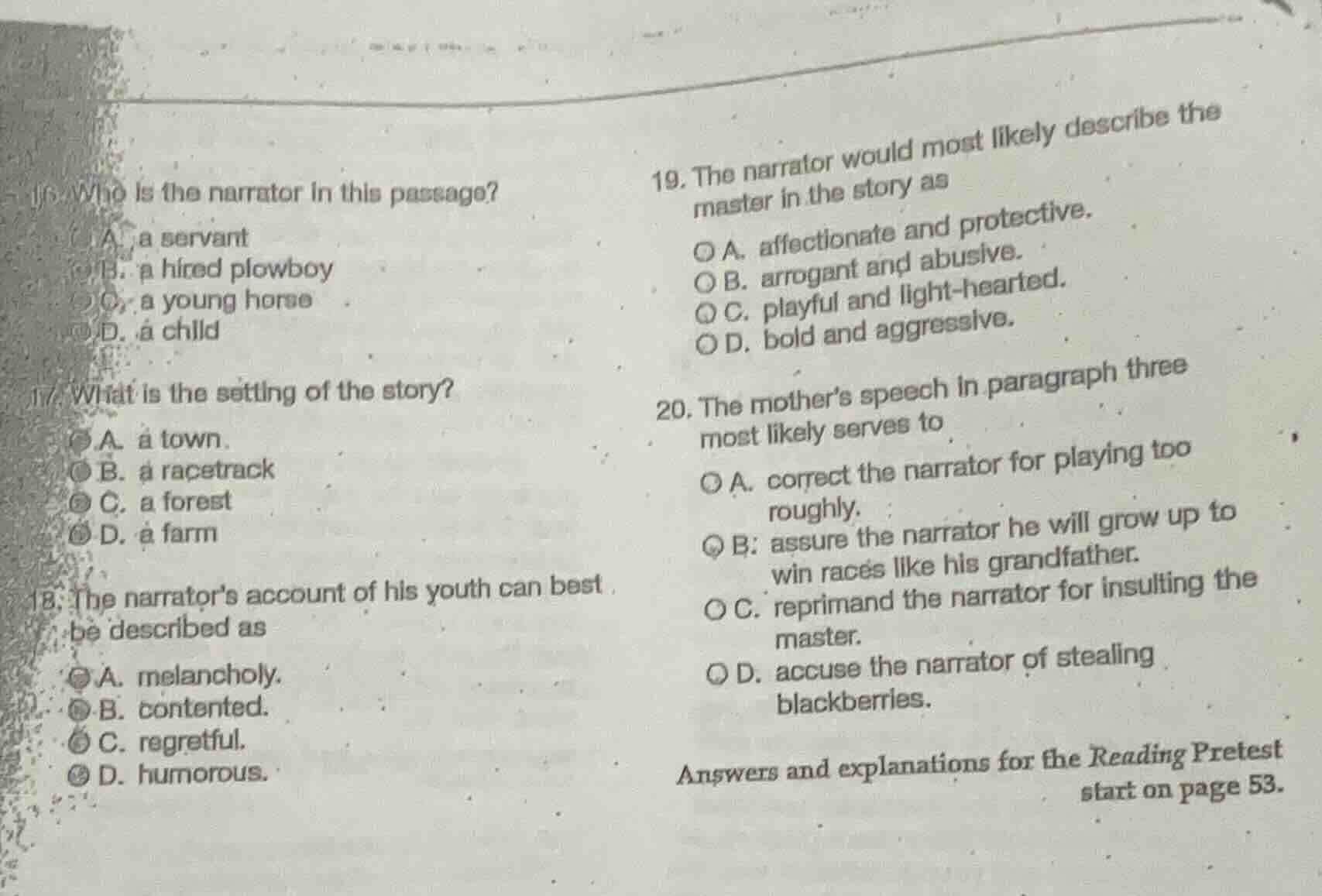
- who is the narrator in this passage?
a. a servant
b. a hired plowboy
c. a young horse
d. a child
- what is the setting of the story?
a. a town
b. a racetrack
c. a forest
d. a farm
- the narrator’s account of his youth can best be described as
a. melancholy.
b. contented.
c. regretful.
d. humorous.
- the narrator would most likely describe the master in the story as
a. affectionate and protective.
b. arrogant and abusive.
c. playful and light - hearted.
d. bold and aggressive.
- the mother’s speech in paragraph three most likely serves to
a. correct the narrator for playing too roughly.
b. assure the narrator he will grow up to win races like his grandfather.
c. reprimand the narrator for insulting the master.
d. accuse the narrator of stealing blackberries.
answers and explanations for the reading pretest start on page 53.
Since the passage (the text of the story) is not provided, we can't answer these questions directly. However, we can give general guidance on how to solve such reading comprehension questions:
For Question 16 (Who is the narrator?):
- Analyze the perspective from which the story is told. Look for pronouns (I, we) and the narrator's relationship to other characters. For example, if the narrator refers to doing tasks like plowing or mentions a master, options like "a hired plowboy" or "a servant" or "a young horse" (if the story is from an animal's perspective) or "a child" could be considered. You need to match the narrator's actions, thoughts, and descriptions to the given options.
For Question 17 (Setting of the story?):
- Look for descriptive words about the location. Words like "farm", "forest", "racetrack", or "town" in the passage. For example, if there are mentions of plowing, crops, or farm animals, "a farm" (option D) is likely. If there are trees, wildlife, etc., "a forest" (option C). Racetrack (B) would have mentions of horses racing, and town (A) would have buildings, people in a village/town setting.
For Question 18 (Narrator's account of youth?):
- Analyze the tone and content of the narrator's description of their youth. "Melancholy" is sad, "contented" is satisfied/happy, "regretful" is full of regret, "humorous" is funny. Look for words and events that show the narrator's feelings. For example, if the narrator talks about happy memories, "contented" (B) is possible. If they talk about sad events, "melancholy" (A), etc.
For Question 19 (Describe the master?):
- Look at how the master is portrayed in the story. "Affectionate and protective" (A) would show care for the narrator. "Arrogant and abusive" (B) would show mean or bossy behavior. "Playful and light - hearted" (C) is more for a fun - loving character. "Bold and aggressive" (D) is for someone assertive/hostile. Analyze the master's actions and interactions with the narrator.
For Question 20 (Mother's speech in paragraph three?):
- Analyze the content of the mother's speech. If she is telling the narrator not to play too rough, then A. If she is talking about the narrator's future in racing (like grandfather), then B. If she is scolding the narrator for insulting the master, then C. If she is accusing of stealing blackberries, then D. You need to find the purpose of her speech by looking at the context before and after the speech in the paragraph.
If you can provide the passage, we can give more specific answers.

Snap & solve any problem in the app
Get step-by-step solutions on Sovi AI
Photo-based solutions with guided steps
Explore more problems and detailed explanations
Since the passage (the text of the story) is not provided, we can't answer these questions directly. However, we can give general guidance on how to solve such reading comprehension questions:
For Question 16 (Who is the narrator?):
- Analyze the perspective from which the story is told. Look for pronouns (I, we) and the narrator's relationship to other characters. For example, if the narrator refers to doing tasks like plowing or mentions a master, options like "a hired plowboy" or "a servant" or "a young horse" (if the story is from an animal's perspective) or "a child" could be considered. You need to match the narrator's actions, thoughts, and descriptions to the given options.
For Question 17 (Setting of the story?):
- Look for descriptive words about the location. Words like "farm", "forest", "racetrack", or "town" in the passage. For example, if there are mentions of plowing, crops, or farm animals, "a farm" (option D) is likely. If there are trees, wildlife, etc., "a forest" (option C). Racetrack (B) would have mentions of horses racing, and town (A) would have buildings, people in a village/town setting.
For Question 18 (Narrator's account of youth?):
- Analyze the tone and content of the narrator's description of their youth. "Melancholy" is sad, "contented" is satisfied/happy, "regretful" is full of regret, "humorous" is funny. Look for words and events that show the narrator's feelings. For example, if the narrator talks about happy memories, "contented" (B) is possible. If they talk about sad events, "melancholy" (A), etc.
For Question 19 (Describe the master?):
- Look at how the master is portrayed in the story. "Affectionate and protective" (A) would show care for the narrator. "Arrogant and abusive" (B) would show mean or bossy behavior. "Playful and light - hearted" (C) is more for a fun - loving character. "Bold and aggressive" (D) is for someone assertive/hostile. Analyze the master's actions and interactions with the narrator.
For Question 20 (Mother's speech in paragraph three?):
- Analyze the content of the mother's speech. If she is telling the narrator not to play too rough, then A. If she is talking about the narrator's future in racing (like grandfather), then B. If she is scolding the narrator for insulting the master, then C. If she is accusing of stealing blackberries, then D. You need to find the purpose of her speech by looking at the context before and after the speech in the paragraph.
If you can provide the passage, we can give more specific answers.