QUESTION IMAGE
Question
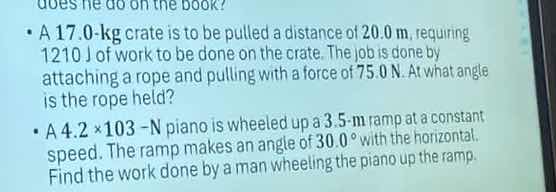
- a 17.0 - kg crate is to be pulled a distance of 20.0 m, requiring 1210 j of work to be done on the crate. the job is done by attaching a rope and pulling with a force of 75.0 n. at what angle is the rope held?
- a 4.2 × 10³ - n piano is wheeled up a 3.5 - m ramp at a constant speed. the ramp makes an angle of 30.0 ° with the horizontal. find the work done by a man wheeling the piano up the ramp.
First Problem (Crate Pulled by Rope)
Step 1: Recall the work formula for a force at an angle
The work done by a force \( F \) applied at an angle \( \theta \) to the displacement \( d \) is given by \( W = Fd\cos\theta \). We need to solve for \( \theta \).
Step 2: Rearrange the formula to solve for \( \cos\theta \)
From \( W = Fd\cos\theta \), we can rearrange to get \( \cos\theta=\frac{W}{Fd} \).
Step 3: Substitute the given values
We know \( W = 1210\space J \), \( F = 75.0\space N \), and \( d = 20.0\space m \). Substituting these values, we get \( \cos\theta=\frac{1210}{75.0\times20.0} \).
Step 4: Calculate the value of \( \cos\theta \)
First, calculate the denominator: \( 75.0\times20.0 = 1500 \). Then, \( \cos\theta=\frac{1210}{1500}\approx0.8067 \).
Step 5: Find the angle \( \theta \)
Take the inverse cosine: \( \theta=\cos^{- 1}(0.8067)\approx36.3^{\circ} \).
Step 1: Analyze the forces and work done
Since the piano moves at a constant speed, the force applied by the man parallel to the ramp (\( F_{\parallel} \)) is equal to the component of the weight of the piano parallel to the ramp. The weight of the piano is \( F_g = 4.2\times10^{3}\space N \), and the angle of the ramp is \( \theta = 30.0^{\circ} \). The component of the weight parallel to the ramp is \( F_{\parallel}=F_g\sin\theta \) (wait, no, actually, when moving up the ramp at constant speed, the applied force parallel to the ramp is equal to the component of the weight down the ramp, which is \( F = F_g\sin\theta \)? Wait, no, the work done by the man is the force he applies times the distance along the ramp, and since the piano moves at constant speed, the force he applies parallel to the ramp is equal to the component of the weight along the ramp (down the ramp), so \( F = F_g\sin\theta \). But actually, the work done is also equal to the change in potential energy, but we can also calculate it using \( W = Fd\cos\phi \), where \( F \) is the applied force, \( d \) is the distance, and \( \phi \) is the angle between the force and displacement. Since the force is applied parallel to the ramp, \( \phi = 0^{\circ} \), and \( F = F_g\sin\theta \) (because the component of weight down the ramp is \( F_g\sin\theta \), and to move at constant speed, the applied force up the ramp is equal to that). Wait, alternatively, the work done against gravity is \( W = mgh \), where \( h \) is the height of the ramp. The height \( h \) of the ramp is \( d\sin\theta \), where \( d = 3.5\space m \) and \( \theta = 30.0^{\circ} \). So \( h = 3.5\sin30.0^{\circ} \). Then \( W = F_g\times h=F_g\times d\sin\theta \).
Step 2: Substitute the values
We have \( F_g = 4.2\times10^{3}\space N \), \( d = 3.5\space m \), and \( \sin30.0^{\circ}=0.5 \). So \( W=(4.2\times10^{3})\times3.5\times0.5 \).
Step 3: Calculate the work done
First, calculate \( 3.5\times0.5 = 1.75 \). Then, \( W = 4.2\times10^{3}\times1.75=7.35\times10^{3}\space J \).

Snap & solve any problem in the app
Get step-by-step solutions on Sovi AI
Photo-based solutions with guided steps
Explore more problems and detailed explanations
The rope is held at an angle of approximately \( \boldsymbol{36.3^{\circ}} \)