QUESTION IMAGE
Question
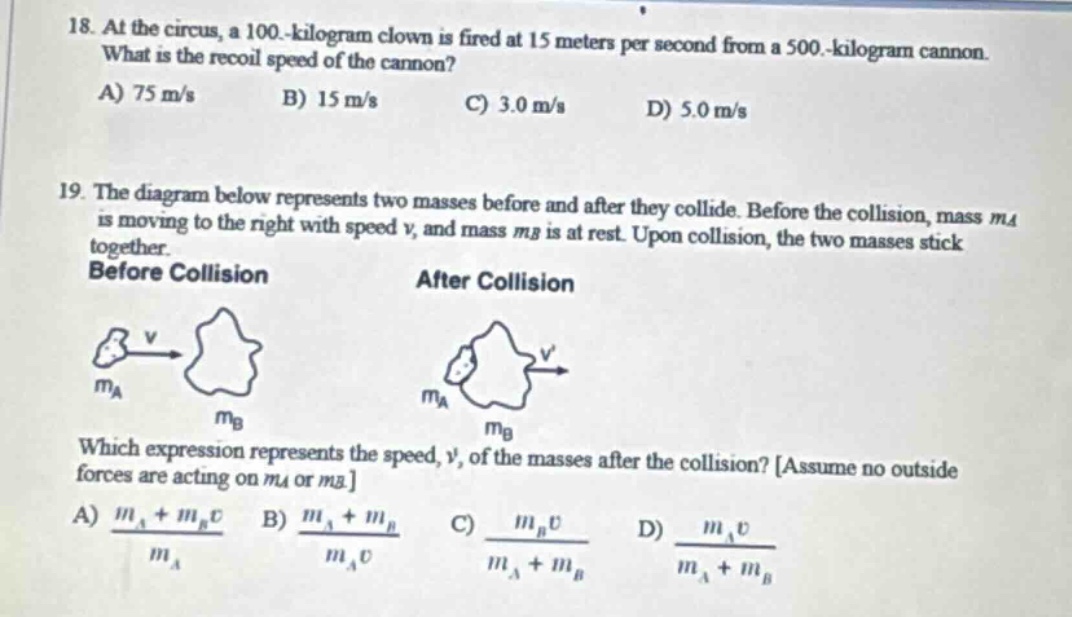
- at the circus, a 100.-kilogram clown is fired at 15 meters per second from a 500.-kilogram cannon. what is the recoil speed of the cannon? a) 75 m/s b) 15 m/s c) 3.0 m/s d) 5.0 m/s 19. the diagram below represents two masses before and after they collide. before the collision, mass ( m_a ) is moving to the right with speed ( v ), and mass ( m_b ) is at rest. upon collision, the two masses stick together. before collision after collision ( \begin{array}{cc} includegraphicsheight=1cm{massa_before.png} & includegraphicsheight=1cm{massa_after.png} \\ m_a & m_a \\ & m_b end{array} ) which expression represents the speed, ( v ), of the masses after the collision? assume no outside forces are acting on ( m_a ) or ( m_b ) a) ( \frac{m_a + m_b v}{m_a} ) b) ( \frac{m_a + m_b}{m_a v} ) c) ( \frac{m_b v}{m_a + m_b} ) d) ( \frac{m_a v}{m_a + m_b} )
Question 18
Step1: Identify the principle
This problem involves the conservation of momentum. The initial momentum of the system (clown + cannon) is zero because they are at rest initially. So, the momentum of the clown after firing should be equal in magnitude and opposite in direction to the momentum of the cannon.
The formula for momentum is \( p = mv \), where \( m \) is mass and \( v \) is velocity.
Let \( m_{clown} = 100\space kg \), \( v_{clown} = 15\space m/s \), \( m_{cannon} = 500\space kg \), and \( v_{cannon} \) be the recoil speed of the cannon.
Step2: Apply conservation of momentum
Initial momentum \( p_{initial} = 0 \) (since both are at rest).
Final momentum \( p_{final} = m_{clown}v_{clown}+m_{cannon}v_{cannon} \)
Since \( p_{initial} = p_{final} \), we have:
\( 0 = m_{clown}v_{clown}+m_{cannon}v_{cannon} \)
\( m_{cannon}v_{cannon}=-m_{clown}v_{clown} \)
We are interested in the magnitude of the recoil speed, so we can ignore the negative sign (which indicates direction).
\( v_{cannon}=\frac{m_{clown}v_{clown}}{m_{cannon}} \)
Step3: Substitute the values
Substitute \( m_{clown} = 100\space kg \), \( v_{clown} = 15\space m/s \), and \( m_{cannon} = 500\space kg \) into the formula:
\( v_{cannon}=\frac{100\times15}{500} \)
\( v_{cannon}=\frac{1500}{500}=3.0\space m/s \)
Step1: Identify the principle
This problem involves the conservation of momentum for a perfectly inelastic collision (where the two masses stick together after collision). The initial momentum of the system (mass \( m_A \) + mass \( m_B \)) should be equal to the final momentum of the combined mass.
The formula for momentum is \( p = mv \).
Before collision: \( m_A \) is moving with speed \( v \), so its momentum is \( m_Av \). \( m_B \) is at rest, so its momentum is \( 0 \). So, initial momentum \( p_{initial}=m_Av + m_B\times0=m_Av \).
After collision: The two masses \( m_A \) and \( m_B \) stick together, so the combined mass is \( m_A + m_B \) and let the speed be \( v' \). So, final momentum \( p_{final}=(m_A + m_B)v' \).
Step2: Apply conservation of momentum
Since \( p_{initial}=p_{final} \) (no external forces), we have:
\( m_Av=(m_A + m_B)v' \)
Step3: Solve for \( v' \)
To find \( v' \), we divide both sides by \( (m_A + m_B) \):
\( v'=\frac{m_Av}{m_A + m_B} \)

Snap & solve any problem in the app
Get step-by-step solutions on Sovi AI
Photo-based solutions with guided steps
Explore more problems and detailed explanations
C) 3.0 m/s