QUESTION IMAGE
Question
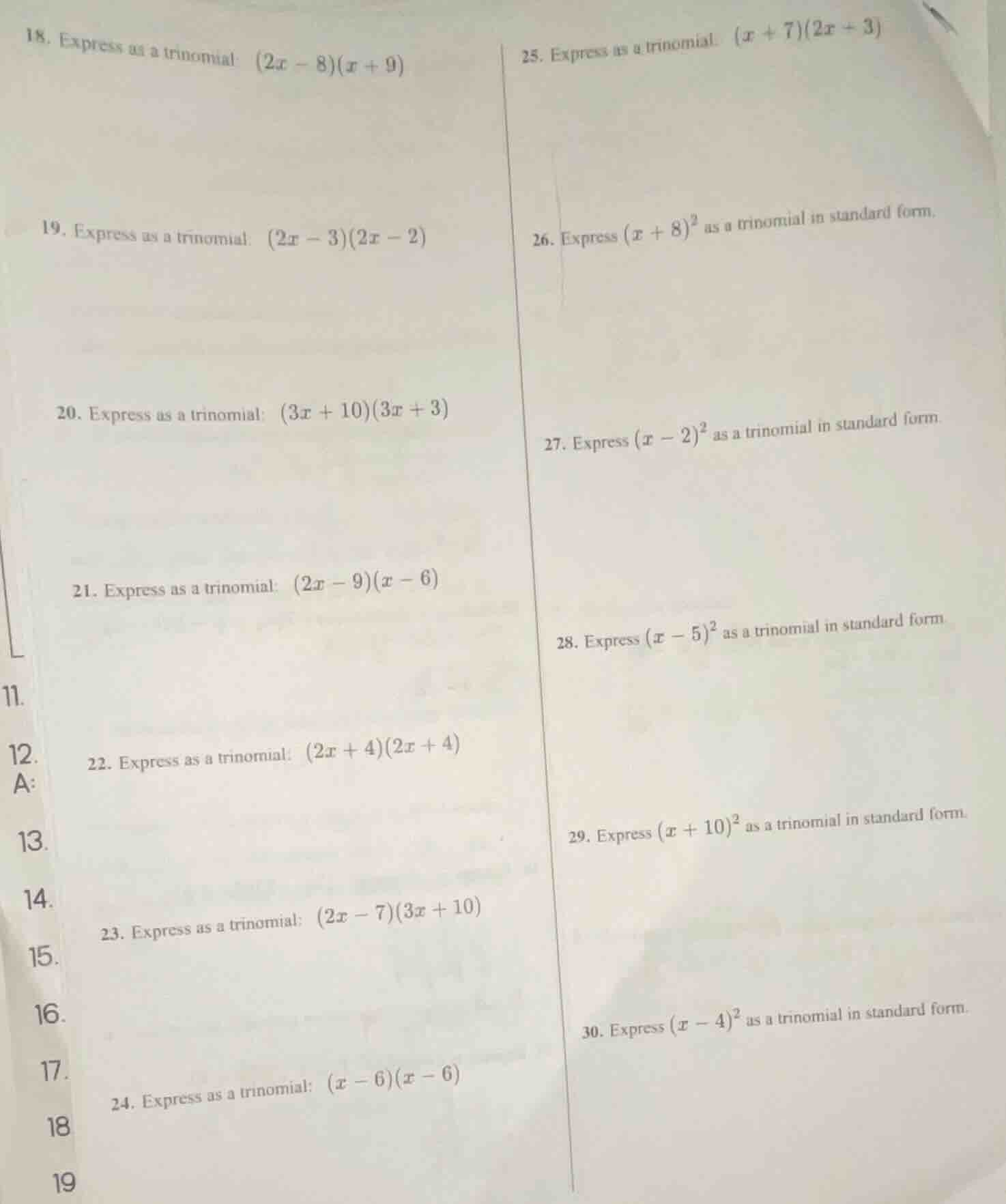
- express as a trinomial: $(2x - 8)(x + 9)$
- express as a trinomial: $(2x - 3)(2x - 2)$
- express as a trinomial: $(3x + 10)(3x + 3)$
- express as a trinomial: $(2x - 9)(x - 6)$
- express as a trinomial: $(2x + 4)(2x + 4)$
- express as a trinomial: $(2x - 7)(3x + 10)$
- express as a trinomial: $(x - 6)(x - 6)$
- express as a trinomial: $(x + 7)(2x + 3)$
- express $(x + 8)^2$ as a trinomial in standard form.
- express $(x - 2)^2$ as a trinomial in standard form.
- express $(x - 5)^2$ as a trinomial in standard form.
- express $(x + 10)^2$ as a trinomial in standard form.
- express $(x - 4)^2$ as a trinomial in standard form.
Let's solve these problems one by one. We'll use the distributive property (FOIL method for binomials) to expand each expression and then combine like terms to get a trinomial.
Problem 18: Express \((2x - 8)(x + 9)\) as a trinomial
Step 1: Apply the FOIL method
First terms: \(2x \cdot x = 2x^2\)
Outer terms: \(2x \cdot 9 = 18x\)
Inner terms: \(-8 \cdot x = -8x\)
Last terms: \(-8 \cdot 9 = -72\)
So, \((2x - 8)(x + 9) = 2x^2 + 18x - 8x - 72\)
Step 2: Combine like terms
\(18x - 8x = 10x\)
So, the trinomial is \(2x^2 + 10x - 72\)
Problem 19: Express \((2x - 3)(2x - 2)\) as a trinomial
Step 1: Apply the FOIL method
First terms: \(2x \cdot 2x = 4x^2\)
Outer terms: \(2x \cdot (-2) = -4x\)
Inner terms: \(-3 \cdot 2x = -6x\)
Last terms: \(-3 \cdot (-2) = 6\)
So, \((2x - 3)(2x - 2) = 4x^2 - 4x - 6x + 6\)
Step 2: Combine like terms
\(-4x - 6x = -10x\)
So, the trinomial is \(4x^2 - 10x + 6\)
Problem 20: Express \((3x + 10)(3x + 3)\) as a trinomial
Step 1: Apply the FOIL method
First terms: \(3x \cdot 3x = 9x^2\)
Outer terms: \(3x \cdot 3 = 9x\)
Inner terms: \(10 \cdot 3x = 30x\)
Last terms: \(10 \cdot 3 = 30\)
So, \((3x + 10)(3x + 3) = 9x^2 + 9x + 30x + 30\)
Step 2: Combine like terms
\(9x + 30x = 39x\)
So, the trinomial is \(9x^2 + 39x + 30\)
Problem 21: Express \((2x - 9)(x - 6)\) as a trinomial
Step 1: Apply the FOIL method
First terms: \(2x \cdot x = 2x^2\)
Outer terms: \(2x \cdot (-6) = -12x\)
Inner terms: \(-9 \cdot x = -9x\)
Last terms: \(-9 \cdot (-6) = 54\)
So, \((2x - 9)(x - 6) = 2x^2 - 12x - 9x + 54\)
Step 2: Combine like terms
\(-12x - 9x = -21x\)
So, the trinomial is \(2x^2 - 21x + 54\)
Problem 22: Express \((2x + 4)(2x + 4)\) as a trinomial
Step 1: Apply the FOIL method
First terms: \(2x \cdot 2x = 4x^2\)
Outer terms: \(2x \cdot 4 = 8x\)
Inner terms: \(4 \cdot 2x = 8x\)
Last terms: \(4 \cdot 4 = 16\)
So, \((2x + 4)(2x + 4) = 4x^2 + 8x + 8x + 16\)
Step 2: Combine like terms
\(8x + 8x = 16x\)
So, the trinomial is \(4x^2 + 16x + 16\)
Problem 23: Express \((2x - 7)(3x + 10)\) as a trinomial
Step 1: Apply the FOIL method
First terms: \(2x \cdot 3x = 6x^2\)
Outer terms: \(2x \cdot 10 = 20x\)
Inner terms: \(-7 \cdot 3x = -21x\)
Last terms: \(-7 \cdot 10 = -70\)
So, \((2x - 7)(3x + 10) = 6x^2 + 20x - 21x - 70\)
Step 2: Combine like terms
\(20x - 21x = -x\)
So, the trinomial is \(6x^2 - x - 70\)
Problem 24: Express \((x - 6)(x - 6)\) as a trinomial
Step 1: Apply the FOIL method
First terms: \(x \cdot x = x^2\)
Outer terms: \(x \cdot (-6) = -6x\)
Inner terms: \(-6 \cdot x = -6x\)
Last terms: \(-6 \cdot (-6) = 36\)
So, \((x - 6)(x - 6) = x^2 - 6x - 6x + 36\)
Step 2: Combine like terms
\(-6x - 6x = -12x\)
So, the trinomial is \(x^2 - 12x + 36\)
Problem 25: Express \((x + 7)(2x + 3)\) as a trinomial
Step 1: Apply the FOIL method
First terms: \(x \cdot 2x = 2x^2\)
Outer terms: \(x \cdot 3 = 3x\)
Inner terms: \(7 \cdot 2x = 14x\)
Last terms: \(7 \cdot 3 = 21\)
So, \((x + 7)(2x + 3) = 2x^2 + 3x + 14x + 21\)
Step 2: Combine like terms
\(3x + 14x = 17x\)
So, the trinomial is \(2x^2 + 17x + 21\)
Problem 26: Express \((x + 8)^2\) as a trinomial in standard form
Recall that \((a + b)^2 = a^2 + 2ab + b^2\)
Here, \(a = x\) and \(b = 8\)
Step 1: Apply the formula
\((x + 8)^2 = x^2 + 2 \cdot x \cdot 8 + 8^2\)
\(= x^2 + 16x + 64\)
Problem 27: Express \((x - 2)^2\) as a trinomial in standard form
Recall that \((a - b)^2 = a^2 - 2ab + b^2\)
Here, \(a = x\) and \(b = 2\)
Step 1: Apply the formula
\((x - 2)^2 = x^2 - 2 \cdot x \cdot 2 + 2^2\)
\(= x^2 - 4x + 4…

Snap & solve any problem in the app
Get step-by-step solutions on Sovi AI
Photo-based solutions with guided steps
Explore more problems and detailed explanations
Let's solve these problems one by one. We'll use the distributive property (FOIL method for binomials) to expand each expression and then combine like terms to get a trinomial.
Problem 18: Express \((2x - 8)(x + 9)\) as a trinomial
Step 1: Apply the FOIL method
First terms: \(2x \cdot x = 2x^2\)
Outer terms: \(2x \cdot 9 = 18x\)
Inner terms: \(-8 \cdot x = -8x\)
Last terms: \(-8 \cdot 9 = -72\)
So, \((2x - 8)(x + 9) = 2x^2 + 18x - 8x - 72\)
Step 2: Combine like terms
\(18x - 8x = 10x\)
So, the trinomial is \(2x^2 + 10x - 72\)
Problem 19: Express \((2x - 3)(2x - 2)\) as a trinomial
Step 1: Apply the FOIL method
First terms: \(2x \cdot 2x = 4x^2\)
Outer terms: \(2x \cdot (-2) = -4x\)
Inner terms: \(-3 \cdot 2x = -6x\)
Last terms: \(-3 \cdot (-2) = 6\)
So, \((2x - 3)(2x - 2) = 4x^2 - 4x - 6x + 6\)
Step 2: Combine like terms
\(-4x - 6x = -10x\)
So, the trinomial is \(4x^2 - 10x + 6\)
Problem 20: Express \((3x + 10)(3x + 3)\) as a trinomial
Step 1: Apply the FOIL method
First terms: \(3x \cdot 3x = 9x^2\)
Outer terms: \(3x \cdot 3 = 9x\)
Inner terms: \(10 \cdot 3x = 30x\)
Last terms: \(10 \cdot 3 = 30\)
So, \((3x + 10)(3x + 3) = 9x^2 + 9x + 30x + 30\)
Step 2: Combine like terms
\(9x + 30x = 39x\)
So, the trinomial is \(9x^2 + 39x + 30\)
Problem 21: Express \((2x - 9)(x - 6)\) as a trinomial
Step 1: Apply the FOIL method
First terms: \(2x \cdot x = 2x^2\)
Outer terms: \(2x \cdot (-6) = -12x\)
Inner terms: \(-9 \cdot x = -9x\)
Last terms: \(-9 \cdot (-6) = 54\)
So, \((2x - 9)(x - 6) = 2x^2 - 12x - 9x + 54\)
Step 2: Combine like terms
\(-12x - 9x = -21x\)
So, the trinomial is \(2x^2 - 21x + 54\)
Problem 22: Express \((2x + 4)(2x + 4)\) as a trinomial
Step 1: Apply the FOIL method
First terms: \(2x \cdot 2x = 4x^2\)
Outer terms: \(2x \cdot 4 = 8x\)
Inner terms: \(4 \cdot 2x = 8x\)
Last terms: \(4 \cdot 4 = 16\)
So, \((2x + 4)(2x + 4) = 4x^2 + 8x + 8x + 16\)
Step 2: Combine like terms
\(8x + 8x = 16x\)
So, the trinomial is \(4x^2 + 16x + 16\)
Problem 23: Express \((2x - 7)(3x + 10)\) as a trinomial
Step 1: Apply the FOIL method
First terms: \(2x \cdot 3x = 6x^2\)
Outer terms: \(2x \cdot 10 = 20x\)
Inner terms: \(-7 \cdot 3x = -21x\)
Last terms: \(-7 \cdot 10 = -70\)
So, \((2x - 7)(3x + 10) = 6x^2 + 20x - 21x - 70\)
Step 2: Combine like terms
\(20x - 21x = -x\)
So, the trinomial is \(6x^2 - x - 70\)
Problem 24: Express \((x - 6)(x - 6)\) as a trinomial
Step 1: Apply the FOIL method
First terms: \(x \cdot x = x^2\)
Outer terms: \(x \cdot (-6) = -6x\)
Inner terms: \(-6 \cdot x = -6x\)
Last terms: \(-6 \cdot (-6) = 36\)
So, \((x - 6)(x - 6) = x^2 - 6x - 6x + 36\)
Step 2: Combine like terms
\(-6x - 6x = -12x\)
So, the trinomial is \(x^2 - 12x + 36\)
Problem 25: Express \((x + 7)(2x + 3)\) as a trinomial
Step 1: Apply the FOIL method
First terms: \(x \cdot 2x = 2x^2\)
Outer terms: \(x \cdot 3 = 3x\)
Inner terms: \(7 \cdot 2x = 14x\)
Last terms: \(7 \cdot 3 = 21\)
So, \((x + 7)(2x + 3) = 2x^2 + 3x + 14x + 21\)
Step 2: Combine like terms
\(3x + 14x = 17x\)
So, the trinomial is \(2x^2 + 17x + 21\)
Problem 26: Express \((x + 8)^2\) as a trinomial in standard form
Recall that \((a + b)^2 = a^2 + 2ab + b^2\)
Here, \(a = x\) and \(b = 8\)
Step 1: Apply the formula
\((x + 8)^2 = x^2 + 2 \cdot x \cdot 8 + 8^2\)
\(= x^2 + 16x + 64\)
Problem 27: Express \((x - 2)^2\) as a trinomial in standard form
Recall that \((a - b)^2 = a^2 - 2ab + b^2\)
Here, \(a = x\) and \(b = 2\)
Step 1: Apply the formula
\((x - 2)^2 = x^2 - 2 \cdot x \cdot 2 + 2^2\)
\(= x^2 - 4x + 4\)
Problem 28: Express \((x - 5)^2\) as a trinomial in standard form
Recall that \((a - b)^2 = a^2 - 2ab + b^2\)
Here, \(a = x\) and \(b = 5\)
Step 1: Apply the formula
\((x - 5)^2 = x^2 - 2 \cdot x \cdot 5 + 5^2\)
\(= x^2 - 10x + 25\)
Problem 29: Express \((x + 10)^2\) as a trinomial in standard form
Recall that \((a + b)^2 = a^2 + 2ab + b^2\)
Here, \(a = x\) and \(b = 10\)
Step 1: Apply the formula
\((x + 10)^2 = x^2 + 2 \cdot x \cdot 10 + 10^2\)
\(= x^2 + 20x + 100\)
Problem 30: Express \((x - 4)^2\) as a trinomial in standard form
Recall that \((a - b)^2 = a^2 - 2ab + b^2\)
Here, \(a = x\) and \(b = 4\)
Step 1: Apply the formula
\((x - 4)^2 = x^2 - 2 \cdot x \cdot 4 + 4^2\)
\(= x^2 - 8x + 16\)
Final Answers:
- \(2x^2 + 10x - 72\)
- \(4x^2 - 10x + 6\)
- \(9x^2 + 39x + 30\)
- \(2x^2 - 21x + 54\)
- \(4x^2 + 16x + 16\)
- \(6x^2 - x - 70\)
- \(x^2 - 12x + 36\)
- \(2x^2 + 17x + 21\)
- \(x^2 + 16x + 64\)
- \(x^2 - 4x + 4\)
- \(x^2 - 10x + 25\)
- \(x^2 + 20x + 100\)
- \(x^2 - 8x + 16\)