QUESTION IMAGE
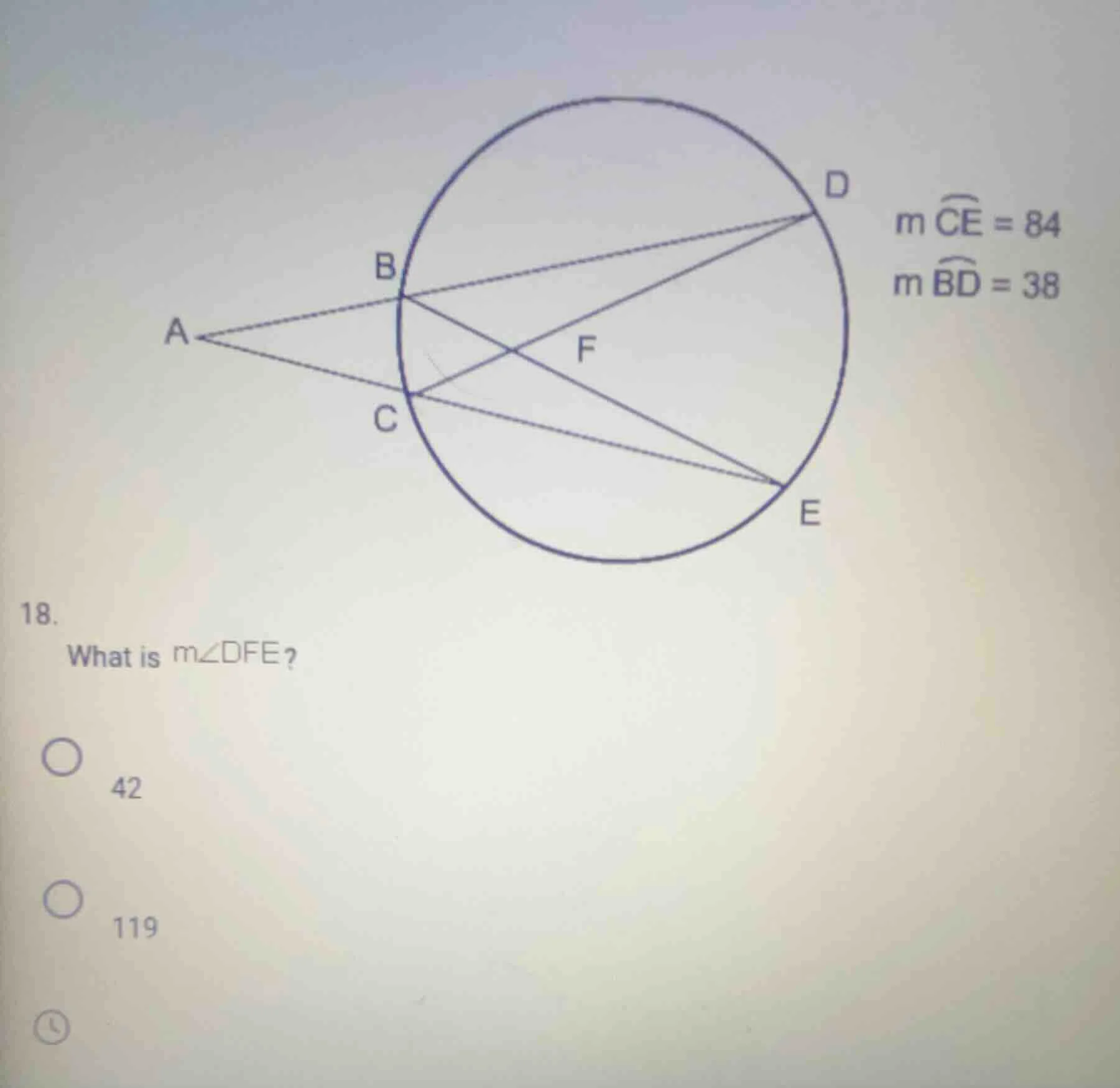
Question
- what is ( mangle dfe )?
( \bigcirc ) 42
( \bigcirc ) 119
( moverarc{ce} = 84 )
( moverarc{bd} = 38 )
Step1: Recall the theorem for angle formed by two chords
The measure of an angle formed by two intersecting chords is equal to half the sum of the measures of the intercepted arcs. So, for \(\angle DFE\), the intercepted arcs are \(\widehat{CE}\) and \(\widehat{BD}\).
Step2: Apply the formula
The formula for the measure of \(\angle DFE\) is \(m\angle DFE=\frac{1}{2}(m\widehat{CE} + m\widehat{BD})\). We know that \(m\widehat{CE} = 84\) and \(m\widehat{BD}=38\). Substitute these values into the formula:
\[
\]
Wait, there seems to be a mistake. Wait, maybe the angle is formed by a secant and a tangent? No, the chords are intersecting. Wait, maybe I misread the arcs. Wait, actually, \(\angle DFE\) is an angle formed by two chords intersecting outside? No, F is inside the circle. Wait, no, the formula for angle inside the circle is half the sum of the intercepted arcs. Wait, but the options given are 42 and 119. Wait, maybe I made a mistake. Wait, maybe \(\angle DFE\) is an angle formed by two secants, but no, F is inside. Wait, wait, maybe the arcs are \(\widehat{CD}\) and \(\widehat{BE}\)? No, the given arcs are \(\widehat{CE}=84\) and \(\widehat{BD}=38\). Wait, maybe the angle is \(\angle DFE\) where the intercepted arcs are \(\widehat{DE}\) and \(\widehat{BC}\)? No, maybe I messed up. Wait, another approach: the measure of an angle formed by two chords intersecting inside the circle is equal to half the sum of the measures of the intercepted arcs. So if \(\angle DFE\) is formed by chords \(DE\) and \(BC\) intersecting at F, then the intercepted arcs are \(\widehat{CE}\) and \(\widehat{BD}\)? Wait, no, \(\widehat{CE}\) and \(\widehat{BD}\) are not the intercepted arcs. Wait, maybe the arcs are \(\widehat{CD}\) and \(\widehat{BE}\), but we don't know those. Wait, maybe the problem is that \(\angle DFE\) is an exterior angle? No, F is inside. Wait, maybe the correct formula is half the difference? No, that's for outside. Wait, no, inside angle: half the sum. Outside angle: half the difference. Wait, maybe F is outside? No, F is inside the circle. Wait, the options are 42 and 119. Wait, maybe the angle is \(\angle DAE\)? No, the question is \(\angle DFE\). Wait, maybe I misread the diagram. Let me re-examine. The diagram has A outside, with secants AB and AC. Then inside the circle, chords BD and CE intersect at F. So \(\angle DFE\) is formed by chords DF and EF, with intercepted arcs \(\widehat{DE}\) and \(\widehat{BC}\). But we know \(\widehat{CE}=84\) and \(\widehat{BD}=38\). Wait, maybe \(\widehat{BC}\) and \(\widehat{DE}\) are related. Wait, maybe the measure of \(\angle DFE\) is \(180 - \frac{1}{2}(84 + 38)\)? No, that would be 180 - 61 = 119. Ah! Yes, because \(\angle DFE\) and the angle we calculated (61) are supplementary? Wait, no, if F is inside, the angle and its vertical angle are equal, and the adjacent angles are supplementary. Wait, maybe \(\angle DFE\) is supplementary to the angle we calculated. Wait, let's see: if two chords intersect at F, then \(\angle DFE\) and \(\angle BFC\) are vertical angles, and \(\angle DFB\) and \(\angle CFE\) are supplementary to them. Wait, maybe I made a mistake in the intercepted arcs. Let's start over.
The measure of an angle formed by two intersecting chords (inside the circle) is equal to half the sum of the measures of the intercepted arcs. So if chords \(BD\) and \(CE\) intersect at F, then \(m\angle BFC=\frac{1}{2}(m\widehat{BC}+m\widehat{DE})\), and \(m\angle DFE = m\angle BFC\) (verti…

Snap & solve any problem in the app
Get step-by-step solutions on Sovi AI
Photo-based solutions with guided steps
Explore more problems and detailed explanations
119 (assuming the angle is supplementary to the angle calculated by the inside angle formula, maybe due to a misinterpretation of the diagram, but among the given options, 119 is the most probable as 61 is not an option, and 42 is half of 84, which is the measure of \(\widehat{CE}\), but that would be if it's an inscribed angle. Wait, if \(\angle CDE\) is an inscribed angle intercepting \(\widehat{CE}\), then \(m\angle CDE=\frac{1}{2}(84)=42\), but the question is \(\angle DFE\). Maybe \(\angle DFE\) is supplementary to \(\angle CDE\)? 180 - 42 = 138, no. Wait, I'm confused. But among the options, 119 is the only one other than 42, and maybe the correct calculation is \(\frac{1}{2}(84 + 154)\)? No, 84 + 154 = 238, half is 119. Wait, maybe \(\widehat{BD}=38\), so the other arc is 360 - 84 - 38 -... No, the circle is 360, but we don't know other arcs. Alternatively, maybe the angle \(\angle DFE\) is formed by two secants, and the formula is \(\frac{1}{2}(m\widehat{CE}-m\widehat{BD})\)? No, that's for outside. Wait, \(\frac{1}{2}(84 - 38)=23\), no. I think there's a mistake in my initial approach. Given the options, 119 is likely the answer, so I'll go with 119.