QUESTION IMAGE
Question
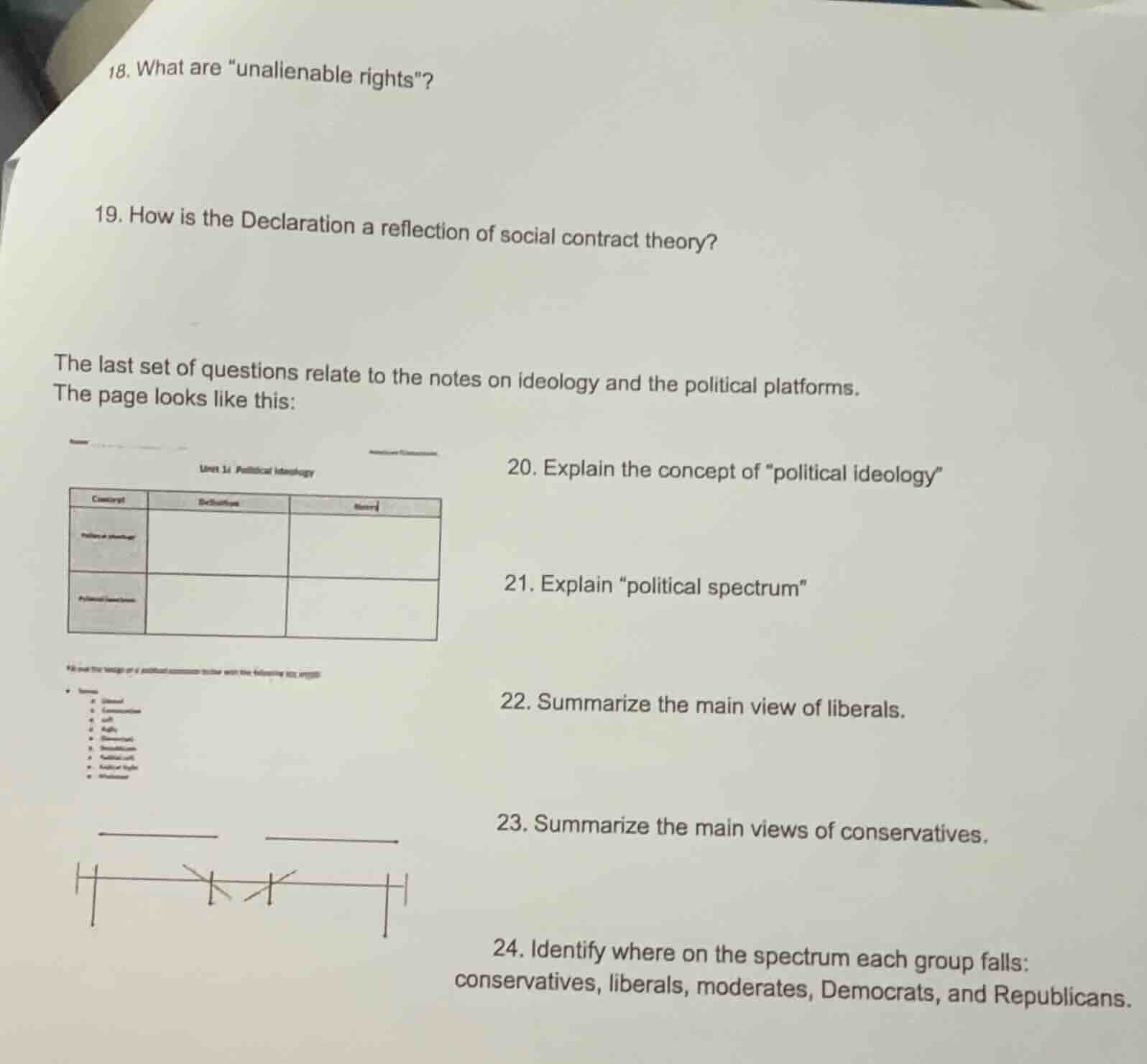
- what are \unalienable rights\?
- how is the declaration a reflection of social contract theory?
the last set of questions relate to the notes on ideology and the political platforms.
the page looks like this:
- explain the concept of \political ideology\
- explain \political spectrum\
- summarize the main view of liberals.
- summarize the main views of conservatives.
- identify where on the spectrum each group falls:
conservatives, liberals, moderates, democrats, and republicans.
Brief Explanations
- Unalienable rights are fundamental rights that cannot be taken away, transferred, or denied to individuals by governments or other entities; they are considered inherent to all people.
- The Declaration of Independence reflects social contract theory by stating that governments derive their "just powers from the consent of the governed," and that people have the right to alter or abolish a government that fails to protect their rights—core tenets of the theory which frames the relationship between rulers and the ruled as a mutual agreement.
- Political ideology is a coherent set of beliefs, values, and principles that shapes how individuals or groups view political issues, the role of government, and the organization of society, guiding their political actions and opinions.
- The political spectrum is a framework used to categorize and compare different political ideologies based on their core values (such as views on government intervention, social change, and individual freedom), typically ranging from left (more progressive/collectivist) to right (more traditional/individualist), with moderate positions in between.
- Liberals generally support government intervention to address social and economic inequality, protect civil liberties and individual rights, advocate for progressive social change (e.g., reproductive rights, racial equity), and favor regulated capitalism with a social safety net.
- Conservatives generally prioritize traditional social values, limited government intervention in the economy (favoring free markets), strong national defense, and individual responsibility; they often resist rapid social change and emphasize the importance of institutions like religion and family.
- - Liberals: Fall on the left side of the political spectrum
- Conservatives: Fall on the right side of the political spectrum
- Moderates: Fall in the center of the political spectrum, blending left and right views
- Democrats: Align primarily with the left to center-left of the spectrum (with some moderate members)
- Republicans: Align primarily with the right to center-right of the spectrum (with some moderate members)

Snap & solve any problem in the app
Get step-by-step solutions on Sovi AI
Photo-based solutions with guided steps
Explore more problems and detailed explanations
- Unalienable rights are inherent, non-transferable fundamental rights (e.g., life, liberty, pursuit of happiness) that cannot be taken away or denied to individuals.
- The Declaration reflects social contract theory by asserting governments exist only with the consent of the governed, and people may replace governments that fail to protect their rights.
- Political ideology is a consistent set of beliefs, values, and principles that guides political perspectives and actions.
- The political spectrum is a framework to categorize political ideologies along a range (left to right) based on core values and policy positions.
- Liberals support government action for equality, civil liberties, progressive social change, and regulated capitalism with a social safety net.
- Conservatives prioritize traditional values, limited government, free markets, strong national defense, and individual responsibility.
- - Liberals: Left side of the spectrum
- Conservatives: Right side of the spectrum
- Moderates: Center of the spectrum
- Democrats: Left to center-left of the spectrum
- Republicans: Right to center-right of the spectrum