QUESTION IMAGE
Question
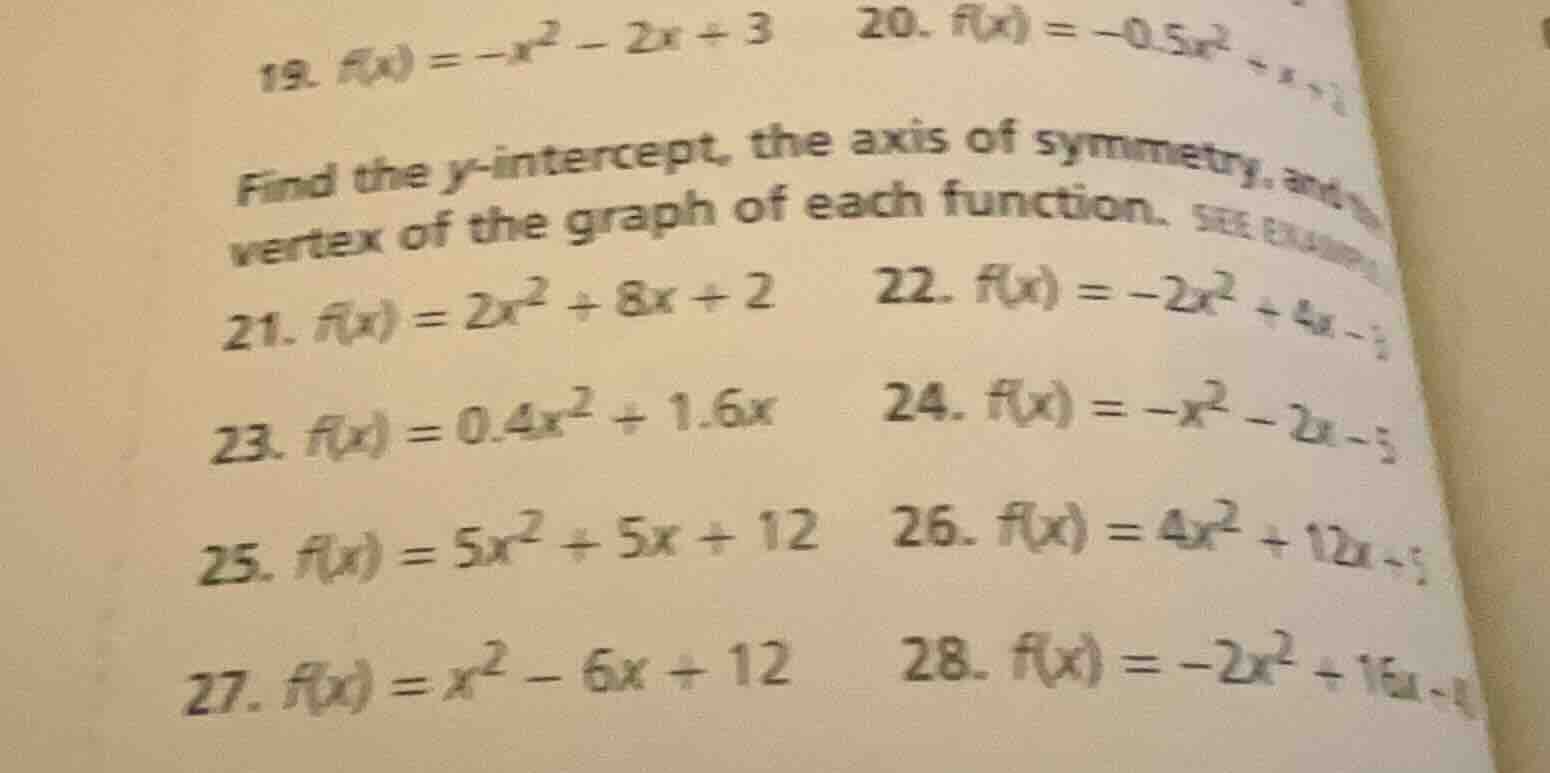
- $f(x) = -x^2 - 2x + 3$ 20. $f(x) = -0.5x^2 + x + 3$ find the $y$-intercept, the axis of symmetry, and the vertex of the graph of each function. see example 21. $f(x) = 2x^2 + 8x + 2$ 22. $f(x) = -2x^2 + 4x - 3$ 23. $f(x) = 0.4x^2 + 1.6x$ 24. $f(x) = -x^2 - 2x - 5$ 25. $f(x) = 5x^2 + 5x + 12$ 26. $f(x) = 4x^2 + 12x + 5$ 27. $f(x) = x^2 - 6x + 12$ 28. $f(x) = -2x^2 + 16x - 40$
For Problem 19: $f(x) = -x^2 - 2x + 3$
Step1: Find y-intercept (x=0)
Substitute $x=0$: $f(0) = -(0)^2 -2(0)+3 = 3$
Step2: Find axis of symmetry
Use formula $x=-\frac{b}{2a}$, where $a=-1, b=-2$:
$x=-\frac{-2}{2(-1)} = \frac{2}{-2} = -1$
Step3: Find vertex (x=-1)
Substitute $x=-1$: $f(-1) = -(-1)^2 -2(-1)+3 = -1+2+3=4$
---
For Problem 21: $f(x) = 2x^2 + 8x + 2$
Step1: Find y-intercept (x=0)
Substitute $x=0$: $f(0)=2(0)^2+8(0)+2=2$
Step2: Find axis of symmetry
Use $x=-\frac{b}{2a}$, $a=2, b=8$:
$x=-\frac{8}{2(2)} = -\frac{8}{4} = -2$
Step3: Find vertex (x=-2)
Substitute $x=-2$: $f(-2)=2(-2)^2+8(-2)+2=8-16+2=-6$
---
For Problem 23: $f(x) = 0.4x^2 + 1.6x$
Step1: Find y-intercept (x=0)
Substitute $x=0$: $f(0)=0.4(0)^2+1.6(0)=0$
Step2: Find axis of symmetry
Use $x=-\frac{b}{2a}$, $a=0.4, b=1.6$:
$x=-\frac{1.6}{2(0.4)} = -\frac{1.6}{0.8} = -2$
Step3: Find vertex (x=-2)
Substitute $x=-2$: $f(-2)=0.4(-2)^2+1.6(-2)=1.6-3.2=-1.6$
---
For Problem 25: $f(x) = 5x^2 + 5x + 12$
Step1: Find y-intercept (x=0)
Substitute $x=0$: $f(0)=5(0)^2+5(0)+12=12$
Step2: Find axis of symmetry
Use $x=-\frac{b}{2a}$, $a=5, b=5$:
$x=-\frac{5}{2(5)} = -\frac{1}{2} = -0.5$
Step3: Find vertex (x=-0.5)
Substitute $x=-0.5$: $f(-0.5)=5(-0.5)^2+5(-0.5)+12=1.25-2.5+12=10.75$
---
For Problem 27: $f(x) = x^2 - 6x + 12$
Step1: Find y-intercept (x=0)
Substitute $x=0$: $f(0)=(0)^2-6(0)+12=12$
Step2: Find axis of symmetry
Use $x=-\frac{b}{2a}$, $a=1, b=-6$:
$x=-\frac{-6}{2(1)} = \frac{6}{2} = 3$
Step3: Find vertex (x=3)
Substitute $x=3$: $f(3)=(3)^2-6(3)+12=9-18+12=3$
---
For Problem 22: $f(x) = -2x^2 + 4x - 1$
Step1: Find y-intercept (x=0)
Substitute $x=0$: $f(0)=-2(0)^2+4(0)-1=-1$
Step2: Find axis of symmetry
Use $x=-\frac{b}{2a}$, $a=-2, b=4$:
$x=-\frac{4}{2(-2)} = -\frac{4}{-4} = 1$
Step3: Find vertex (x=1)
Substitute $x=1$: $f(1)=-2(1)^2+4(1)-1=-2+4-1=1$
---
For Problem 24: $f(x) = -x^2 - 2x - 5$
Step1: Find y-intercept (x=0)
Substitute $x=0$: $f(0)=-(0)^2-2(0)-5=-5$
Step2: Find axis of symmetry
Use $x=-\frac{b}{2a}$, $a=-1, b=-2$:
$x=-\frac{-2}{2(-1)} = \frac{2}{-2} = -1$
Step3: Find vertex (x=-1)
Substitute $x=-1$: $f(-1)=-(-1)^2-2(-1)-5=-1+2-5=-4$
---
For Problem 26: $f(x) = 4x^2 + 12x + 5$
Step1: Find y-intercept (x=0)
Substitute $x=0$: $f(0)=4(0)^2+12(0)+5=5$
Step2: Find axis of symmetry
Use $x=-\frac{b}{2a}$, $a=4, b=12$:
$x=-\frac{12}{2(4)} = -\frac{12}{8} = -1.5$
Step3: Find vertex (x=-1.5)
Substitute $x=-1.5$: $f(-1.5)=4(-1.5)^2+12(-1.5)+5=9-18+5=-4$
---
For Problem 28: $f(x) = -2x^2 + 16x + 4$
Step1: Find y-intercept (x=0)
Substitute $x=0$: $f(0)=-2(0)^2+16(0)+4=4$
Step2: Find axis of symmetry
Use $x=-\frac{b}{2a}$, $a=-2, b=16$:
$x=-\frac{16}{2(-2)} = -\frac{16}{-4} = 4$
Step3: Find vertex (x=4)
Substitute $x=4$: $f(4)=-2(4)^2+16(4)+4=-32+64+4=36$

Snap & solve any problem in the app
Get step-by-step solutions on Sovi AI
Photo-based solutions with guided steps
Explore more problems and detailed explanations
- Y-intercept: $3$, Axis of symmetry: $x=-1$, Vertex: $(-1, 4)$
- Y-intercept: $2$, Axis of symmetry: $x=-2$, Vertex: $(-2, -6)$
- Y-intercept: $0$, Axis of symmetry: $x=-2$, Vertex: $(-2, -1.6)$
- Y-intercept: $12$, Axis of symmetry: $x=-0.5$, Vertex: $(-0.5, 10.75)$
- Y-intercept: $12$, Axis of symmetry: $x=3$, Vertex: $(3, 3)$
- Y-intercept: $-1$, Axis of symmetry: $x=1$, Vertex: $(1, 1)$
- Y-intercept: $-5$, Axis of symmetry: $x=-1$, Vertex: $(-1, -4)$
- Y-intercept: $5$, Axis of symmetry: $x=-1.5$, Vertex: $(-1.5, -4)$
- Y-intercept: $4$, Axis of symmetry: $x=4$, Vertex: $(4, 36)$
(Note: Problem 20 is cut off and cannot be solved with the provided image)