QUESTION IMAGE
Question
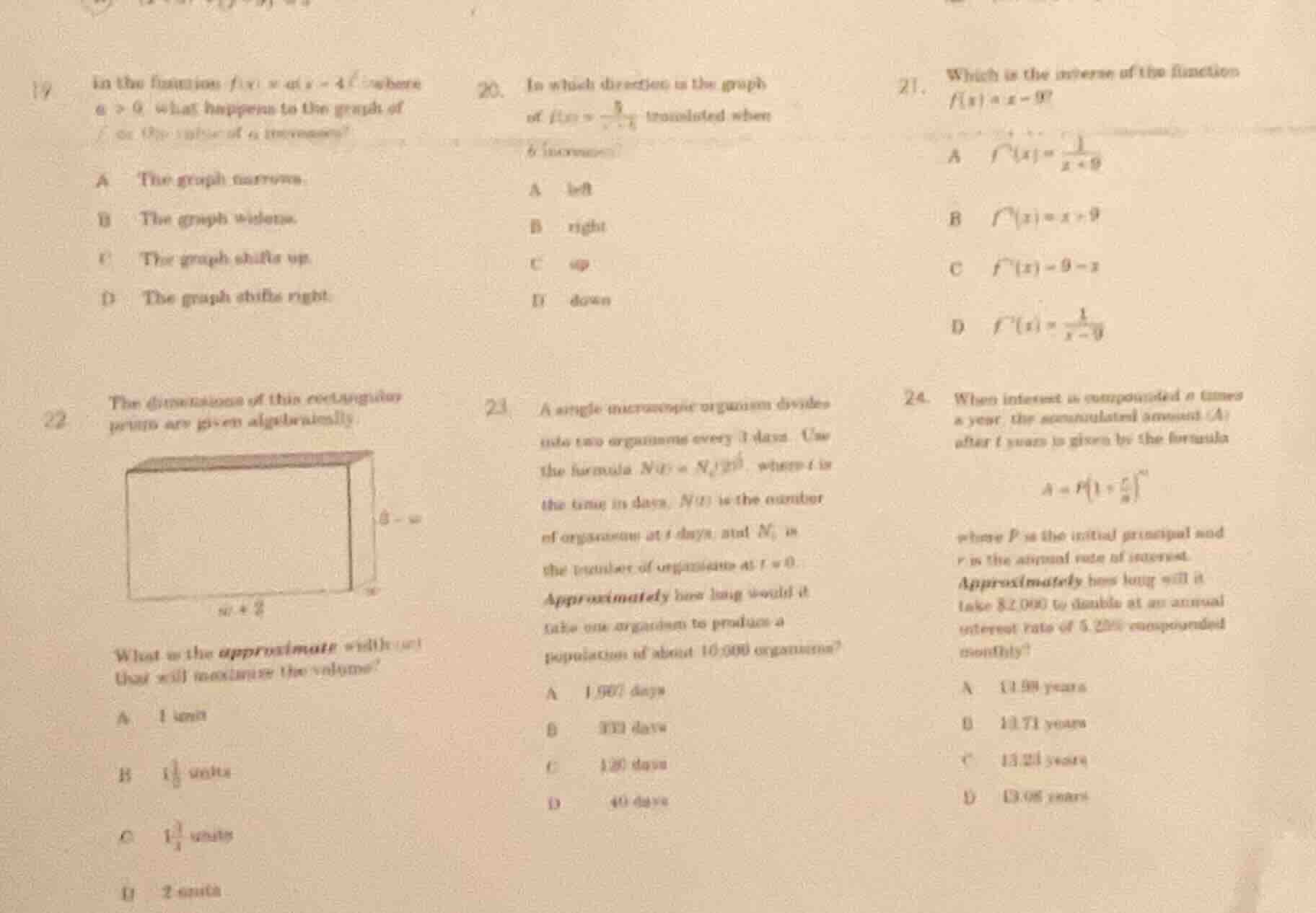
- in the function $f(x) = a|x - 4|$ where $a > 0$, what happens to the graph of $f$ as the value of $a$ increases?
a. the graph narrows.
b. the graph widens.
c. the graph shifts up.
d. the graph shifts right.
- in which direction is the graph of $f(x) = \frac{5}{x - b}$ translated when $b$ increases?
a. left
b. right
c. up
d. down
- which is the inverse of the function $f(x) = x - 9$?
a. $f^{-1}(x) = \frac{1}{x + 9}$
b. $f^{-1}(x) = x + 9$
c. $f^{-1}(x) = 9 - x$
d. $f^{-1}(x) = \frac{1}{x - 9}$
- the dimensions of this rectangular prism are given algebraically. what is the approximate width (in units) that will maximize the volume?
(image of a rectangular prism with length $w + 2$, width $w$, height $8 - w$)
a. 1 unit
b. $1\frac{1}{3}$ units
c. $1\frac{3}{4}$ units
d. 2 units
- a single microscopic organism divides into two organisms every 3 days. use the formula $n(t) = n_0(2)^{\frac{t}{3}}$, where $t$ is the time in days, $n(t)$ is the number of organisms at $t$ days, and $n_0$ is the number of organisms at $t = 0$. approximately how long would it take one organism to produce a population of about 10,000 organisms?
a. 1,987 days
b. 333 days
c. 120 days
d. 40 days
- when interest is compounded $n$ times a year, the accumulated amount $a$ after $t$ years is given by the formula $a = p\left(1 + \frac{r}{n}\
ight)^{nt}$ where $p$ is the initial principal and $r$ is the annual rate of interest. approximately how long will it take $\\$2,000$ to double at an annual interest rate of 5.2% compounded monthly?
a. 11.98 years
b. 13.71 years
c. 13.21 years
d. 13.08 years
Question 19
Step1: Analyze vertical scaling effect
For $f(x)=a(x-4)^2$, $a>0$. As $a$ increases, the vertical stretch factor increases, making the graph narrower.
Step1: Identify vertical translation parameter
The function is $f(x)=\frac{3}{x}+b$. A positive $b$ adds a vertical shift upward.
Step1: Set $y=f(x)$ and swap $x,y$
Let $y=x-9$. Swap variables: $x=y-9$.
Step2: Solve for $y$ (inverse function)
Rearrange: $y=x+9$, so $f^{-1}(x)=x+9$.

Snap & solve any problem in the app
Get step-by-step solutions on Sovi AI
Photo-based solutions with guided steps
Explore more problems and detailed explanations
A. The graph narrows.
---