QUESTION IMAGE
Question
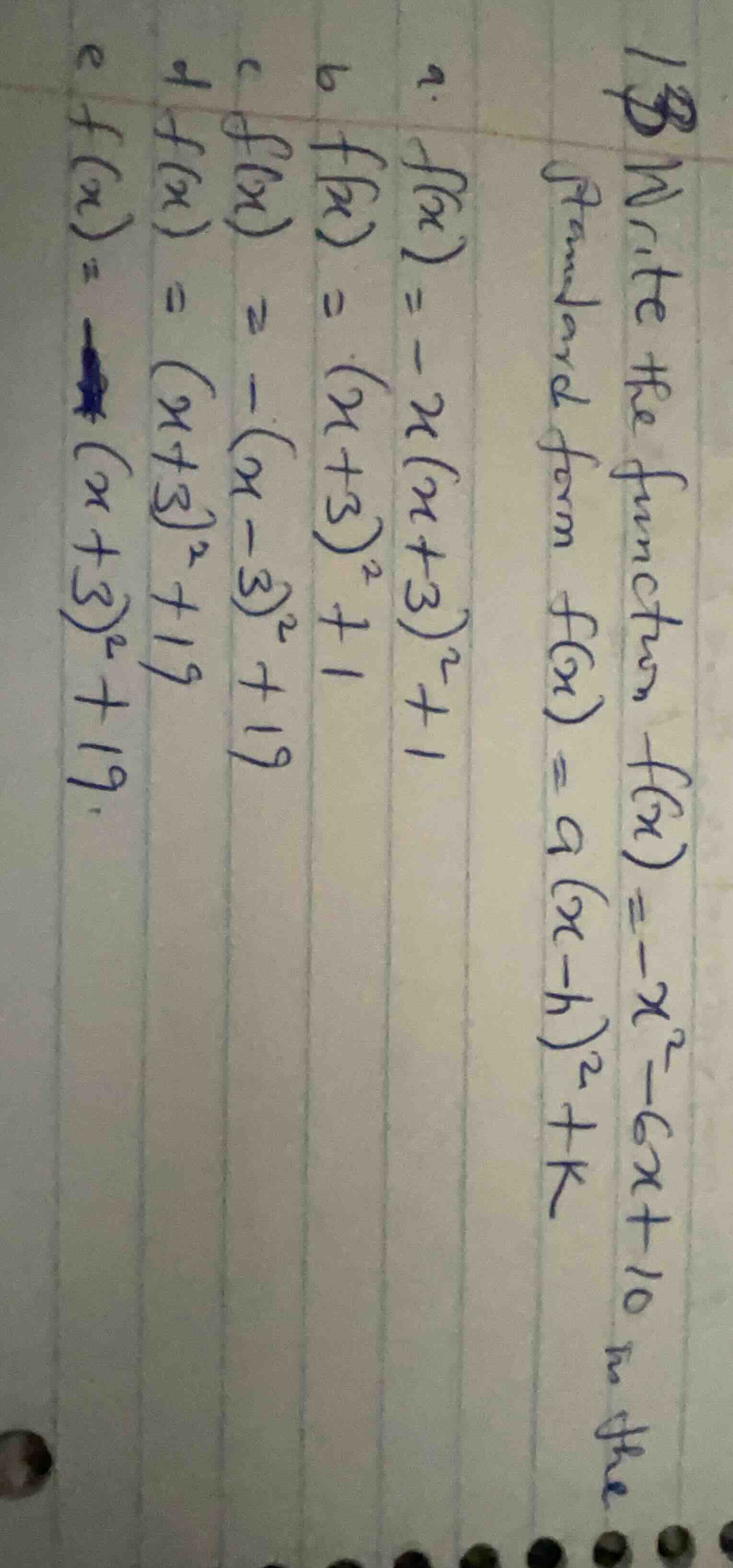
- write the function ( f(x) = -x^2 - 6x + 10 ) in the form ( f(x) = a(x - h)^2 + k )
a. ( f(x) = -x(x + 3)^2 + 1 )
b. ( f(x) = (x + 3)^2 + 1 )
c. ( f(x) = - (x - 3)^2 + 19 )
d. ( f(x) = (x + 3)^2 + 19 )
e. ( f(x) = - (x + 3)^2 + 19 )
We are given the quadratic function \( f(x) = -x^2 - 6x + 10 \) and we need to write it in vertex form \( f(x)=a(x - h)^2 + k \).
Step 1: Factor out the coefficient of \( x^2 \) from the first two terms
First, we factor out -1 from the terms involving \( x \):
\( f(x) = -1(x^2 + 6x) + 10 \)
Step 2: Complete the square inside the parentheses
To complete the square for \( x^2 + 6x \), we take half of the coefficient of \( x \) (which is \( \frac{6}{2}=3 \)), square it (which is \( 3^2 = 9 \)), and add and subtract it inside the parentheses. But since there is a factor of -1 outside the parentheses, we need to be careful with the sign:
\( f(x) = -1[(x^2 + 6x + 9) - 9] + 10 \)
The expression \( x^2 + 6x + 9 \) is a perfect square trinomial, which factors as \( (x + 3)^2 \). So we can rewrite the function as:
\( f(x) = -1[(x + 3)^2 - 9] + 10 \)
Step 3: Distribute the -1
Now we distribute the -1 to both terms inside the brackets:
\( f(x) = -1(x + 3)^2 + (-1)(-9) + 10 \)
\( f(x) = -1(x + 3)^2 + 9 + 10 \)
Step 4: Combine the constant terms
Finally, we combine the constant terms 9 and 10:
\( f(x) = -1(x + 3)^2 + 19 \)

Snap & solve any problem in the app
Get step-by-step solutions on Sovi AI
Photo-based solutions with guided steps
Explore more problems and detailed explanations
\( f(x) = - (x + 3)^2 + 19 \)