QUESTION IMAGE
Question
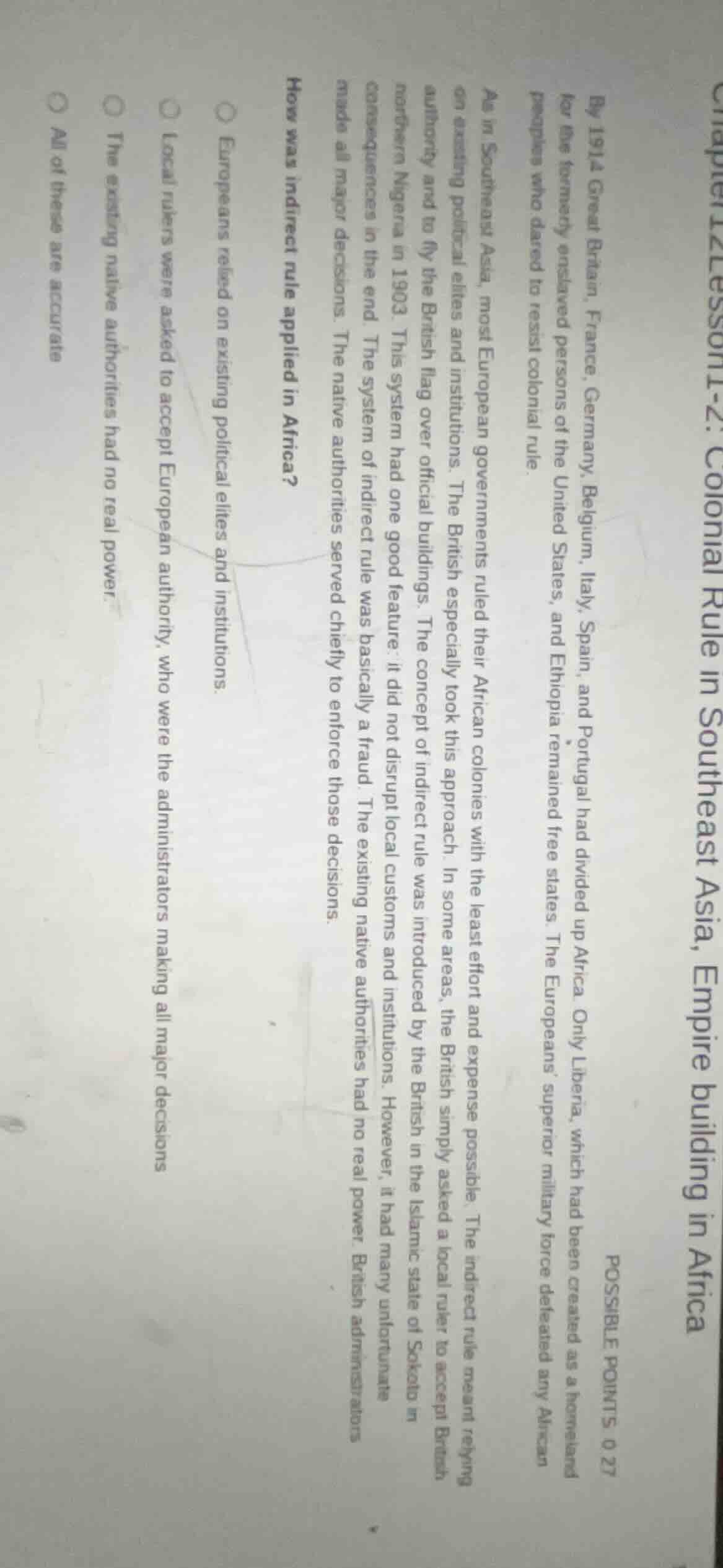
by 1914 great britain, france, germany, belgium, italy, spain, and portugal had divided up africa. only liberia, which had been created as a homeland for the formerly enslaved persons of the united states, and ethiopia remained free states. the europeans’ superior military force defeated any african peoples who dared to resist colonial rule. as in southeast asia, most european governments ruled their african colonies with the least effort and expense possible. the indirect rule meant relying on existing political elites and institutions. the british especially took this approach. in some areas, the british simply asked a local ruler to accept british authority and to fly the british flag over official buildings. the concept of indirect rule was introduced by the british in the islamic state of sokoto in northern nigeria in 1903. this system had one good feature: it did not disrupt local customs and institutions. however, it had many unfortunate consequences in the end. the system of indirect rule was basically a fraud. the existing native authorities had no real power. british administrators made all major decisions. the native authorities served chiefly to enforce those decisions. how was indirect rule applied in africa? europeans relied on existing political elites and institutions. local rulers were asked to accept european authority, who were the administrators making all major decisions the existing native authorities had no real power. all of these are accurate
The text states that indirect rule in Africa relied on existing political elites/institutions, local rulers were made to accept European authority (with Europeans making major decisions), and native authorities had no real independent power. All the listed statements align with the description of how indirect rule was applied.

Snap & solve any problem in the app
Get step-by-step solutions on Sovi AI
Photo-based solutions with guided steps
Explore more problems and detailed explanations
All of these are accurate