QUESTION IMAGE
Question
2-2 assignment: lesson 9 and 10 practice
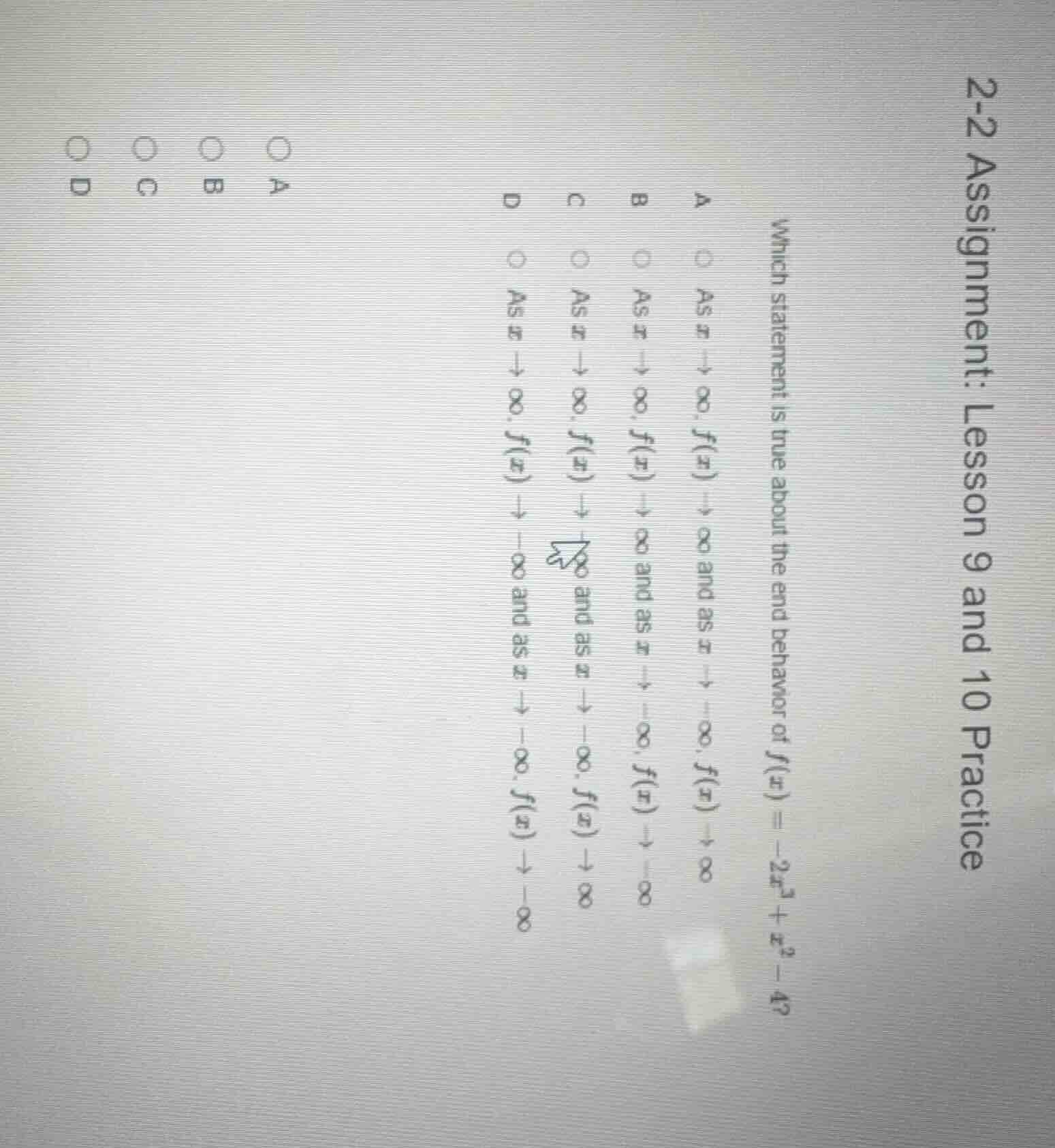
which statement is true about the end behavior of ( f(x) = -2x^3 + x^2 - 4 )?
a
as ( x \to infty ), ( f(x) \to infty ) and as ( x \to -infty ), ( f(x) \to infty )
b
as ( x \to infty ), ( f(x) \to infty ) and as ( x \to -infty ), ( f(x) \to -infty )
c
as ( x \to infty ), ( f(x) \to -infty ) and as ( x \to -infty ), ( f(x) \to infty )
d
as ( x \to infty ), ( f(x) \to -infty ) and as ( x \to -infty ), ( f(x) \to -infty )
a
b
c
d
To determine the end - behavior of the function \(f(x)=- 2x^{3}+x^{2}-4\), we analyze the leading term of the polynomial. The leading term of a polynomial is the term with the highest degree. For the polynomial \(f(x)=-2x^{3}+x^{2}-4\), the leading term is \(-2x^{3}\), and the degree of the polynomial (the highest power of \(x\)) is \(n = 3\) (which is odd) and the leading coefficient \(a=-2\) (which is negative).
Step 1: Analyze the case when \(x
ightarrow\infty\)
When we consider the behavior of \(y = ax^{n}\) as \(x
ightarrow\infty\), we use the following rule:
- If \(n\) is odd:
- If \(a>0\), then as \(x
ightarrow\infty\), \(y
ightarrow\infty\) and as \(x
ightarrow-\infty\), \(y
ightarrow - \infty\).
- If \(a < 0\), then as \(x
ightarrow\infty\), \(y
ightarrow-\infty\) and as \(x
ightarrow-\infty\), \(y
ightarrow\infty\).
For our function, \(a=-2<0\) and \(n = 3\) (odd). So when \(x
ightarrow\infty\), we look at the leading term \(-2x^{3}\). As \(x\) becomes a very large positive number, \(x^{3}\) is positive, and multiplying by \(-2\) (a negative number) gives a very large negative number. So \(\lim_{x
ightarrow\infty}f(x)=\lim_{x
ightarrow\infty}(-2x^{3}+x^{2}-4)=-\infty\) (because the term \(-2x^{3}\) dominates the other terms as \(x\) becomes very large).
Step 2: Analyze the case when \(x
ightarrow-\infty\)
When \(x
ightarrow-\infty\), \(x^{3}\) is negative (because the cube of a negative number is negative). Then \(-2x^{3}=-2\times(\text{negative number})=\text{positive number}\). As \(x\) becomes a very large negative number, \(x^{3}\) is a very large negative number, and multiplying by \(-2\) gives a very large positive number. So \(\lim_{x
ightarrow-\infty}f(x)=\lim_{x
ightarrow-\infty}(-2x^{3}+x^{2}-4)=\infty\) (again, the term \(-2x^{3}\) dominates the other terms as \(x\) becomes very large in magnitude in the negative direction).
So, as \(x
ightarrow\infty\), \(f(x)
ightarrow-\infty\) and as \(x
ightarrow-\infty\), \(f(x)
ightarrow\infty\). Looking at the options:
- Option A: Says as \(x
ightarrow\infty\), \(f(x)
ightarrow\infty\) and as \(x
ightarrow-\infty\), \(f(x)
ightarrow\infty\) which is wrong.
- Option B: Says as \(x
ightarrow\infty\), \(f(x)
ightarrow\infty\) and as \(x
ightarrow-\infty\), \(f(x)
ightarrow-\infty\) which is wrong.
- Option C: Says as \(x
ightarrow\infty\), \(f(x)
ightarrow-\infty\) and as \(x
ightarrow-\infty\), \(f(x)
ightarrow\infty\) which is correct.
- Option D: Says as \(x
ightarrow\infty\), \(f(x)
ightarrow-\infty\) and as \(x
ightarrow-\infty\), \(f(x)
ightarrow-\infty\) which is wrong.

Snap & solve any problem in the app
Get step-by-step solutions on Sovi AI
Photo-based solutions with guided steps
Explore more problems and detailed explanations
C. As \(x
ightarrow\infty\), \(f(x)
ightarrow-\infty\) and as \(x
ightarrow-\infty\), \(f(x)
ightarrow\infty\)