QUESTION IMAGE
Question
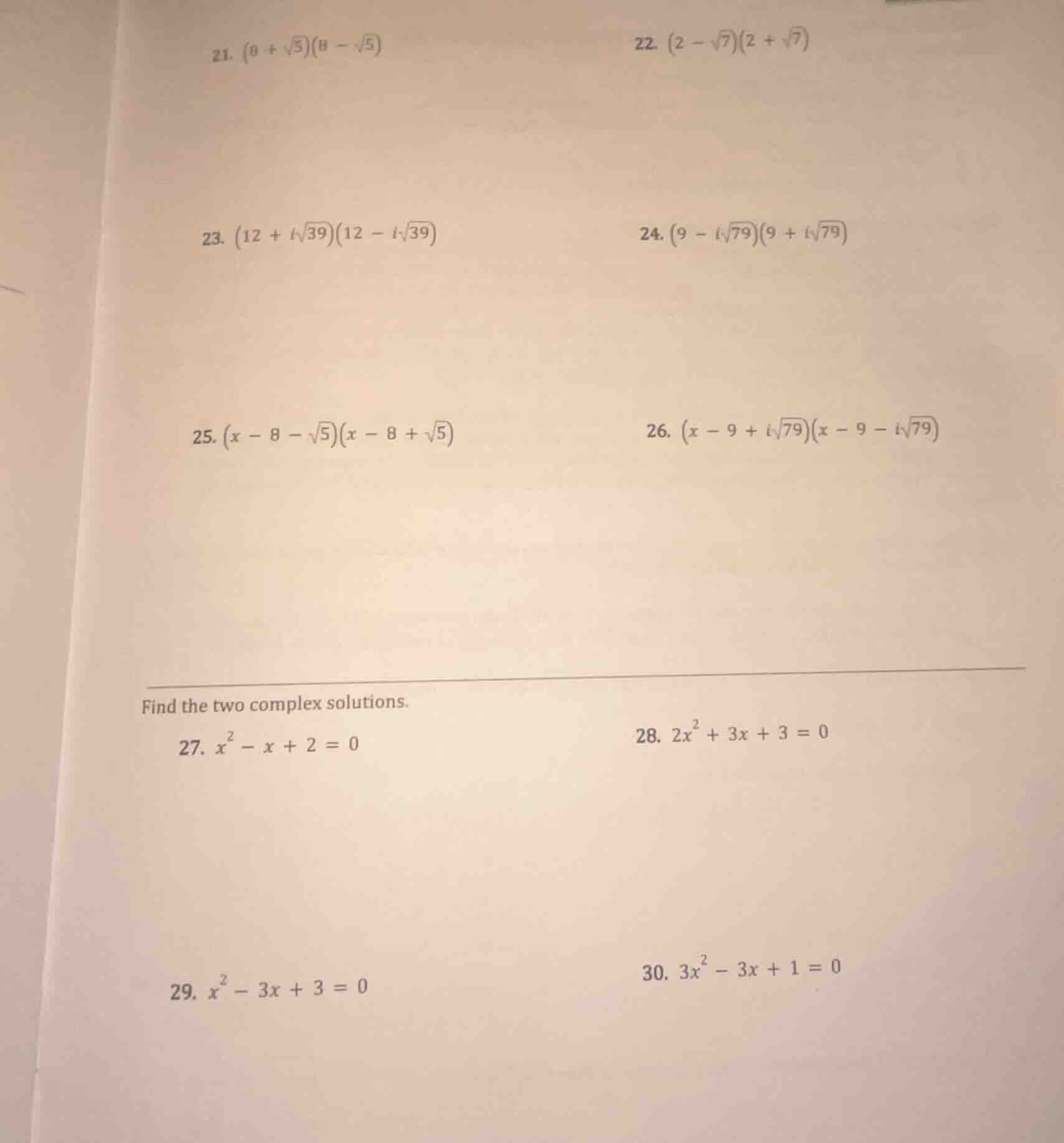
- $(8 + \sqrt{5})(8 - \sqrt{5})$ 22. $(2 - \sqrt{7})(2 + \sqrt{7})$ 23. $(12 + i\sqrt{39})(12 - i\sqrt{39})$ 24. $(9 - i\sqrt{79})(9 + i\sqrt{79})$ 25. $(x - 8 - \sqrt{5})(x - 8 + \sqrt{5})$ 26. $(x - 9 + i\sqrt{79})(x - 9 - i\sqrt{79})$ find the two complex solutions. 27. $x^2 - x + 2 = 0$ 28. $2x^2 + 3x + 3 = 0$ 29. $x^2 - 3x + 3 = 0$ 30. $3x^2 - 3x + 1 = 0$
Let's solve problem 27: \(x^2 - x + 2 = 0\) using the quadratic formula.
Step 1: Identify coefficients
For a quadratic equation \(ax^2 + bx + c = 0\), here \(a = 1\), \(b = -1\), \(c = 2\).
Step 2: Quadratic formula
The quadratic formula is \(x=\frac{-b\pm\sqrt{b^2 - 4ac}}{2a}\).
Substitute \(a = 1\), \(b=-1\), \(c = 2\) into the formula:
First, calculate the discriminant \(\Delta=b^2-4ac=(-1)^2-4\times1\times2=1 - 8=-7\)
Then \(x=\frac{-(-1)\pm\sqrt{-7}}{2\times1}=\frac{1\pm i\sqrt{7}}{2}\) (since \(\sqrt{-7}=i\sqrt{7}\))
Step 1: Identify coefficients
For the quadratic equation \(ax^2+bx + c = 0\), here \(a = 2\), \(b = 3\), \(c = 3\)
Step 2: Quadratic formula
Using the quadratic formula \(x=\frac{-b\pm\sqrt{b^2-4ac}}{2a}\)
First, calculate the discriminant \(\Delta=b^2 - 4ac=(3)^2-4\times2\times3=9 - 24=-15\)
Then \(x=\frac{-3\pm\sqrt{-15}}{2\times2}=\frac{-3\pm i\sqrt{15}}{4}\) (since \(\sqrt{-15}=i\sqrt{15}\))
Step 1: Identify coefficients
For the quadratic equation \(ax^2+bx + c = 0\), here \(a = 1\), \(b=-3\), \(c = 3\)
Step 2: Quadratic formula
Using the quadratic formula \(x=\frac{-b\pm\sqrt{b^2-4ac}}{2a}\)
First, calculate the discriminant \(\Delta=b^2-4ac=(-3)^2-4\times1\times3=9 - 12=-3\)
Then \(x=\frac{-(-3)\pm\sqrt{-3}}{2\times1}=\frac{3\pm i\sqrt{3}}{2}\) (since \(\sqrt{-3}=i\sqrt{3}\))

Snap & solve any problem in the app
Get step-by-step solutions on Sovi AI
Photo-based solutions with guided steps
Explore more problems and detailed explanations
The two complex solutions are \(x=\frac{1 + i\sqrt{7}}{2}\) and \(x=\frac{1 - i\sqrt{7}}{2}\)
Let's solve problem 28: \(2x^2+3x + 3 = 0\) using the quadratic formula.