QUESTION IMAGE
Question
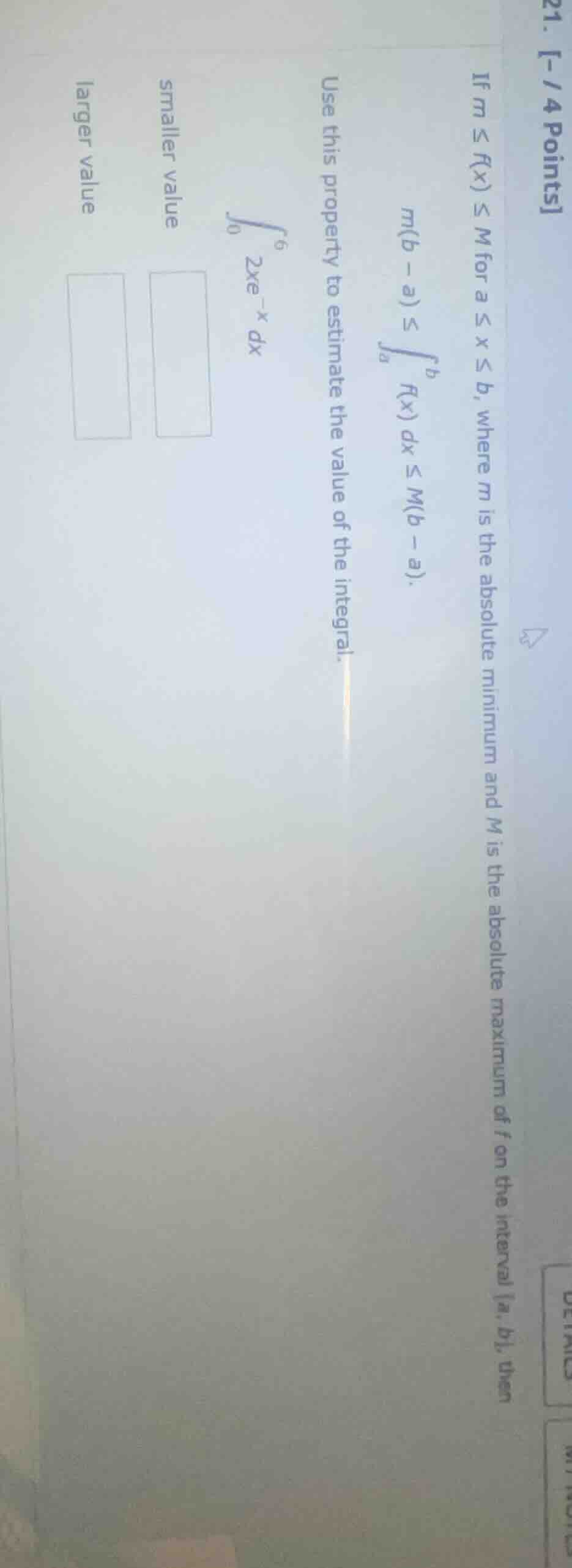
- -/4 points if ( m leq f(x) leq m ) for ( a leq x leq b ), where ( m ) is the absolute minimum and ( m ) is the absolute maximum of ( f ) on the interval (a, b), then ( m(b - a) leq int_{a}^{b} f(x) dx leq m(b - a) ). use this property to estimate the value of the integral. (int_{0}^{6} 2x e^{-x} dx) smaller value larger value
Step1: Define $f(x)$ and find critical points
Let $f(x)=2xe^{-x}$. Find derivative via product rule:
$f'(x)=2e^{-x} + 2x(-e^{-x})=2e^{-x}(1-x)$
Set $f'(x)=0$: $2e^{-x}(1-x)=0$. Since $e^{-x}>0$ for all $x$, critical point at $x=1$.
Step2: Evaluate $f(x)$ at key points
Evaluate $f(x)$ at $x=0,1,6$:
- $f(0)=2(0)e^{0}=0$
- $f(1)=2(1)e^{-1}=\frac{2}{e}\approx0.7358$
- $f(6)=2(6)e^{-6}=\frac{12}{e^6}\approx0.039$
Step3: Identify $m$ and $M$
Absolute minimum $m=0$ (at $x=0$), absolute maximum $M=\frac{2}{e}$ (at $x=1$). Interval $[a,b]=[0,6]$, so $b-a=6$.
Step4: Apply integral estimation property
Lower bound: $m(b-a)=0\times6=0$
Upper bound: $M(b-a)=\frac{2}{e}\times6=\frac{12}{e}\approx4.414$

Snap & solve any problem in the app
Get step-by-step solutions on Sovi AI
Photo-based solutions with guided steps
Explore more problems and detailed explanations
smaller value: $0$
larger value: $\frac{12}{e}$ (or approximately $4.41$)