QUESTION IMAGE
Question
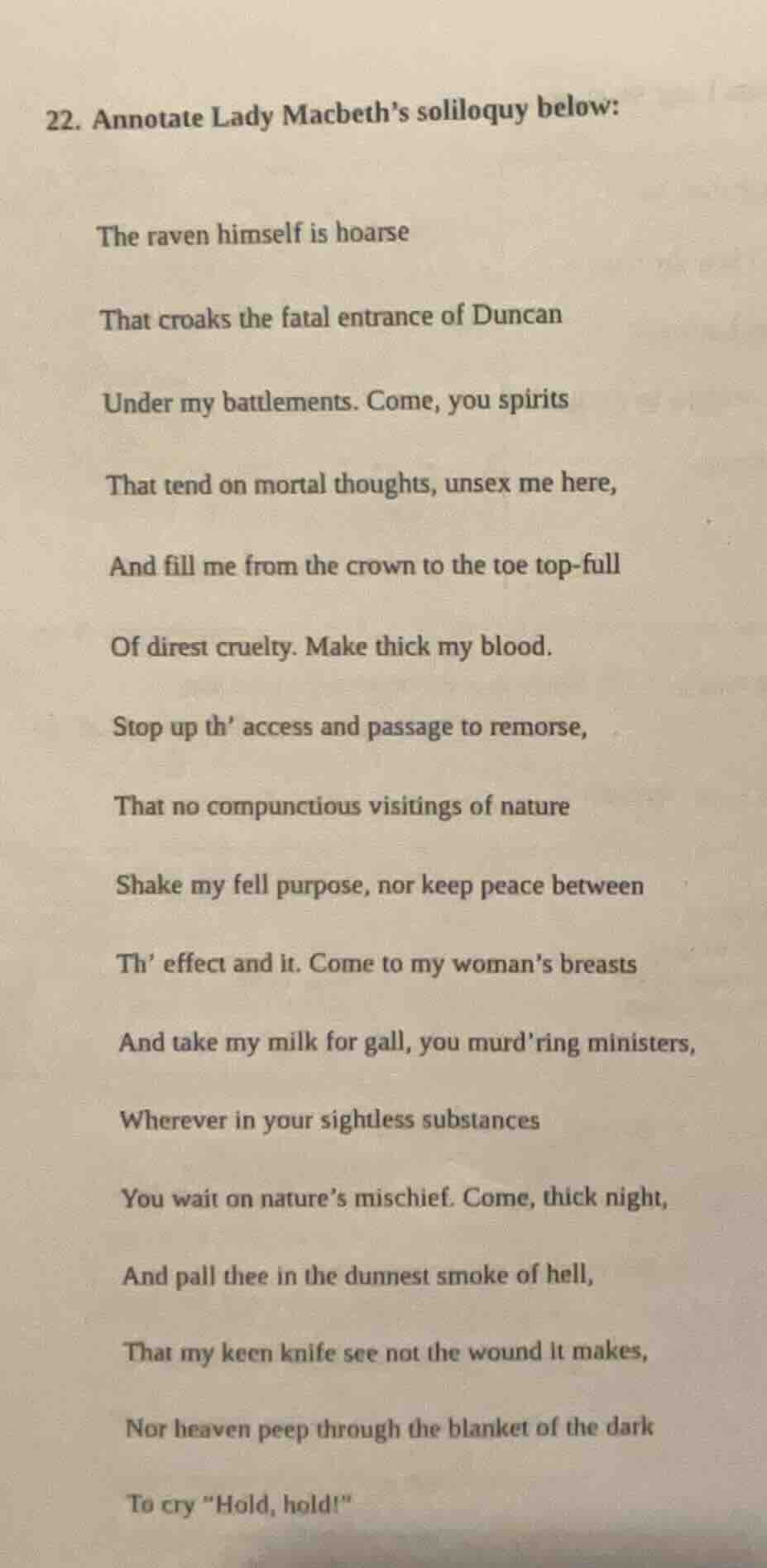
- annotate lady macbeth’s soliloquy below:
the raven himself is hoarse
that croaks the fatal entrance of duncan
under my battlements. come, you spirits
that tend on mortal thoughts, unsex me here,
and fill me from the crown to the toe top - full
of direst cruelty. make thick my blood.
stop up th’ access and passage to remorse,
that no compunctious visitings of nature
shake my fell purpose, nor keep peace between
th’ effect and it. come to my woman’s breasts
and take my milk for gall, you murd’ring ministers,
wherever in your sightless substances
you wait on nature’s mischief. come, thick night,
and pall thee in the dunnest smoke of hell,
that my keen knife see not the wound it makes,
nor heaven peep through the blanket of the dark
to cry “hold, hold!”
To annotate Lady Macbeth's soliloquy, we analyze literary devices, themes, and character development:
- "The raven himself is hoarse / That croaks the fatal entrance of Duncan": Ravens symbolize death/evil; "fatal entrance" foreshadows Duncan’s murder.
- "Come, you spirits / That tend on mortal thoughts, unsex me here": Lady Macbeth rejects femininity (associated with mercy) to embrace cruelty, asking spirits to "unsex" her (strip her of womanly compassion).
- "And fill me from the crown to the toe top - full / Of direst cruelty. Make thick my blood": She desires to be filled with cruelty, with "thick blood" blocking remorse (remorse is linked to a "thin" or sensitive conscience).
- "Stop up th’ access and passage to remorse": She wants to eliminate any feelings of guilt.
- "Come to my woman’s breasts / And take my milk for gall": "Milk" (feminine, nurturing) is replaced with "gall" (bitterness, cruelty), emphasizing her rejection of maternal/womanly traits.
- "Come, thick night, / And pall thee in the dunnest smoke of hell": Night is a symbol of secrecy and evil; she wants darkness to hide her actions from heaven (morality) and herself.
- "That my keen knife see not the wound it makes, / Nor heaven peep through the blanket of the dark": She wishes for darkness to shield her from the reality of her crime and divine judgment.

Snap & solve any problem in the app
Get step-by-step solutions on Sovi AI
Photo-based solutions with guided steps
Explore more problems and detailed explanations
Line - by - Line Annotation:
- "The raven himself is hoarse / That croaks the fatal entrance of Duncan": Ravens are omens of death. "Fatal entrance" foreshadows Duncan’s murder at Macbeth’s castle.
- "Under my battlements": Refers to Macbeth’s castle, setting the scene of the planned murder.
- "Come, you spirits / That tend on mortal thoughts, unsex me here": Lady Macbeth calls on evil spirits to rid her of feminine traits (mercy, compassion) to commit murder.
- "And fill me from the crown to the toe top - full / Of direst cruelty. Make thick my blood": She wants to be completely cruel, with "thick blood" preventing remorse (remorse is linked to a sensitive, "thin" conscience).
- "Stop up th’ access and passage to remorse": She seeks to block any feelings of guilt.
- "That no compunctious visitings of nature / Shake my fell purpose": She doesn’t want natural human compassion (remorse) to weaken her resolve.
- "Come to my woman’s breasts / And take my milk for gall, you murd’ring ministers": "Milk" (nurturing, feminine) is replaced with "gall" (bitterness, cruelty), rejecting womanly/maternal traits.
- "Wherever in your sightless substances / You wait on nature’s mischief": Spirits wait to aid in evil deeds ("nature’s mischief").
- "Come, thick night, / And pall thee in the dunnest smoke of hell": She calls for dark, hellish night to hide her actions from heaven (morality) and herself.
- "That my keen knife see not the wound it makes, / Nor heaven peep through the blanket of the dark": She wants darkness to hide her crime from her own sight and from divine judgment.
- "To cry ‘Hold, hold!’": She fears heaven (morality) might intervene, so she wants darkness to silence that moral voice.
Thematic and Character Insights:
This soliloquy reveals Lady Macbeth’s ambition, her willingness to reject her identity as a woman to achieve power, and her embrace of evil. It also explores themes of gender roles (femininity vs. cruelty), guilt/remorse (and the desire to avoid it), and the corrupting influence of ambition.