QUESTION IMAGE
Question
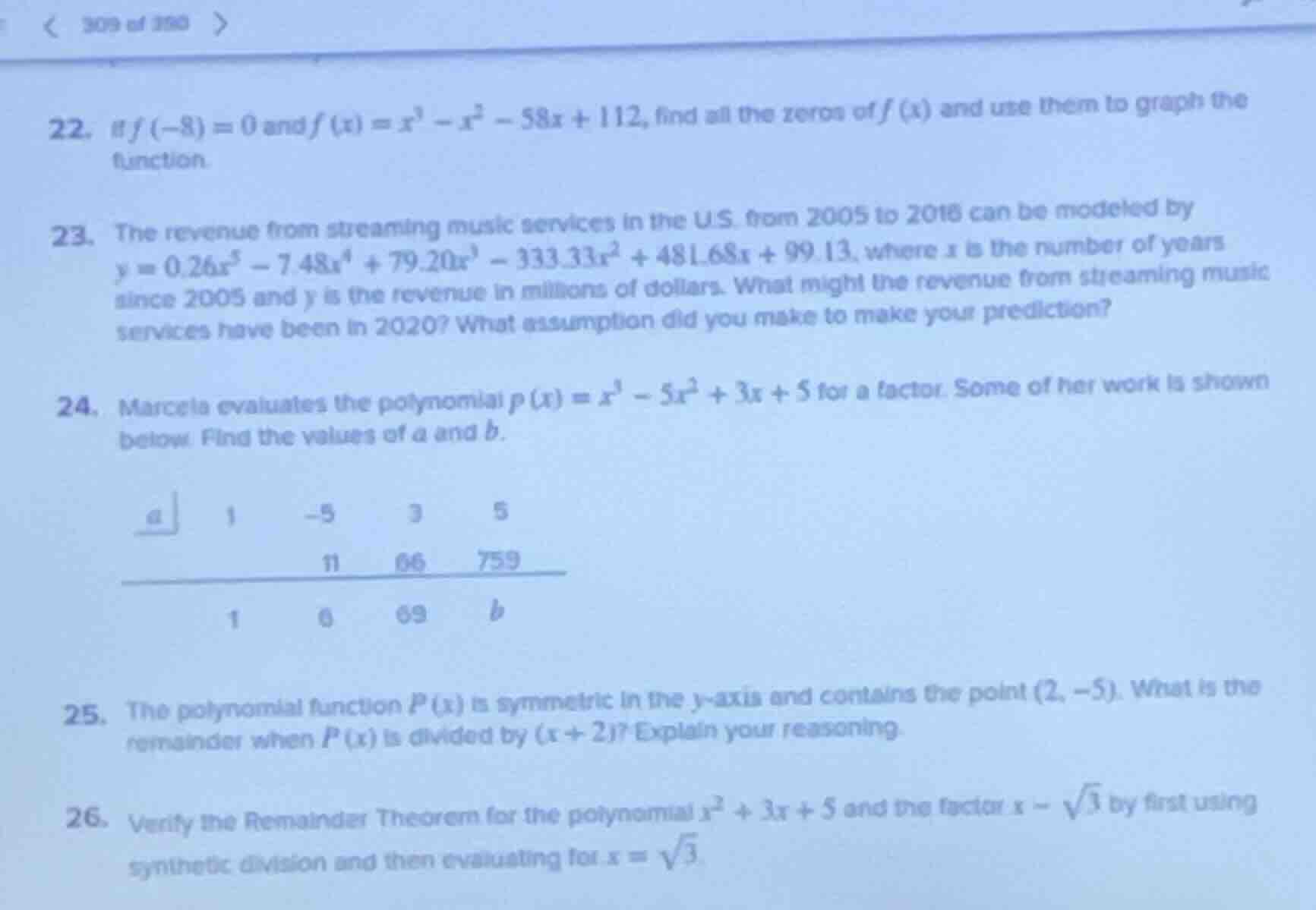
- if $f(-8) = 0$ and $f(x) = x^3 - x^2 - 58x + 112$, find all the zeros of $f(x)$ and use them to graph the function.
- the revenue from streaming music services in the u.s. from 2005 to 2016 can be modeled by $y = 0.26x^5 - 7.48x^4 + 79.20x^3 - 333.33x^2 + 481.68x + 99.13$, where $x$ is the number of years since 2005 and $y$ is the revenue in millions of dollars. what might the revenue from streaming music services have been in 2020? what assumption did you make to make your prediction?
- marcela evaluates the polynomial $p(x) = x^3 - 5x^2 + 3x + 5$ for a factor. some of her work is shown below. find the values of $a$ and $b$.
\
- the polynomial function $p(x)$ is symmetric in the $y$-axis and contains the point $(2, -5)$. what is the remainder when $p(x)$ is divided by $(x + 2)$? explain your reasoning.
- verify the remainder theorem for the polynomial $x^2 + 3x + 5$ and the factor $x - \sqrt{3}$ by first using synthetic division and then evaluating for $x = \sqrt{3}$.
Question 22
Step 1: Identify the factor
Since \( f(-8) = 0 \), by the Factor Theorem, \( (x + 8) \) is a factor of \( f(x)=x^{3}-x^{2}-58x + 112 \).
Step 2: Perform polynomial division or use synthetic division
We use synthetic division with root \( -8 \):
\[
\]
So, \( f(x)=(x + 8)(x^{2}-9x + 14) \).
Step 3: Factor the quadratic
Factor \( x^{2}-9x + 14 \): we need two numbers that multiply to \( 14 \) and add to \( -9 \). The numbers are \( -2 \) and \( -7 \). So, \( x^{2}-9x + 14=(x - 2)(x - 7) \).
Step 4: Find the zeros
Set \( f(x)=0 \): \( (x + 8)(x - 2)(x - 7)=0 \). The zeros are \( x=-8 \), \( x = 2 \), and \( x = 7 \).
Step 1: Determine the value of \( x \) for 2020
Since \( x \) is the number of years since 2005, for 2020, \( x=2020 - 2005=15 \).
Step 2: Substitute \( x = 15 \) into the model
Substitute \( x = 15 \) into \( y = 0.26x^{5}-7.48x^{4}+79.20x^{3}-333.33x^{2}+481.68x + 99.13 \):
\[
\]
Step 3: State the assumption
The assumption is that the revenue model (the given polynomial) continues to hold for the year 2020 (i.e., the trend in revenue from 2005 - 2016 continues to 2020).
Step 1: Analyze the synthetic division
In synthetic division, the first number in the second row is the product of \( a \) and the leading coefficient (which is \( 1 \)). The second number in the third row is \( -5 + a\times1 \). From the table, the second number in the third row is \( 6 \), so:
\( -5 + a=6 \)
Step 2: Solve for \( a \)
Solve \( -5 + a=6 \): \( a=6 + 5=11 \).
Step 3: Solve for \( b \)
The last number in the third row \( b \) is the sum of the last number in the first row and the last number in the second row. The last number in the first row is \( 5 \) and the last number in the second row is \( 759 \), so \( b = 5+759 = 764 \).

Snap & solve any problem in the app
Get step-by-step solutions on Sovi AI
Photo-based solutions with guided steps
Explore more problems and detailed explanations
The zeros of \( f(x) \) are \( \boldsymbol{-8} \), \( \boldsymbol{2} \), and \( \boldsymbol{7} \).