QUESTION IMAGE
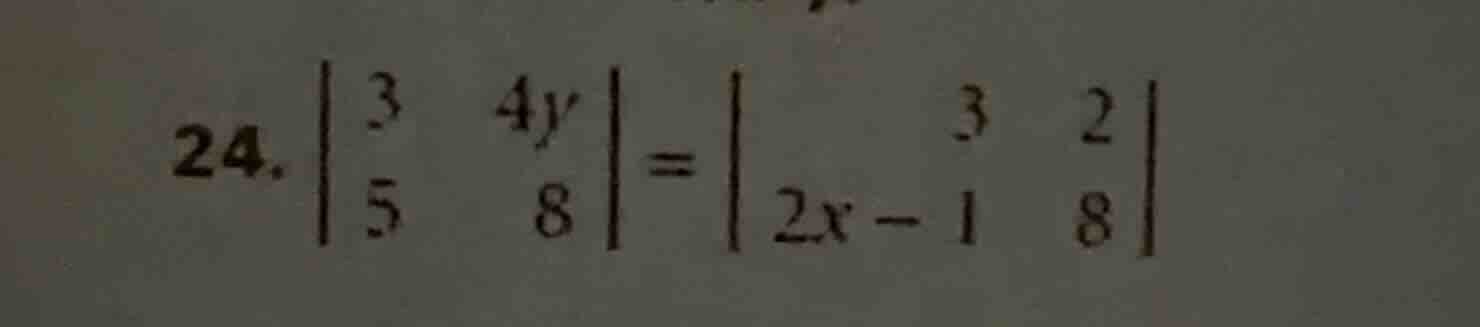
Question
- \
= \
Step1: Recall determinant formula
For a \(2\times2\) matrix \(
\), the determinant is \(ad - bc\). Apply this to both sides.
Left side: \(
=3\times8 - 5\times4y = 24 - 20y\)
Right side: \(
=3\times8 - 2\times(2x - 1)=24 - 4x + 2 = 26 - 4x\)
Step2: Set determinants equal
Since the determinants are equal, we have:
\(24 - 20y = 26 - 4x\) Wait, no, actually, let's re - check the right - hand side matrix. Wait, the original right - hand side matrix is \(
\)? Wait, no, the original problem is \(
=
\)? Wait, no, the user's problem: the left - hand side is \(
\), the right - hand side is \(
\)? Wait, no, looking back: the right - hand side matrix is \(
\)? Wait, no, the original problem is \(
=
\)? Wait, no, the user's input: \(
=
\)
Wait, actually, let's recalculate the determinants correctly.
Left determinant: For \(
=ad - bc\), so left side: \(3\times8-5\times4y = 24 - 20y\)
Right side: \(
=3\times8-2\times(2x - 1)=24-(4x - 2)=24 - 4x + 2=26 - 4x\)
Wait, but also, maybe we can equate the corresponding elements? Wait, no, for two \(2\times2\) matrices, if their determinants are equal, but also, maybe the matrices are equal? Wait, no, the problem is about determinants. Wait, but maybe the user made a typo, but assuming it's determinant equality.
Wait, but actually, if we consider that the two matrices have the same determinant, and also, maybe the matrices are equal? Wait, no, the left matrix is \(
\), the right matrix is \(
\). If we assume that the matrices are equal (since their determinants are equal and maybe the matrices are equal), then the corresponding elements must be equal.
So, for the first row, first column: \(3 = 3\) (which is true).
First row, second column: \(4y=2\), so \(y=\frac{2}{4}=\frac{1}{2}\)
Second row, first column: \(5 = 2x - 1\), so \(2x=5 + 1=6\), so \(x = 3\)
Second row, second column: \(8 = 8\) (which is true).
Ah, maybe the problem is about matrix equality (since the determinants are equal and the matrices are \(2\times2\)), so we can equate the corresponding elements.
Let's re - approach:
If \(
=
\) (since the determinants of two equal matrices are equal), then:
- For the \((1,2)\) element: \(4y = 2\)
- For the \((2,1)\) element: \(5=2x - 1\)
Step3: Solve for y
From \(4y = 2\), divide both sides by 4: \(y=\frac{2}{4}=\frac{1}{2}\)
Step4: Solve for x
From \(5 = 2x - 1\), add 1 to both sides: \(5 + 1=2x\), so \(6 = 2x\), divide both sides by 2: \(x = 3\)

Snap & solve any problem in the app
Get step-by-step solutions on Sovi AI
Photo-based solutions with guided steps
Explore more problems and detailed explanations
\(x = 3\), \(y=\frac{1}{2}\)