QUESTION IMAGE
Question
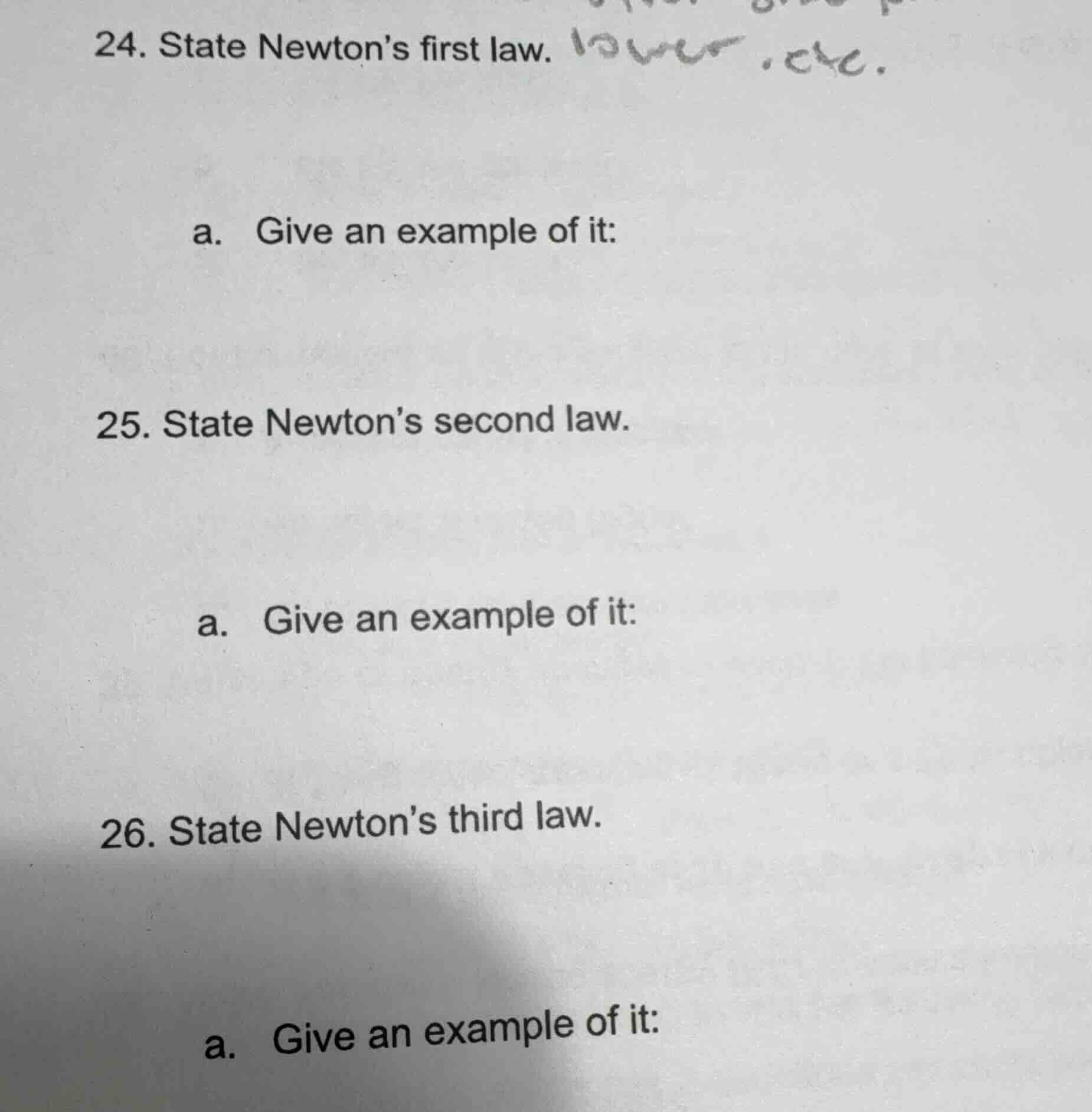
- state newton’s first law.
a. give an example of it:
- state newton’s second law.
a. give an example of it:
- state newton’s third law.
a. give an example of it:
Question 24
State Newton’s first law:
Newton's first law (Law of Inertia) states that an object at rest will remain at rest, and an object in motion will continue in motion with a constant velocity (same speed and direction) unless acted upon by a net external force.
a. Give an example of it:
- Example: A book lying on a table remains at rest until someone pushes it (applies an external force). Another example: A car moving at a constant speed on a frictionless road (in ideal conditions) would continue moving at that speed forever if no external forces like friction or air resistance acted on it. In real - life, if a driver suddenly stops the car, a passenger not wearing a seatbelt will tend to move forward because the passenger's body wants to continue moving with the same velocity the car had before braking (the seatbelt provides the external force to stop the passenger from moving forward).
Question 25
State Newton’s second law:
Newton's second law states that the acceleration of an object is directly proportional to the net force acting on it and inversely proportional to its mass. Mathematically, it is expressed as $F = ma$, where $F$ is the net force, $m$ is the mass of the object, and $a$ is the acceleration.
a. Give an example of it:
- Example: Pushing a small toy car (with less mass) is easier (requires less force) to achieve a certain acceleration compared to pushing a large, heavy car (with more mass) to achieve the same acceleration. If you apply a force of 10 N to a 2 - kg mass, using $a=\frac{F}{m}$, the acceleration $a=\frac{10}{2}=5\ m/s^{2}$. If you apply the same 10 N force to a 5 - kg mass, the acceleration $a = \frac{10}{5}=2\ m/s^{2}$, showing that more mass leads to less acceleration for the same force.
Question 26
State Newton’s third law:
Newton's third law states that for every action, there is an equal and opposite reaction. The action and reaction forces act on different objects.
a. Give an example of it:
- Example: When you jump off a boat onto the shore, as you push the boat backward (action force), the boat pushes you forward (reaction force) with an equal magnitude of force. Another example: A rocket moves forward because it expels hot gases backward (action force), and the hot gases exert an equal and opposite force on the rocket (reaction force) that propels it forward.

Snap & solve any problem in the app
Get step-by-step solutions on Sovi AI
Photo-based solutions with guided steps
Explore more problems and detailed explanations
Question 24
State Newton’s first law:
Newton's first law (Law of Inertia) states that an object at rest will remain at rest, and an object in motion will continue in motion with a constant velocity (same speed and direction) unless acted upon by a net external force.
a. Give an example of it:
- Example: A book lying on a table remains at rest until someone pushes it (applies an external force). Another example: A car moving at a constant speed on a frictionless road (in ideal conditions) would continue moving at that speed forever if no external forces like friction or air resistance acted on it. In real - life, if a driver suddenly stops the car, a passenger not wearing a seatbelt will tend to move forward because the passenger's body wants to continue moving with the same velocity the car had before braking (the seatbelt provides the external force to stop the passenger from moving forward).
Question 25
State Newton’s second law:
Newton's second law states that the acceleration of an object is directly proportional to the net force acting on it and inversely proportional to its mass. Mathematically, it is expressed as $F = ma$, where $F$ is the net force, $m$ is the mass of the object, and $a$ is the acceleration.
a. Give an example of it:
- Example: Pushing a small toy car (with less mass) is easier (requires less force) to achieve a certain acceleration compared to pushing a large, heavy car (with more mass) to achieve the same acceleration. If you apply a force of 10 N to a 2 - kg mass, using $a=\frac{F}{m}$, the acceleration $a=\frac{10}{2}=5\ m/s^{2}$. If you apply the same 10 N force to a 5 - kg mass, the acceleration $a = \frac{10}{5}=2\ m/s^{2}$, showing that more mass leads to less acceleration for the same force.
Question 26
State Newton’s third law:
Newton's third law states that for every action, there is an equal and opposite reaction. The action and reaction forces act on different objects.
a. Give an example of it:
- Example: When you jump off a boat onto the shore, as you push the boat backward (action force), the boat pushes you forward (reaction force) with an equal magnitude of force. Another example: A rocket moves forward because it expels hot gases backward (action force), and the hot gases exert an equal and opposite force on the rocket (reaction force) that propels it forward.