QUESTION IMAGE
Question
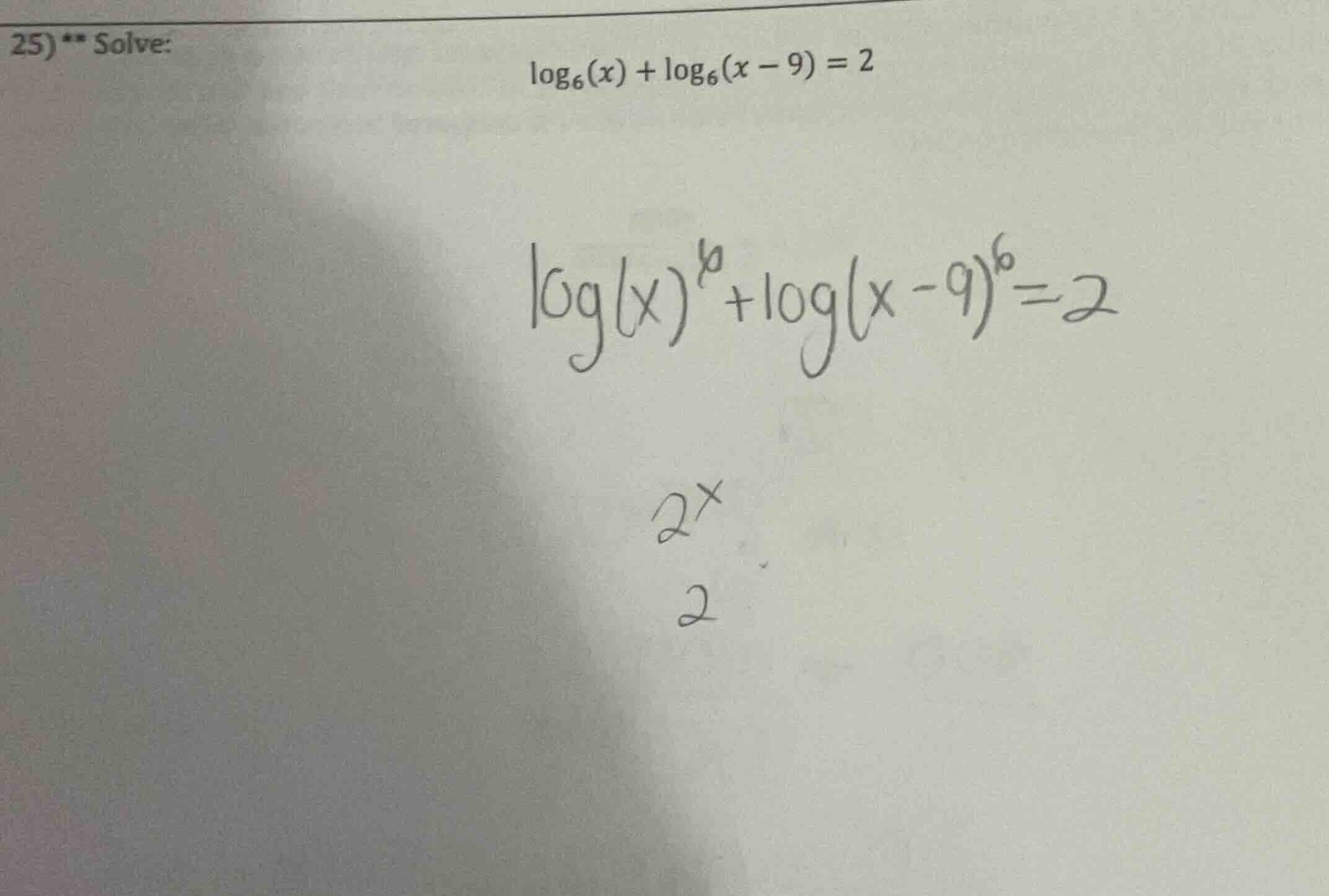
- ** solve: \\(\log_{6}(x) + \log_{6}(x - 9) = 2\\)
Step1: Apply log addition rule
Using the property \(\log_a(M) + \log_a(N)=\log_a(MN)\), we combine the left - hand side:
\(\log_6(x)+\log_6(x - 9)=\log_6[x(x - 9)]\)
So the equation becomes \(\log_6[x(x - 9)] = 2\)
Step2: Convert to exponential form
Recall that if \(\log_a(b)=c\), then \(b = a^c\). For \(a = 6\), \(b=x(x - 9)\) and \(c = 2\), we have:
\(x(x - 9)=6^2\)
\(x(x - 9)=36\)
Step3: Expand and form quadratic equation
Expand the left - hand side: \(x^{2}-9x=36\)
Rearrange to get a quadratic equation in standard form \(ax^{2}+bx + c = 0\):
\(x^{2}-9x - 36=0\)
Step4: Solve the quadratic equation
We can factor the quadratic equation. We need two numbers that multiply to \(- 36\) and add up to \(-9\). The numbers are \(-12\) and \(3\).
So, \(x^{2}-9x - 36=(x - 12)(x+3)=0\)
Setting each factor equal to zero gives \(x-12 = 0\) or \(x + 3=0\). So \(x = 12\) or \(x=-3\)
Step5: Check the domain of the logarithm
For \(\log_6(x)\) and \(\log_6(x - 9)\) to be defined, we need \(x>0\) and \(x-9>0\) (i.e., \(x>9\)).
- If \(x=-3\), then \(\log_6(-3)\) is undefined (since the argument of a logarithm must be positive).
- If \(x = 12\), then \(\log_6(12)\) and \(\log_6(12 - 9)=\log_6(3)\) are both defined.

Snap & solve any problem in the app
Get step-by-step solutions on Sovi AI
Photo-based solutions with guided steps
Explore more problems and detailed explanations
\(x = 12\)