QUESTION IMAGE
Question
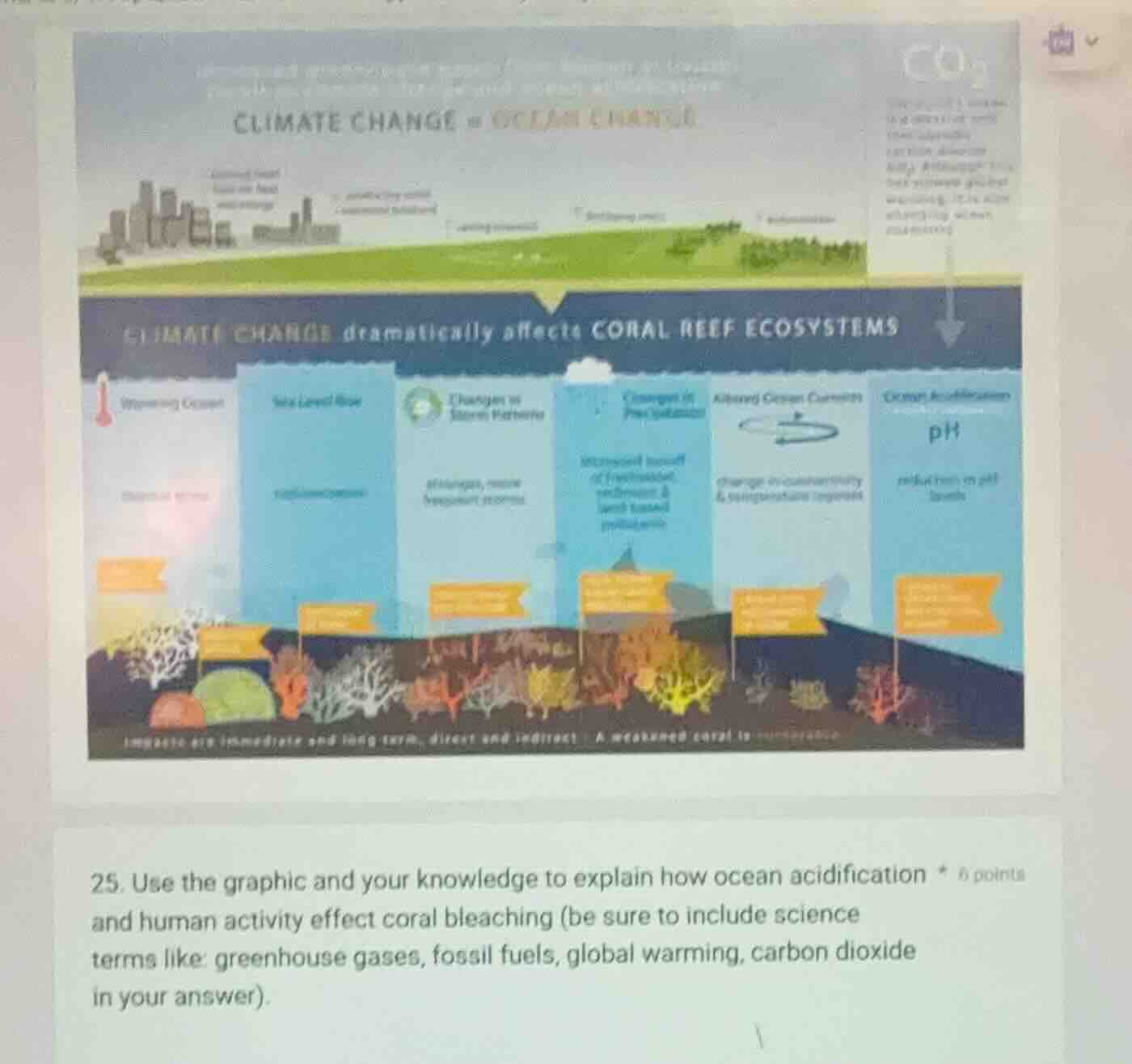
- use the graphic and your knowledge to explain how ocean acidification and human activity effect coral bleaching (be sure to include science terms like: greenhouse gases, fossil fuels, global warming, carbon dioxide in your answer).
- Human Activity & Greenhouse Gas Link: Human activities (like burning fossil fuels for energy, industrial processes, and transportation) release large amounts of greenhouse gases, most notably carbon dioxide ($CO_2$), into the atmosphere.
- Global Warming & Ocean Warming: These greenhouse gases trap heat in the atmosphere, causing global warming. The ocean absorbs over 90% of this excess atmospheric heat, leading to ocean warming, a key trigger for coral bleaching. When water temperatures rise above a coral's tolerance, the symbiotic algae (zooxanthellae) that live in coral tissue and provide it with food and color are expelled. Without these algae, the coral loses its color (bleaches) and its main food source, making it vulnerable to starvation and disease.
- Ocean Acidification Mechanism: Around 30% of atmospheric $CO_2$ is absorbed by the ocean. When $CO_2$ dissolves in seawater, it reacts to form carbonic acid ($H_2CO_3$), which lowers ocean pH (ocean acidification). The chemical reaction is:
- Ocean Acidification & Coral Vulnerability: Ocean acidification reduces the concentration of carbonate ions ($CO_3^{2-}$) in seawater, which corals (and other marine calcifiers) need to build their calcium carbonate ($CaCO_3$) skeletons. This makes it harder for corals to grow and repair damage, weakening their structure. Combined with the stress from ocean warming, this significantly increases the likelihood and severity of coral bleaching events, and reduces the corals' ability to recover after bleaching.

Snap & solve any problem in the app
Get step-by-step solutions on Sovi AI
Photo-based solutions with guided steps
Explore more problems and detailed explanations
Human activities such as burning fossil fuels release greenhouse gases, including large amounts of carbon dioxide ($CO_2$), into the atmosphere. This drives global warming: the trapped heat warms the ocean, which triggers coral bleaching by causing corals to expel their symbiotic, food-providing zooxanthellae, leaving corals discolored and vulnerable. Additionally, the ocean absorbs roughly 30% of excess atmospheric $CO_2$, which reacts with seawater to lower ocean pH (ocean acidification). This process reduces the carbonate ions corals need to build and maintain their calcium carbonate skeletons, weakening corals further, increasing their susceptibility to bleaching, and impairing their ability to recover. Together, ocean warming from global warming and ocean acidification, both rooted in human-caused $CO_2$ emissions, severely damage coral reef ecosystems.