QUESTION IMAGE
Question
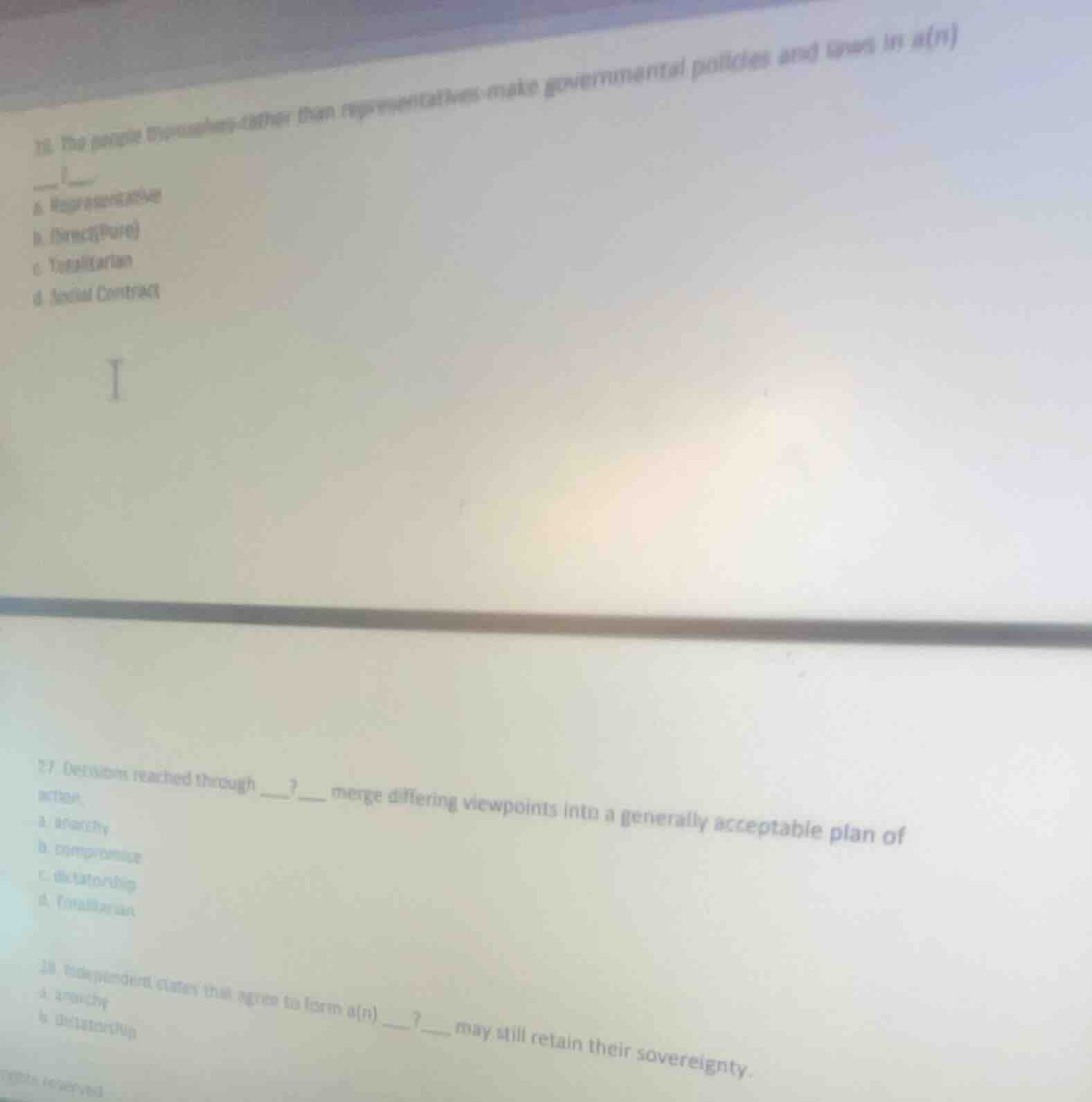
- the people (themselves rather than representatives) make governmental policies and laws in a(n) ?
a. representative
b. direct(pure)
c. totalitarian
d. social contract
- decisions reached through ? merge differing viewpoints into a generally acceptable plan of action.
a. identity
b. compromise
c. dictatorship
d. finalization
- independent states that agree to form a(n) ? may still retain their sovereignty.
a. monarchy
b. dictatorship
Response
Question 26
Brief Explanations
To solve this, we analyze each option:
- Option a (Representative): In a representative system, representatives make policies, not the people directly. Eliminate.
- Option b (Direct (Pure)): In a direct (pure) democracy, the people themselves (not representatives) make governmental policies and laws. This matches the description.
- Option c (Totalitarian): A totalitarian system is controlled by a single authority, not the people. Eliminate.
- Option d (Social Contract): Social contract is a theory about the origin of government, not a form where people directly make policies. Eliminate.
Brief Explanations
Analyze each option:
- Option a (Identity): Identity doesn't involve merging differing viewpoints. Eliminate.
- Option b (Compromise): Compromise is the process of reaching an agreement by merging differing viewpoints into a generally acceptable plan. This fits.
- Option c (Dictatorship): Dictatorship involves one person or group imposing decisions, not merging viewpoints. Eliminate.
- Option d (Finalization): Finalization is just completing a decision, not merging viewpoints. Eliminate.

Snap & solve any problem in the app
Get step-by-step solutions on Sovi AI
Photo-based solutions with guided steps
Explore more problems and detailed explanations
b. Direct(Pure)