QUESTION IMAGE
Question
28
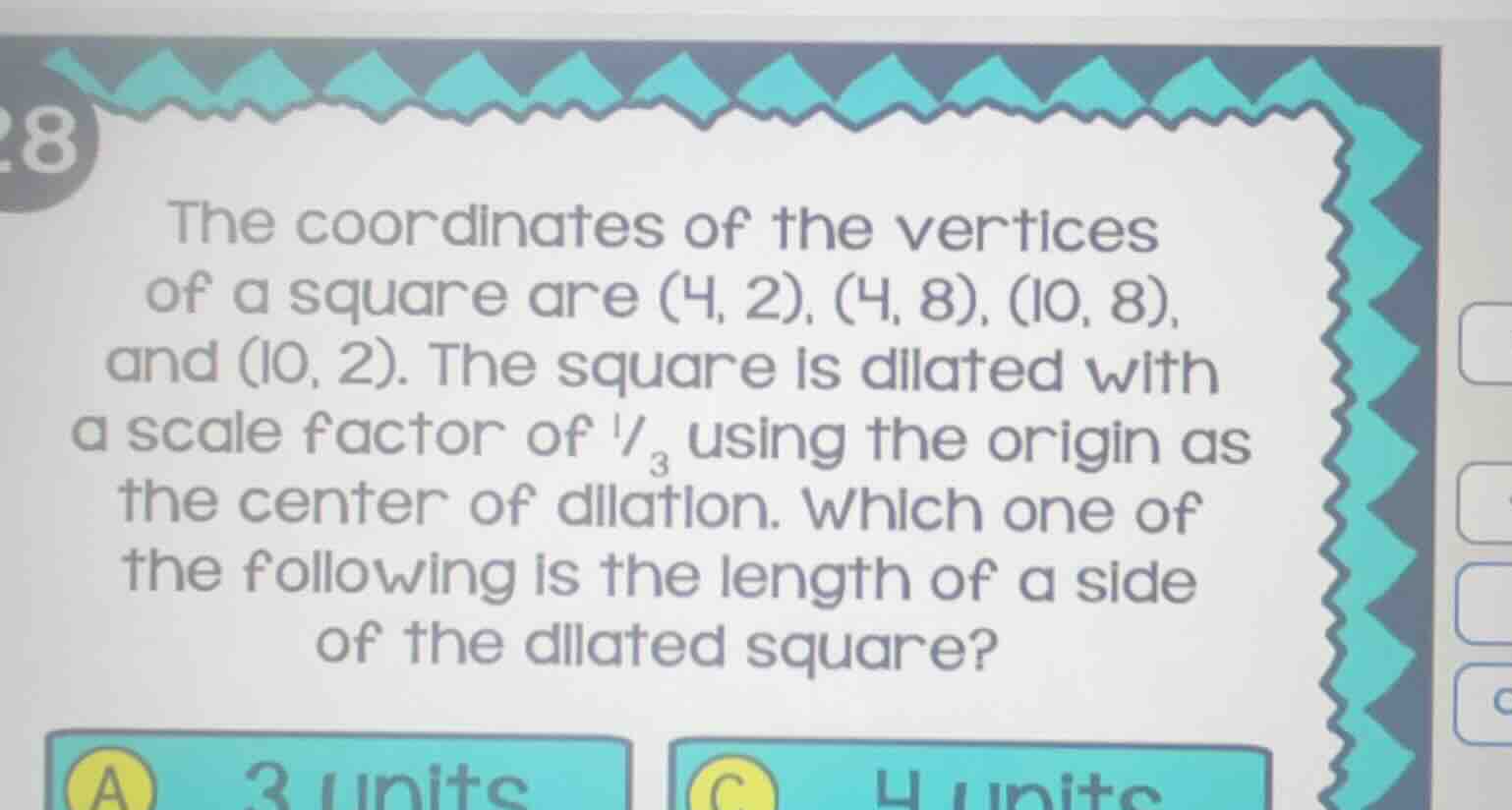
the coordinates of the vertices
of a square are (4, 2), (4, 8), (10, 8),
and (10, 2). the square is dilated with
a scale factor of $\frac{1}{3}$ using the origin as
the center of dilation. which one of
the following is the length of a side
of the dilated square?
a 3 units
c 4 units
Step1: Find original square side length
Take two vertical vertices $(4,2)$ and $(4,8)$. Calculate distance: $8 - 2 = 6$ units.
Step2: Apply dilation scale factor
Multiply original side length by $\frac{1}{3}$: $6 \times \frac{1}{3} = 2$
Wait, correction: Alternatively, use horizontal vertices $(4,2)$ and $(10,2)$: $10-4=6$, same original side length. Dilation gives $6\times\frac{1}{3}=2$.
(Note: The visible options A and C do not show the correct answer, but the calculation is as follows)

Snap & solve any problem in the app
Get step-by-step solutions on Sovi AI
Photo-based solutions with guided steps
Explore more problems and detailed explanations
2 units
(Note: Based on the calculation, the correct side length of the dilated square is 2 units, which is not among the partially visible options provided.)