QUESTION IMAGE
Question
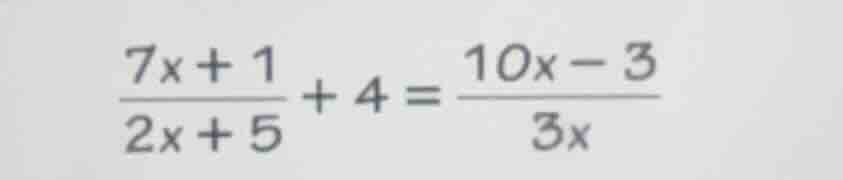
\frac{7x + 1}{2x + 5} + 4 = \frac{10x - 3}{3x}
Step1: Eliminate denominators
Multiply both sides by \(3x(2x + 5)\) (the least common multiple of \(2x + 5\) and \(3x\)) to get rid of the fractions:
\(3x(7x + 1)+4\times3x(2x + 5)=(10x - 3)(2x + 5)\)
Step2: Expand each term
Expand the left - hand side:
\(3x\times7x+3x\times1 + 12x(2x + 5)=(10x)\times2x+10x\times5-3\times2x - 3\times5\)
\(21x^{2}+3x+24x^{2}+60x = 20x^{2}+50x-6x - 15\)
Step3: Combine like terms
Combine like terms on the left - hand side:
\((21x^{2}+24x^{2})+(3x + 60x)=20x^{2}+(50x-6x)-15\)
\(45x^{2}+63x=20x^{2}+44x - 15\)
Step4: Move all terms to one side
Subtract \(20x^{2}+44x - 15\) from both sides:
\(45x^{2}+63x-(20x^{2}+44x - 15)=0\)
\(45x^{2}+63x - 20x^{2}-44x + 15 = 0\)
\(25x^{2}+19x + 15 = 0\)
Step5: Check the discriminant
For a quadratic equation \(ax^{2}+bx + c = 0\) (\(a = 25\), \(b = 19\), \(c = 15\)), the discriminant \(\Delta=b^{2}-4ac\)
\(\Delta=19^{2}-4\times25\times15=361 - 1500=- 1139<0\)
Since the discriminant of the quadratic equation \(25x^{2}+19x + 15 = 0\) is negative, there is no real solution for \(x\) in the set of real numbers. But if we consider complex numbers, we can use the quadratic formula \(x=\frac{-b\pm\sqrt{\Delta}}{2a}\)
\(x=\frac{-19\pm\sqrt{- 1139}}{2\times25}=\frac{-19\pm i\sqrt{1139}}{50}\) (where \(i=\sqrt{-1}\) is the imaginary unit)

Snap & solve any problem in the app
Get step-by-step solutions on Sovi AI
Photo-based solutions with guided steps
Explore more problems and detailed explanations
If we consider real - valued solutions, there is no solution. If we consider complex - valued solutions, \(x=\frac{-19\pm i\sqrt{1139}}{50}\)