QUESTION IMAGE
Question
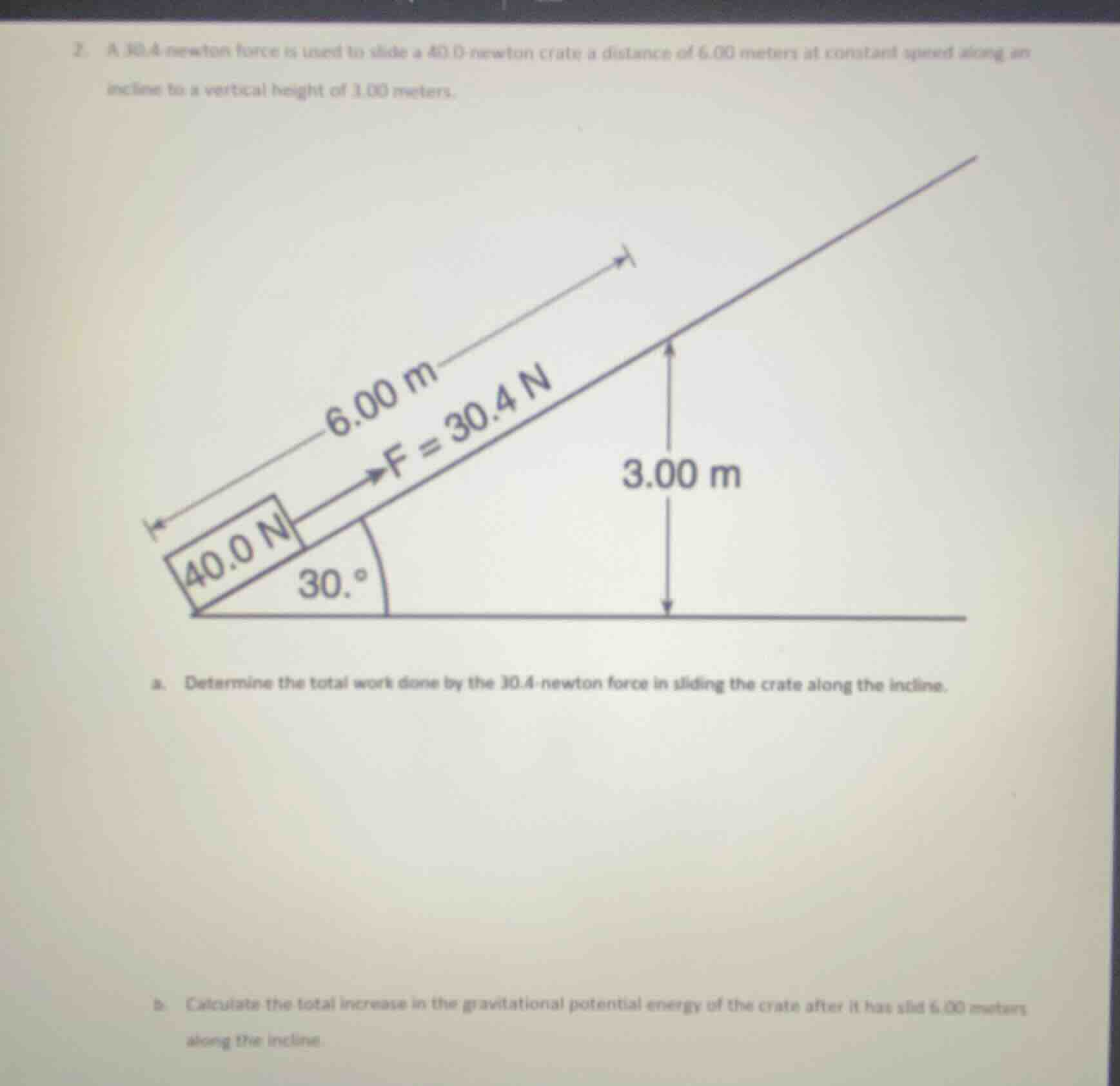
- a 30.4 newton force is used to slide a 40.0 newton crate a distance of 6.00 meters at constant speed along an incline to a vertical height of 3.00 meters.
a. determine the total work done by the 30.4 - newton force in sliding the crate along the incline.
b. calculate the total increase in the gravitational potential energy of the crate after it has slid 6.00 meters along the incline.
Part a
Step1: Recall work formula
The formula for work done by a force is \( W = F \cdot d \cdot \cos\theta \), where \( F \) is the force, \( d \) is the displacement, and \( \theta \) is the angle between the force and displacement. Here, the force is parallel to the incline, so \( \theta = 0^\circ \) and \( \cos(0^\circ)=1 \).
Step2: Substitute values
Given \( F = 30.4\,\text{N} \), \( d = 6.00\,\text{m} \), and \( \cos(0^\circ) = 1 \). So \( W = 30.4\,\text{N} \times 6.00\,\text{m} \times 1 \).
Step3: Calculate work
\( W = 30.4\times6.00 = 182.4\,\text{J} \) (rounded appropriately, maybe to three significant figures as given in the problem).
Step1: Recall gravitational potential energy formula
The formula for gravitational potential energy change is \( \Delta U = mgh \), but since weight \( W = mg \), we can also write \( \Delta U = W \cdot h \), where \( W \) is the weight of the crate and \( h \) is the vertical height gained.
Step2: Substitute values
Given \( W = 40.0\,\text{N} \), \( h = 3.00\,\text{m} \). So \( \Delta U = 40.0\,\text{N} \times 3.00\,\text{m} \).
Step3: Calculate potential energy change
\( \Delta U = 40.0\times3.00 = 120.0\,\text{J} \)

Snap & solve any problem in the app
Get step-by-step solutions on Sovi AI
Photo-based solutions with guided steps
Explore more problems and detailed explanations
The total work done is \( \boldsymbol{182\,\text{J}} \) (or \( 182.4\,\text{J} \))