QUESTION IMAGE
Question
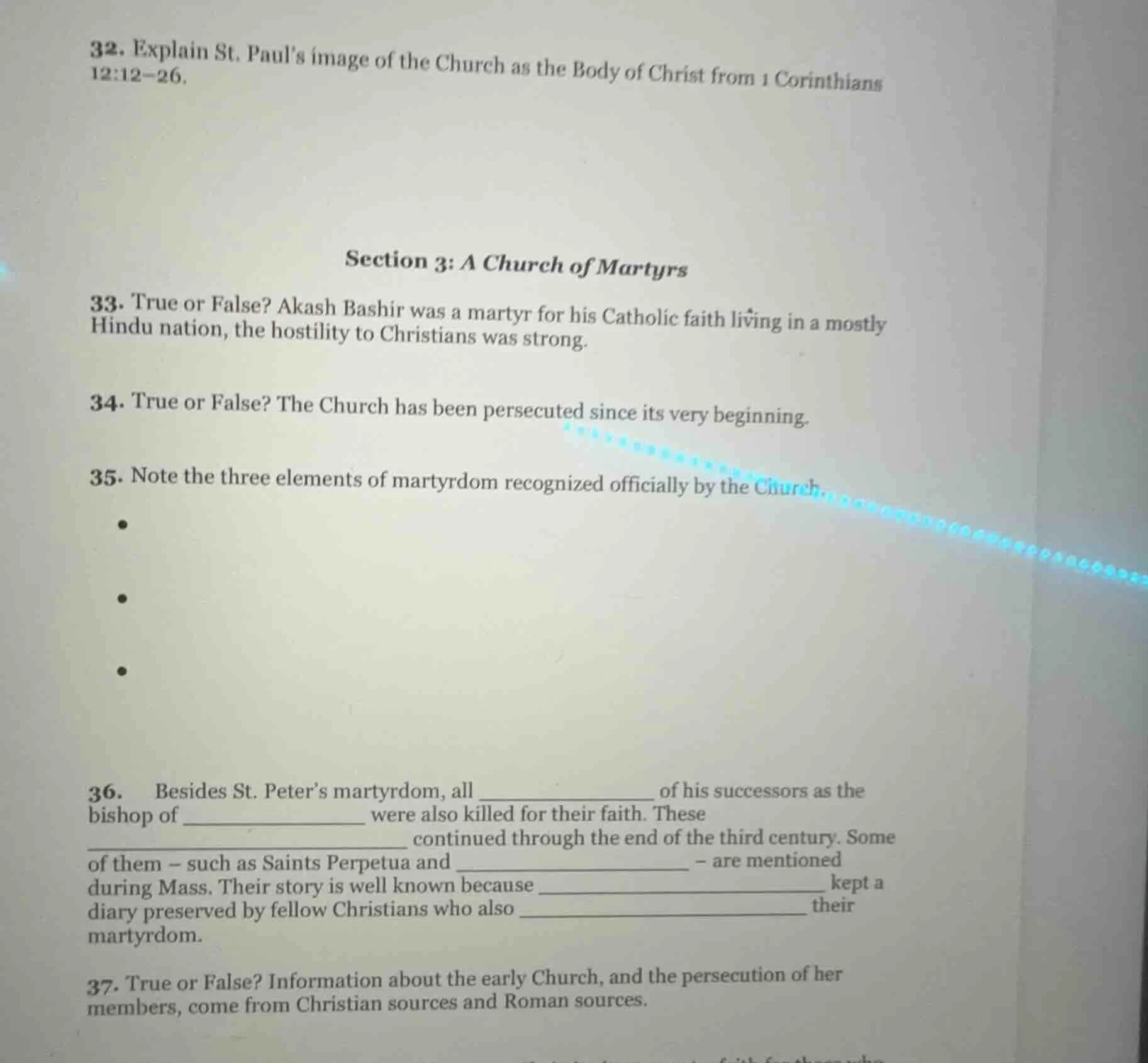
- explain st. paul’s image of the church as the body of christ from 1 corinthians 12:12–26.
section 3: a church of martyrs
- true or false? akash bashir was a martyr for his catholic faith living in a mostly hindu nation, the hostility to christians was strong.
- true or false? the church has been persecuted since its very beginning.
- note the three elements of martyrdom recognized officially by the church.
- besides st. peter’s martyrdom, all ________ of his successors as the bishop of ______ were also killed for their faith. these ______ continued through the end of the third century. some of them – such as saints perpetua and ______ – are mentioned during mass. their story is well known because ______ kept a diary preserved by fellow christians who also ________ their martyrdom.
- true or false? information about the early church, and the persecution of her members, come from christian sources and roman sources.
Q32:
St. Paul uses the Body of Christ metaphor to frame the Church as a unified, interdependent community. Each member (believer) has a unique spiritual gift, and all are connected to Christ, the head. No single part is independent; the health of the whole depends on every member fulfilling their role, and the community shares in each other's joys and sufferings.
Q33:
Akash Bashir was a Pakistani (majority Muslim, not Hindu) Catholic killed for his faith, so the statement is false.
Q34:
From its origins in 1st-century Judea and the Roman Empire, the early Christian Church faced persecution (e.g., under Nero, Roman authorities), so the statement is true.
Q35:
The three official elements are: 1) Witness to the Christian faith, 2) Unwillingness to renounce that faith, 3) Death resulting from this refusal.
Q36:
The blanks correspond to key facts about early papal martyrs and the story of Perpetua and Felicity: early popes (bishops of Rome) were martyred until the 3rd century, Perpetua's companion was Felicity, and Perpetua kept the diary that survived with fellow martyrs.
Q37:
Early Church history and persecution are documented in both Christian sources (e.g., martyr accounts, Church fathers) and Roman sources (e.g., official records, writings of Tacitus), so the statement is true.

Snap & solve any problem in the app
Get step-by-step solutions on Sovi AI
Photo-based solutions with guided steps
Explore more problems and detailed explanations
- St. Paul's image of the Church as the Body of Christ (1 Corinthians 12:12-26) teaches that the Church is a single, unified community rooted in Christ as its head. Every believer is a distinct "member" with a unique spiritual gift, and all members are interdependent—no part is irrelevant, and the whole community shares in each other's experiences. This unity means the Church functions as one body, with Christ directing and sustaining it.
- False
- True
- - Witness to the Christian faith
- Refusal to renounce the Christian faith
- Death resulting from this refusal of apostasy
- Besides St. Peter's martyrdom, all the first eleven of his successors as the bishop of Rome were also killed for their faith. These persecutions of the popes continued through the end of the third century. Some of them – such as Saints Perpetua and Felicity – are mentioned during Mass. Their story is well known because Perpetua kept a diary preserved by fellow Christians who also shared in their martyrdom.
- True