QUESTION IMAGE
Question
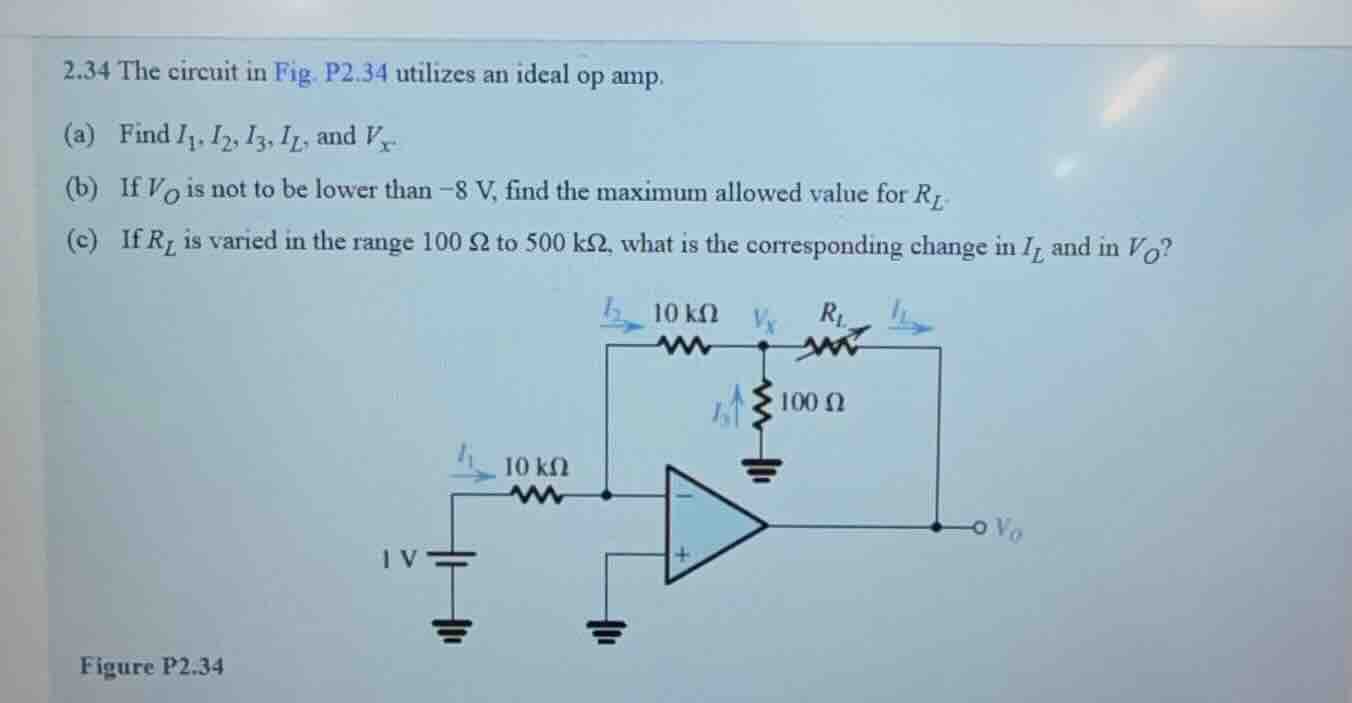
2.34 the circuit in fig. p2.34 utilizes an ideal op amp.
(a) find ( i_1, i_2, i_3, i_l, ) and ( v_x ).
(b) if ( v_o ) is not to be lower than ( -8 , \text{v} ), find the maximum allowed value for ( r_l ).
(c) if ( r_l ) is varied in the range ( 100 , omega ) to ( 500 , \text{k}omega ), what is the corresponding change in ( i_l ) and in ( v_o )?
Step1: Apply virtual ground to op-amp
For an ideal op-amp, the voltage at the inverting terminal is equal to the voltage at the non-inverting terminal (ground, 0 V). Calculate $I_1$ using Ohm's law:
$I_1 = \frac{1\ \text{V} - 0\ \text{V}}{10\ \text{k}\Omega} = 0.1\ \text{mA}$
Step2: Apply ideal op-amp current rule
In an ideal op-amp, no current flows into the input terminals, so $I_1 = I_2$.
$I_2 = I_1 = 0.1\ \text{mA}$
Step3: Calculate $V_x$ using Ohm's law
$V_x$ is the voltage across the 100 Ω resistor. First, note $I_2$ flows through the 10 kΩ resistor to $V_x$:
$V_x = 0\ \text{V} - I_2 \times 10\ \text{k}\Omega = -0.1\ \text{mA} \times 10\ \text{k}\Omega = -1\ \text{V}$
Then calculate $I_3$:
$I_3 = \frac{V_x - 0\ \text{V}}{100\ \Omega} = \frac{-1\ \text{V}}{100\ \Omega} = -10\ \text{mA}$
(The negative sign indicates current flows opposite to the drawn direction)
Step4: Apply KCL at $V_x$ node
$I_2 = I_3 + I_L$, so solve for $I_L$:
$I_L = I_2 - I_3 = 0.1\ \text{mA} - (-10\ \text{mA}) = 10.1\ \text{mA}$
---
Step5: Solve for max $R_L$ (part b)
Relate $V_O$ to $V_x$: $V_O = V_x - I_L R_L$. Substitute known values and set $V_O = -8\ \text{V}$:
$-8\ \text{V} = -1\ \text{V} - 10.1\ \text{mA} \times R_L$
Rearrange to solve for $R_L$:
$R_L = \frac{-1\ \text{V} - (-8\ \text{V})}{10.1\ \text{mA}} = \frac{7\ \text{V}}{10.1 \times 10^{-3}\ \text{A}} \approx 693.07\ \Omega$
---
Step6: Analyze $I_L$ and $V_O$ range (part c)
$I_L$ is determined by $I_2$ and $I_3$, which are independent of $R_L$, so $I_L$ remains constant:
$\Delta I_L = 10.1\ \text{mA} - 10.1\ \text{mA} = 0$
Calculate $V_O$ at $R_L=100\ \Omega$:
$V_{O1} = -1\ \text{V} - 10.1\ \text{mA} \times 100\ \Omega = -1\ \text{V} - 1.01\ \text{V} = -2.01\ \text{V}$
Calculate $V_O$ at $R_L=500\ \text{k}\Omega$:
$V_{O2} = -1\ \text{V} - 10.1\ \text{mA} \times 500\ \text{k}\Omega = -1\ \text{V} - 5050\ \text{V} = -5051\ \text{V}$
Find the change in $V_O$:
$\Delta V_O = V_{O2} - V_{O1} = -5051\ \text{V} - (-2.01\ \text{V}) = -5048.99\ \text{V}$

Snap & solve any problem in the app
Get step-by-step solutions on Sovi AI
Photo-based solutions with guided steps
Explore more problems and detailed explanations
Part (a)
$I_1 = 0.1\ \text{mA}$, $I_2 = 0.1\ \text{mA}$, $I_3 = -10\ \text{mA}$, $I_L = 10.1\ \text{mA}$, $V_x = -1\ \text{V}$
Part (b)
Maximum $R_L \approx 693\ \Omega$
Part (c)
Change in $I_L = 0\ \text{mA}$, change in $V_O = -5048.99\ \text{V}$ (from $-2.01\ \text{V}$ to $-5051\ \text{V}$)