QUESTION IMAGE
Question
- an elevator is supported by a cable and moving upward through the elevator shaft at an increasing speed. how does the upward tension force compare to the downward force of gravity?
a. the upward tension force is stronger than the downward force of gravity.
b. the downward force of gravity is stronger than the upward tension force.
c. the tension force and the force of gravity are equal in strength.
d. the tension force and the force of gravity are mutual forces.
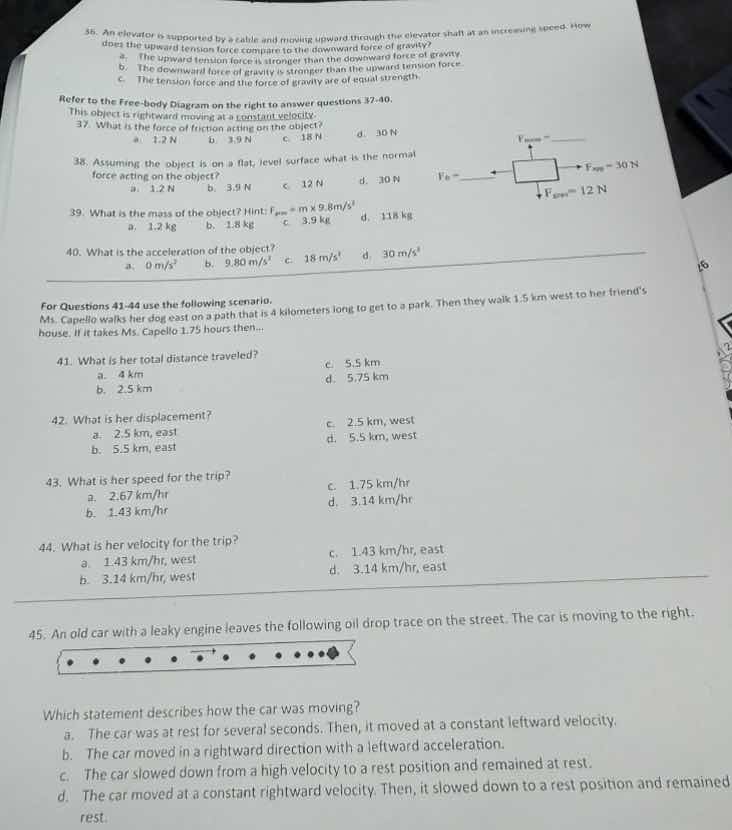
refer to the free - body diagram on the right to answer questions 37 - 40.
this object is rightward moving at a constant velocity.
- what is the force of friction acting on the object?
a. 12 n
b. 3.9 n
c. 18 n
d. 30 n
- assuming the object is on a flat, level surface what is the normal force acting on the object?
a. 12 n
b. 3.9 n
c. 18 n
d. 30 n
- what is the mass of the object? (hint: ( f_{weight}=m\times9.80m/s^{2} ))
a. 1.2 kg
b. 1.8 kg
c. 3.9 kg
d. 118 kg
- what is the acceleration of the object?
a. ( 0m/s^{2} )
b. ( 9.80m/s^{2} )
c. ( 18m/s^{2} )
d. ( 30m/s^{2} )
for questions 41 - 44 use the following scenario.
ms. capello walks her dog east on a path that is 4 kilometers long to get to a park. then they walk 1.5 km west to her friends house. if it takes ms. capello 3.75 hours then...
- what is her total distance traveled?
a. 4 km
b. 2.5 km
c. 5.5 km
d. 5.75 km
- what is her displacement?
a. 2.5 km, east
b. 5.5 km, east
c. 2.5 km, west
d. 5.5 km, west
- what is her speed for the trip?
a. 2.67 km/hr
b. 1.43 km/hr
c. 1.75 km/hr
d. 3.14 km/hr
- what is her velocity for the trip?
a. 1.43 km/hr, west
b. 3.14 km/hr, west
c. 1.43 km/hr, east
d. 3.14 km/hr, east
- an old car with a leaky engine leaves the following oil drop trace on the street. the car is moving to the right.
oil drop trace image
which statement describes how the car was moving?
a. the car was at rest for several seconds. then, it moved at a constant leftward velocity.
b. the car moved in a rightward direction with a leftward acceleration.
c. the car slowed down from a high velocity to a rest position and remained at rest.
d. the car moved at a constant rightward velocity. then, it slowed down to a rest position and remained at rest.
Questions 36-40
Step1: Analyze elevator force balance
The elevator accelerates upward, so net force is upward. By Newton's second law: $F_{tension} - F_{gravity} = ma$. Thus, $F_{tension} > F_{gravity}$.
Step2: Identify friction for constant velocity
For constant velocity, friction equals applied force: $F_{friction}=F_{app}=30\ \text{N}$? No, correction: Wait, normal force cancels gravity. Wait, question 37: object moves at constant velocity, friction balances applied force $F_{app}=30\ \text{N}$? No, no—wait, free-body diagram: $F_{app}=30\ \text{N}$ right, $F_{friction}$ left, $F_N$ up, $F_g=12\ \text{N}$ down. For constant velocity, friction equals applied force? No, no: $F_{friction}=\mu F_N$, but for constant velocity, horizontal forces balance: $F_{friction}=30\ \text{N}$? No, wait no—wait question 37 says "force of friction acting on the object": since it moves at constant velocity, friction equals applied horizontal force, so $30\ \text{N}$? No, wait $F_g=12\ \text{N}$, so $F_N=F_g=12\ \text{N}$ (vertical balance). Then friction: wait no, question 37: if moving at constant velocity, horizontal forces balance, so $F_{friction}=F_{app}=30\ \text{N}$? Wait no, the free-body diagram: $F_{app}=30\ \text{N}$ right, $F_f$ left, $F_N$ up, $F_g=12\ \text{N}$ down. So step 2: vertical balance, $F_N=F_g=12\ \text{N}$ (for question 38). Step3: mass from $F_g=mg$, so $m=\frac{F_g}{g}=\frac{12}{9.8}\approx1.2\ \text{kg}$ (question39). Step4: constant velocity means acceleration $0\ \text{m/s}^2$ (question40).
Step3: Calculate normal force (Q38)
Vertical forces balance, so $F_N=F_g=12\ \text{N}$.
Step4: Calculate mass (Q39)
Use $m=\frac{F_g}{g}$.
$m=\frac{12\ \text{N}}{9.8\ \text{m/s}^2}\approx1.2\ \text{kg}$
Step5: Acceleration for constant velocity (Q40)
Constant velocity means $a=0\ \text{m/s}^2$
Step1: Total distance traveled (Q41)
Add all path lengths: $4\ \text{km} + 1.5\ \text{km}=5.5\ \text{km}$
Step2: Calculate displacement (Q42)
Displacement is net distance: East is positive, west is negative. $4\ \text{km} -1.5\ \text{km}=2.5\ \text{km}$, east.
Step3: Calculate speed (Q43)
Speed = total distance / time: $\frac{5.5\ \text{km}}{1.75\ \text{hr}}\approx3.14\ \text{km/hr}$
Step4: Calculate velocity (Q44)
Velocity = displacement / time: $\frac{2.5\ \text{km}}{1.75\ \text{hr}}\approx1.43\ \text{km/hr}$, east.
Oil drops get closer when the car slows down (less distance covered per unit time), and no new drops mean it stops. First, drops are evenly spaced (constant rightward velocity), then drops get closer (slowing down), then no drops (stationary).

Snap & solve any problem in the app
Get step-by-step solutions on Sovi AI
Photo-based solutions with guided steps
Explore more problems and detailed explanations
- a. The upward tension force is stronger than the downward force of gravity
- d. 30 N
- c. 12 N
- a. 1.2 kg
- a. 0 m/s²
---