QUESTION IMAGE
Question
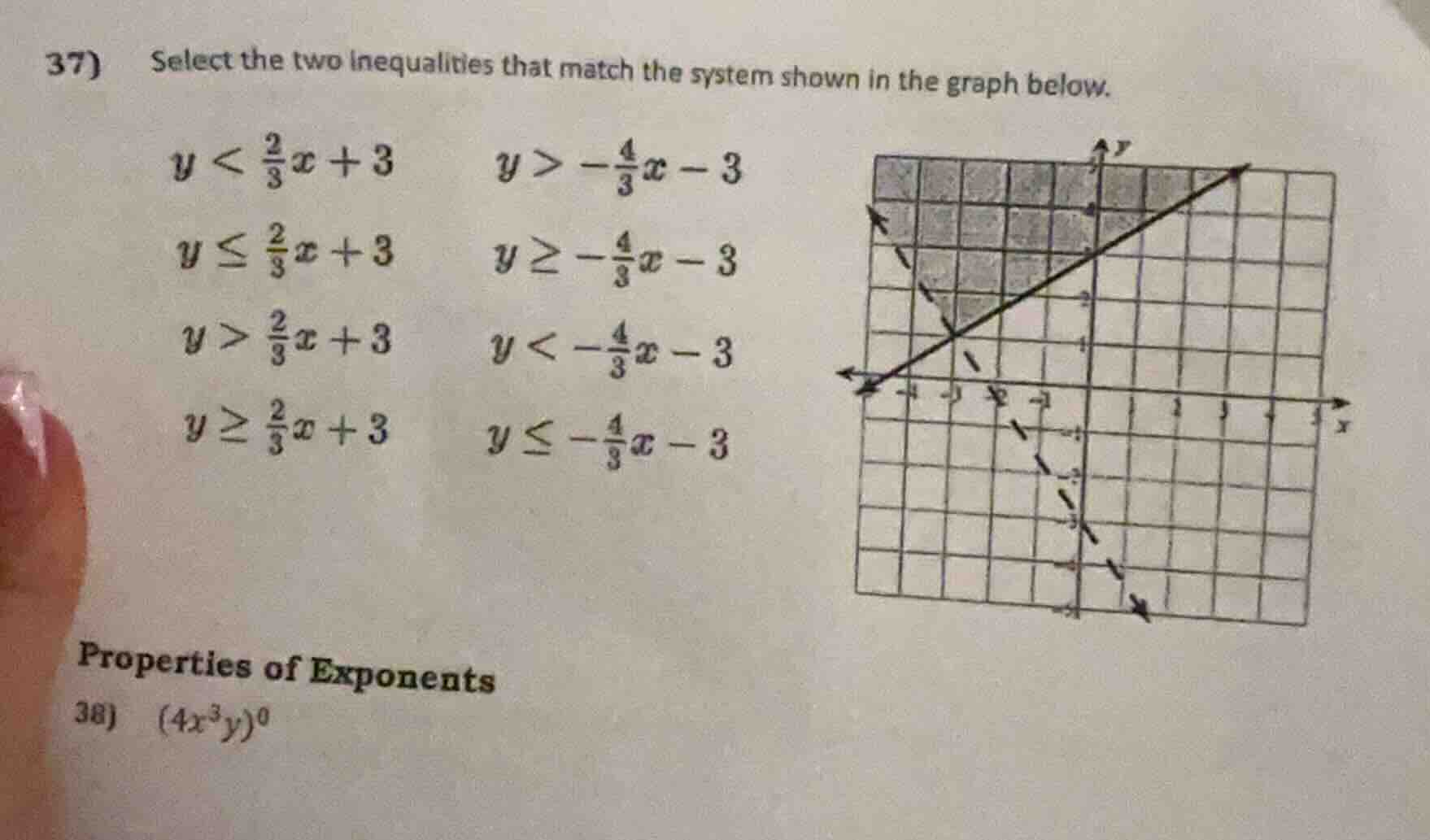
- select the two inequalities that match the system shown in the graph below.
$y < \frac{2}{3}x + 3$ $y > -\frac{4}{3}x - 3$
$y \leq \frac{2}{3}x + 3$ $y \geq -\frac{4}{3}x - 3$
$y > \frac{2}{3}x + 3$ $y < -\frac{4}{3}x - 3$
$y \geq \frac{2}{3}x + 3$ $y \leq -\frac{4}{3}x - 3$
(graph: a coordinate grid with a solid line and a dashed line, and a shaded region)
- $(4x^3y)^0$
Problem 37:
Step 1: Analyze the solid line (first inequality)
The solid line has the equation \( y = \frac{2}{3}x + 3 \). The shaded region is above this line, and since it's a solid line, the inequality should include equality, so \( y \geq \frac{2}{3}x + 3 \).
Step 2: Analyze the dashed line (second inequality)
The dashed line has the equation \( y = -\frac{4}{3}x - 3 \). The shaded region is above this dashed line, and since it's a dashed line, the inequality does not include equality, so \( y > -\frac{4}{3}x - 3 \)? Wait, no, wait. Wait, looking at the graph, the dashed line: let's check the direction. Wait, maybe I made a mistake. Wait, the solid line: when the line is solid, the inequality is \( \leq \) or \( \geq \). The shaded area for the solid line \( y = \frac{2}{3}x + 3 \): looking at the graph, the shaded region is above the solid line? Wait, no, the solid line goes through (0,3) and (3,5) maybe? Wait, the graph: the solid line is increasing, and the shaded region is above it? Wait, no, let's check the options. Wait, the first line: solid line, so inequality is \( y \geq \frac{2}{3}x + 3 \) or \( y \leq \). Wait, maybe I got the direction wrong. Wait, the standard form: for a line \( y = mx + b \), if the shaded region is above the line, it's \( y > mx + b \) (dashed) or \( y \geq mx + b \) (solid). If below, \( y < \) or \( y \leq \).
Looking at the solid line \( y = \frac{2}{3}x + 3 \): the shaded region is above it, and the line is solid, so \( y \geq \frac{2}{3}x + 3 \).
Now the dashed line: \( y = -\frac{4}{3}x - 3 \). The shaded region is above this dashed line, so since it's dashed, the inequality is \( y > -\frac{4}{3}x - 3 \)? Wait, no, wait the dashed line: let's check the graph. The dashed line goes through, say, (0, -3) and (3, -7)? Wait, no, the slope is -4/3, so from (0, -3), going down 4, right 3. So the dashed line is \( y = -\frac{4}{3}x - 3 \). The shaded region is above this dashed line, so the inequality is \( y > -\frac{4}{3}x - 3 \)? But wait, the options: the second inequality options are \( y > -\frac{4}{3}x - 3 \), \( y \geq \), \( y < \), \( y \leq \). Wait, no, looking at the graph again: the shaded region is between the two lines. Wait, maybe I messed up. Wait, the solid line: \( y = \frac{2}{3}x + 3 \), and the shaded region is above it? Or below? Wait, the solid line passes through (0, 3) and (3, 5) (since slope 2/3: 3 + 2/33 = 5). The dashed line passes through (0, -3) and (3, -7) (slope -4/3: -3 + (-4/3)3 = -7). The shaded region is above the solid line and above the dashed line? Wait, no, the shaded area is in the upper left. Wait, maybe the solid line is \( y = \frac{2}{3}x + 3 \), and the shaded region is above it (so \( y \geq \frac{2}{3}x + 3 \)) and the dashed line is \( y = -\frac{4}{3}x - 3 \), and the shaded region is above it (so \( y > -\frac{4}{3}x - 3 \))? But the options: the first column has \( y \geq \frac{2}{3}x + 3 \) as an option, and the second column has \( y > -\frac{4}{3}x - 3 \)? Wait, no, the options are:
First column:
- \( y < \frac{2}{3}x + 3 \)
- \( y \leq \frac{2}{3}x + 3 \)
- \( y > \frac{2}{3}x + 3 \)
- \( y \geq \frac{2}{3}x + 3 \)
Second column:
- \( y > -\frac{4}{3}x - 3 \)
- \( y \geq -\frac{4}{3}x - 3 \)
- \( y < -\frac{4}{3}x - 3 \)
- \( y \leq -\frac{4}{3}x - 3 \)
Wait, maybe I had the direction wrong for the solid line. Let's take a test point. Let's pick a point in the shaded region, say (0, 4). Plug into \( y = \frac{2}{3}x + 3 \): 4 vs \( \frac{2}{3}(0) + 3 = 3 \). So 4 > 3, so \( y > \frac{2}{3}x + 3 \)? But the line is solid, so it shou…
Step 1: Recall the zero exponent rule
Any non - zero number (or expression) raised to the power of 0 is equal to 1. The expression \((4x^{3}y)\) is a non - zero expression (assuming \(x\) and \(y\) are not such that \(4x^{3}y = 0\), but in the context of exponent rules, we consider the base as non - zero when applying the zero exponent rule). So, by the rule \(a^{0}=1\) for \(a
eq0\), we have \((4x^{3}y)^{0}=1\).

Snap & solve any problem in the app
Get step-by-step solutions on Sovi AI
Photo-based solutions with guided steps
Explore more problems and detailed explanations
s:
- The two inequalities are \( y \geq \frac{2}{3}x + 3 \) and \( y > -\frac{4}{3}x - 3 \) (corresponding to the fourth option in the first column and the first option in the second column).
- \(\boxed{1}\)