QUESTION IMAGE
Question
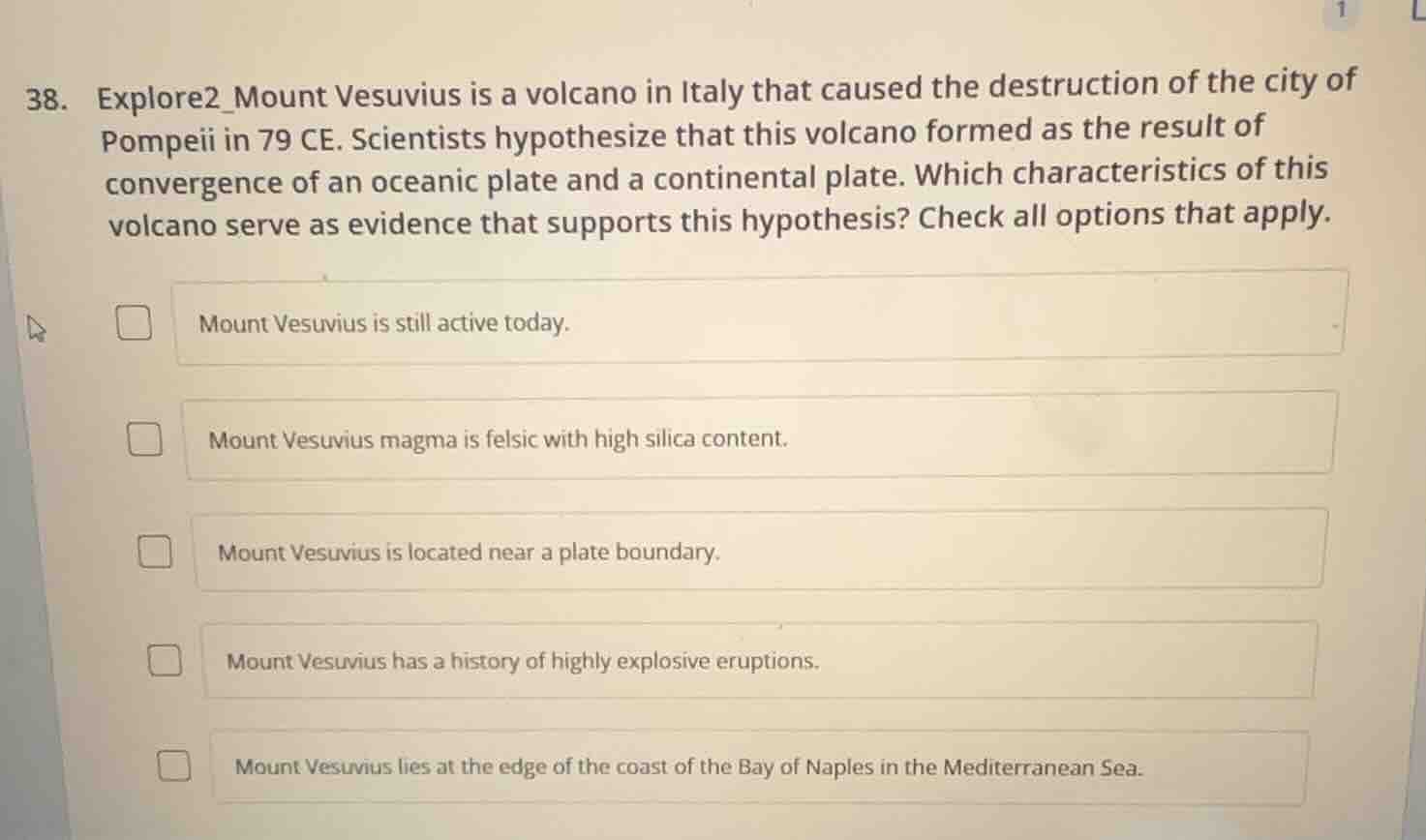
- explore2_mount vesuvius is a volcano in italy that caused the destruction of the city of pompeii in 79 ce. scientists hypothesize that this volcano formed as the result of convergence of an oceanic plate and a continental plate. which characteristics of this volcano serve as evidence that supports this hypothesis? check all options that apply. mount vesuvius is still active today. mount vesuvius magma is felsic with high silica content. mount vesuvius is located near a plate boundary. mount vesuvius has a history of highly explosive eruptions. mount vesuvius lies at the edge of the coast of the bay of naples in the mediterranean sea.
Brief Explanations
- Mount Vesuvius magma is felsic with high silica content: At oceanic - continental convergent boundaries, the subducted oceanic plate (rich in water - carrying minerals) causes partial melting of the continental crust. Continental crust is rich in silica, so the magma formed is felsic (high silica) and has high viscosity, which is consistent with the magma characteristics of Mount Vesuvius.
- Mount Vesuvius is located near a plate boundary: The hypothesis is about its formation at an oceanic - continental plate convergence. Being near a plate boundary supports the idea that it formed due to plate interactions.
- Mount Vesuvius has a history of highly explosive eruptions: Felsic magma (from oceanic - continental convergence) has high viscosity, which traps gases. When these gases are released, they cause highly explosive eruptions, matching Mount Vesuvius' eruption history.
- Mount Vesuvius lies at the edge of the coast of the Bay of Naples in the Mediterranean Sea: The Mediterranean region is near the boundary of the African (oceanic - like in parts) and Eurasian (continental) plates. Its coastal location near a sea (where an oceanic plate could be subducting under a continental plate) supports the oceanic - continental convergence hypothesis.
- Mount Vesuvius is still active today: The activity of the volcano alone does not directly relate to the type of plate boundary (oceanic - continental convergence) that formed it. Volcanoes at other types of boundaries can also be active.

Snap & solve any problem in the app
Get step-by-step solutions on Sovi AI
Photo-based solutions with guided steps
Explore more problems and detailed explanations
B. Mount Vesuvius magma is felsic with high silica content, C. Mount Vesuvius is located near a plate boundary, D. Mount Vesuvius has a history of highly explosive eruptions, E. Mount Vesuvius lies at the edge of the coast of the Bay of Naples in the Mediterranean Sea