QUESTION IMAGE
Question
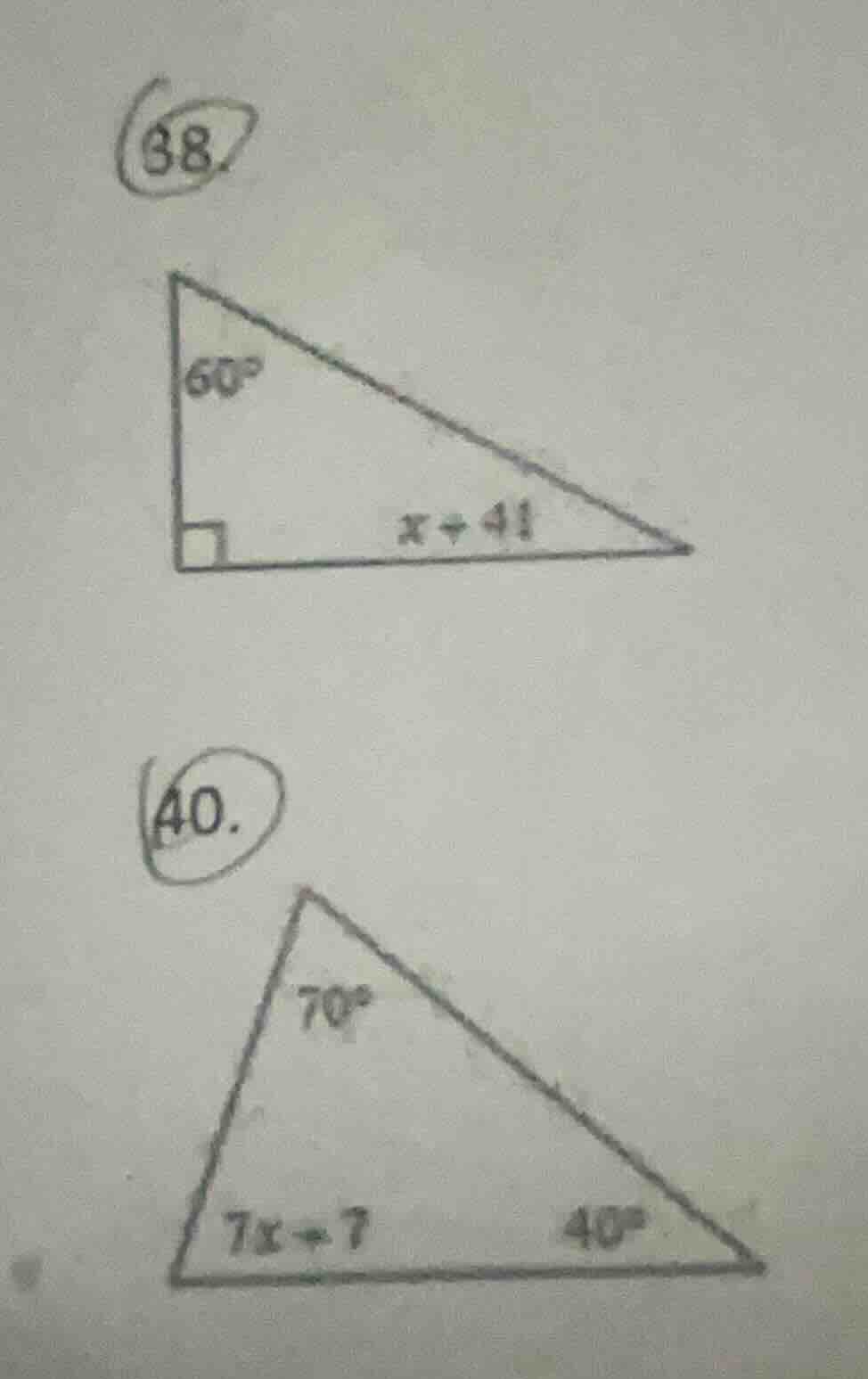
- right triangle with one angle 60°, side labeled x + 41 40. triangle with angles 70°, 40°, and side labeled 7x + 7
Problem 38:
Step1: Identify triangle type (right triangle)
This is a right - angled triangle (one angle is \(90^{\circ}\)) and another angle is \(60^{\circ}\). The sum of angles in a triangle is \(180^{\circ}\), so the third angle \(y\) satisfies \(90 + 60+y=180\), \(y = 30^{\circ}\). In a \(30 - 60-90\) triangle, the side opposite \(30^{\circ}\) is half the hypotenuse, but here we can also use angle - sum property for the angle (wait, actually, maybe we made a mistake. Wait, the side is \(x + 41\), but maybe we need to find the angle first? Wait, no, in a right triangle, the two non - right angles sum to \(90^{\circ}\). So the angle opposite the side \(x + 41\) is \(30^{\circ}\) (since \(90-60 = 30\)). But maybe the problem is to find \(x\) such that the angle is \(30^{\circ}\)? Wait, no, maybe the triangle has angles \(90^{\circ}\), \(60^{\circ}\), and \(30^{\circ}\), and the side \(x + 41\) is opposite \(30^{\circ}\), but we need more info? Wait, no, maybe the problem is to find \(x\) by using the fact that in a right triangle, the acute angles add up to \(90^{\circ}\). Wait, no, the angle given is \(60^{\circ}\), right angle is \(90^{\circ}\), so the third angle is \(30^{\circ}\). But maybe the side \(x + 41\) is related to the angle? Wait, maybe the problem is to find \(x\) such that the angle (the non - right, non - 60 angle) is equal to some value. Wait, maybe I misread. Wait, the triangle is right - angled, so the two acute angles sum to \(90^{\circ}\). So if one acute angle is \(60^{\circ}\), the other is \(30^{\circ}\). But the side is \(x + 41\). Wait, maybe the problem is to find \(x\) where the angle (the one with the side \(x + 41\)) is \(30^{\circ}\), but we need to set up an equation. Wait, maybe the problem is that the angle (the acute angle) is \(30^{\circ}\), and we have an expression for the angle? No, the side is \(x + 41\). Wait, maybe it's a typo, and the angle is related to \(x\)? Wait, no, let's re - examine.
Wait, maybe the problem is to find \(x\) such that the angle (the acute angle) is \(30^{\circ}\), and we have an expression for the angle? No, the side is \(x + 41\). Wait, maybe the triangle is a right triangle, and we can use the fact that the sum of angles is \(180^{\circ}\). Let's assume that the angle opposite the side \(x + 41\) is \(30^{\circ}\), and maybe there is a relationship between the side and the angle, but since we don't have the other side, maybe the problem is to find \(x\) such that the angle (the acute angle) is \(30^{\circ}\), and we have an equation for the angle. Wait, no, maybe the problem is to find \(x\) by using the angle - sum property. Wait, the sum of angles in a triangle is \(180^{\circ}\). So \(90+60+(angle)=180\), so \(angle = 30^{\circ}\). But how does \(x + 41\) come into play? Maybe the angle is \(x + 41\) degrees? Oh! That must be it. So the acute angle (the one not \(90^{\circ}\) or \(60^{\circ}\)) is \(x + 41\) degrees. Since in a right triangle, the two acute angles sum to \(90^{\circ}\), so \(60+(x + 41)=90\).
Step2: Solve the equation \(60+(x + 41)=90\)
First, simplify the left - hand side: \(x+101 = 90\). Then, subtract 101 from both sides: \(x=90 - 101=- 11\). Wait, that seems odd. Maybe the angle is \(x + 41\) and it's the \(30^{\circ}\) angle? So \(x + 41=30\), then \(x=30 - 41=-11\).
Problem 40:
Step1: Use angle - sum property of triangle
The sum of angles in a triangle is \(180^{\circ}\). The given angles are \(70^{\circ}\), \(40^{\circ}\), and the angle with measure \(7x + 7\) degrees. So we set up the equation: \(70+40+(7x + 7)=180\).
Step2: Simplify the left - hand side
\(70 + 40+7+7x=180\), which simplifies to \(117+7x = 180\).
Step3: Solve for \(x\)
Subtract 117 from both sides: \(7x=180 - 117 = 63\). Then divide both sides by 7: \(x=\frac{63}{7}=9\).
Problem 38 Answer:
If we assume the acute angle (non - right, non - 60) is \(x + 41\) degrees, and since in a right triangle acute angles sum to \(90^{\circ}\), \(60+(x + 41)=90\), then \(x=-11\)
Problem 40 Answer:
\(x = 9\)
Final Answers:
Problem 38: \(\boldsymbol{x=-11}\)
Problem 40: \(\boldsymbol{x = 9}\)

Snap & solve any problem in the app
Get step-by-step solutions on Sovi AI
Photo-based solutions with guided steps
Explore more problems and detailed explanations
Step1: Use angle - sum property of triangle
The sum of angles in a triangle is \(180^{\circ}\). The given angles are \(70^{\circ}\), \(40^{\circ}\), and the angle with measure \(7x + 7\) degrees. So we set up the equation: \(70+40+(7x + 7)=180\).
Step2: Simplify the left - hand side
\(70 + 40+7+7x=180\), which simplifies to \(117+7x = 180\).
Step3: Solve for \(x\)
Subtract 117 from both sides: \(7x=180 - 117 = 63\). Then divide both sides by 7: \(x=\frac{63}{7}=9\).
Problem 38 Answer:
If we assume the acute angle (non - right, non - 60) is \(x + 41\) degrees, and since in a right triangle acute angles sum to \(90^{\circ}\), \(60+(x + 41)=90\), then \(x=-11\)
Problem 40 Answer:
\(x = 9\)
Final Answers:
Problem 38: \(\boldsymbol{x=-11}\)
Problem 40: \(\boldsymbol{x = 9}\)