QUESTION IMAGE
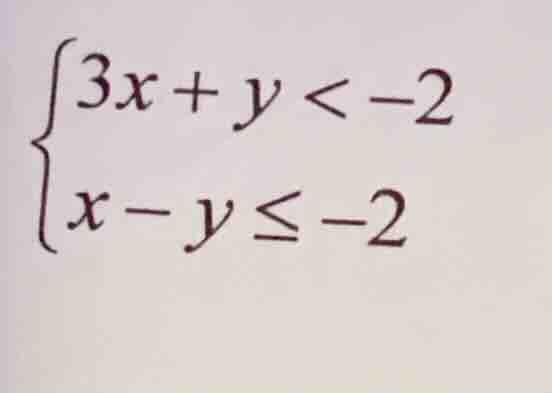
Question
\
To solve the system of linear inequalities \(
\), we can use the method of graphing or find the solution by manipulating the inequalities. Here, we'll solve it by finding the range of \(x\) and \(y\) or by graphing the boundary lines.
Step 1: Rewrite the inequalities in slope - intercept form (\(y=mx + b\))
- For the first inequality \(3x + y < -2\), we can solve for \(y\):
\(y<-3x - 2\)
The boundary line is \(y=-3x - 2\), which has a slope of \(- 3\) and a \(y\) - intercept of \(-2\). Since the inequality is \(y < - 3x-2\), we draw a dashed line (because the inequality is strict, \(y\) is not equal to \(-3x - 2\)) and shade the region below the line.
- For the second inequality \(x - y \leq -2\), we solve for \(y\):
\(-y\leq -x - 2\)
Multiply both sides by \(- 1\) (and remember to reverse the inequality sign when multiplying or dividing by a negative number), we get \(y\geq x + 2\)
The boundary line is \(y=x + 2\), which has a slope of \(1\) and a \(y\) - intercept of \(2\). Since the inequality is \(y\geq x + 2\), we draw a solid line (because the inequality is non - strict, \(y\) can be equal to \(x + 2\)) and shade the region above the line.
Step 2: Find the intersection of the two regions
To find the solution of the system, we need to find the region that is common to both shaded regions.
We can also find the intersection of the two boundary lines \(y=-3x - 2\) and \(y=x + 2\) by setting them equal to each other:
\(-3x-2=x + 2\)
Add \(3x\) to both sides: \(-2 = 4x+2\)
Subtract \(2\) from both sides: \(-4 = 4x\)
Divide both sides by \(4\): \(x=-1\)
Substitute \(x = - 1\) into \(y=x + 2\), we get \(y=-1 + 2=1\)
The solution to the system of inequalities is the set of all points \((x,y)\) that satisfy both \(y < - 3x-2\) and \(y\geq x + 2\). In other words, the solution is the region that is above the line \(y = x + 2\) (including the line \(y=x + 2\)) and below the line \(y=-3x - 2\) (excluding the line \(y=-3x - 2\)).
If we want to express the solution in terms of \(x\) and \(y\) or find a particular solution (for example, integer solutions), we can test points. For example, let's test the point \((-2,0)\):
- For \(3x + y\): \(3\times(-2)+0=-6< - 2\)
- For \(x - y\): \(-2-0=-2\leq - 2\)
So the point \((-2,0)\) is a solution of the system.
In general, the solution of the system \(
\) is the set of all ordered pairs \((x,y)\) such that \(y\geq x + 2\) and \(y < - 3x-2\)
If we want to write the solution in terms of \(x\):
From \(y\geq x + 2\) and \(y < - 3x-2\), we have \(x + 2\leq y < - 3x-2\)
Also, from \(x + 2 < - 3x-2\) (since \(y\) has to satisfy both inequalities, the lower bound of \(y\) from the second inequality must be less than the upper bound from the first inequality)
\(x+2<-3x - 2\)
\(x + 3x<-2 - 2\)
\(4x<-4\)
\(x < - 1\)
And since \(y\geq x + 2\) and \(x < - 1\), when \(x=-2\), \(y\geq0\) and \(y < 4\) (from \(y < - 3\times(-2)-2=4\))
The solution to the system of inequalities is the set of all points \((x,y)\) with \(x < - 1\) and \(x + 2\leq y < - 3x-2\)

Snap & solve any problem in the app
Get step-by-step solutions on Sovi AI
Photo-based solutions with guided steps
Explore more problems and detailed explanations
To solve the system of linear inequalities \(
\), we can use the method of graphing or find the solution by manipulating the inequalities. Here, we'll solve it by finding the range of \(x\) and \(y\) or by graphing the boundary lines.
Step 1: Rewrite the inequalities in slope - intercept form (\(y=mx + b\))
- For the first inequality \(3x + y < -2\), we can solve for \(y\):
\(y<-3x - 2\)
The boundary line is \(y=-3x - 2\), which has a slope of \(- 3\) and a \(y\) - intercept of \(-2\). Since the inequality is \(y < - 3x-2\), we draw a dashed line (because the inequality is strict, \(y\) is not equal to \(-3x - 2\)) and shade the region below the line.
- For the second inequality \(x - y \leq -2\), we solve for \(y\):
\(-y\leq -x - 2\)
Multiply both sides by \(- 1\) (and remember to reverse the inequality sign when multiplying or dividing by a negative number), we get \(y\geq x + 2\)
The boundary line is \(y=x + 2\), which has a slope of \(1\) and a \(y\) - intercept of \(2\). Since the inequality is \(y\geq x + 2\), we draw a solid line (because the inequality is non - strict, \(y\) can be equal to \(x + 2\)) and shade the region above the line.
Step 2: Find the intersection of the two regions
To find the solution of the system, we need to find the region that is common to both shaded regions.
We can also find the intersection of the two boundary lines \(y=-3x - 2\) and \(y=x + 2\) by setting them equal to each other:
\(-3x-2=x + 2\)
Add \(3x\) to both sides: \(-2 = 4x+2\)
Subtract \(2\) from both sides: \(-4 = 4x\)
Divide both sides by \(4\): \(x=-1\)
Substitute \(x = - 1\) into \(y=x + 2\), we get \(y=-1 + 2=1\)
The solution to the system of inequalities is the set of all points \((x,y)\) that satisfy both \(y < - 3x-2\) and \(y\geq x + 2\). In other words, the solution is the region that is above the line \(y = x + 2\) (including the line \(y=x + 2\)) and below the line \(y=-3x - 2\) (excluding the line \(y=-3x - 2\)).
If we want to express the solution in terms of \(x\) and \(y\) or find a particular solution (for example, integer solutions), we can test points. For example, let's test the point \((-2,0)\):
- For \(3x + y\): \(3\times(-2)+0=-6< - 2\)
- For \(x - y\): \(-2-0=-2\leq - 2\)
So the point \((-2,0)\) is a solution of the system.
In general, the solution of the system \(
\) is the set of all ordered pairs \((x,y)\) such that \(y\geq x + 2\) and \(y < - 3x-2\)
If we want to write the solution in terms of \(x\):
From \(y\geq x + 2\) and \(y < - 3x-2\), we have \(x + 2\leq y < - 3x-2\)
Also, from \(x + 2 < - 3x-2\) (since \(y\) has to satisfy both inequalities, the lower bound of \(y\) from the second inequality must be less than the upper bound from the first inequality)
\(x+2<-3x - 2\)
\(x + 3x<-2 - 2\)
\(4x<-4\)
\(x < - 1\)
And since \(y\geq x + 2\) and \(x < - 1\), when \(x=-2\), \(y\geq0\) and \(y < 4\) (from \(y < - 3\times(-2)-2=4\))
The solution to the system of inequalities is the set of all points \((x,y)\) with \(x < - 1\) and \(x + 2\leq y < - 3x-2\)