QUESTION IMAGE
Question
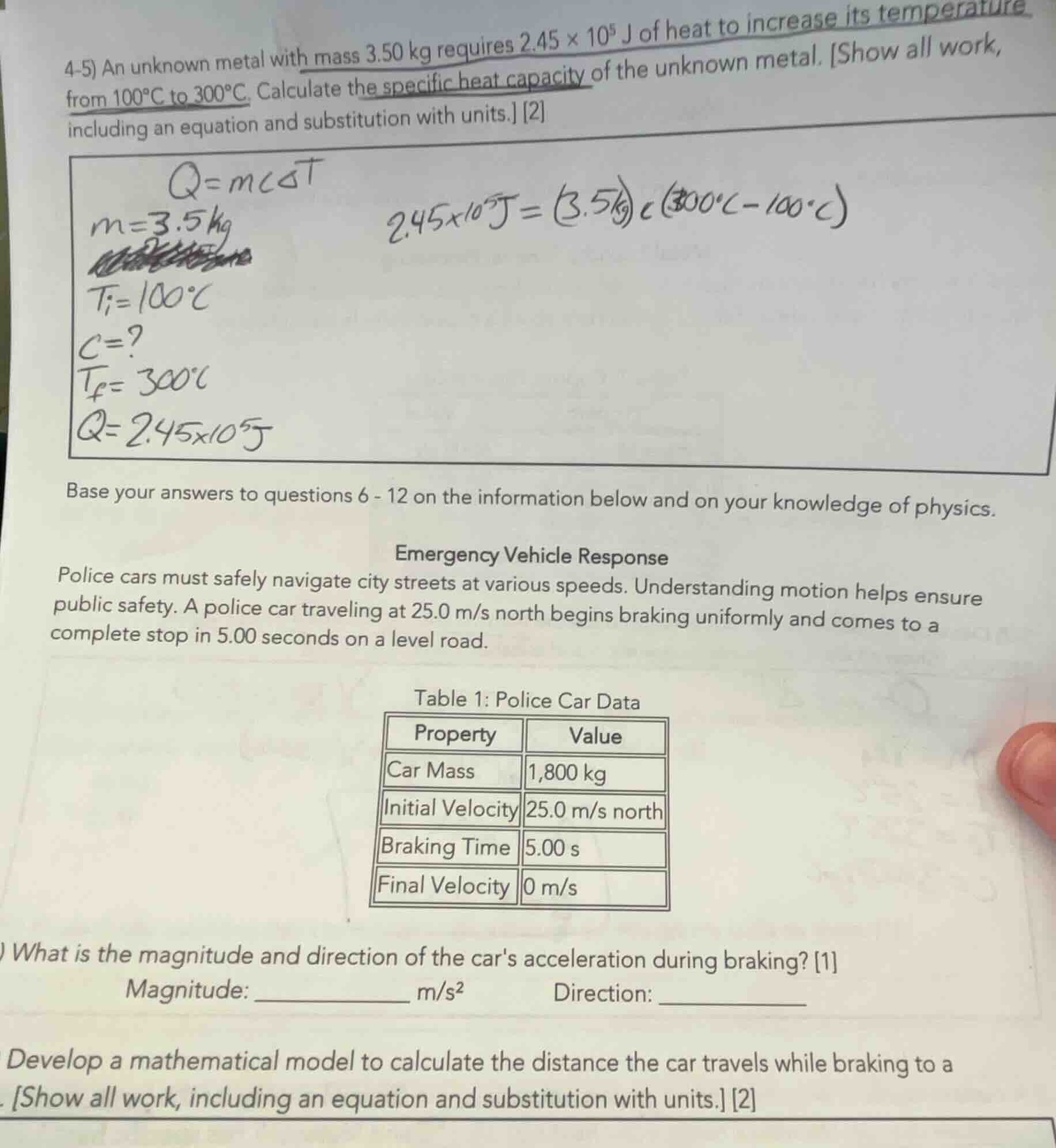
4-5) an unknown metal with mass 3.50 kg requires 2.45 × 10⁵ j of heat to increase its temperature from 100°c to 300°c. calculate the specific heat capacity of the unknown metal. show all work, including an equation and substitution with units. 2
q = mcδt
m = 3.5 kg
tᵢ = 100°c
c = ?
tբ = 300°c
q = 2.45×10⁵ j
2.45×10⁵ j = (3.5 kg)c(300°c - 100°c)
base your answers to questions 6 - 12 on the information below and on your knowledge of physics.
emergency vehicle response
police cars must safely navigate city streets at various speeds. understanding motion helps ensure public safety. a police car traveling at 25.0 m/s north begins braking uniformly and comes to a complete stop in 5.00 seconds on a level road.
table 1: police car data
| property | value |
|---|---|
| initial velocity | 25.0 m/s north |
| braking time | 5.00 s |
| final velocity | 0 m/s |
) what is the magnitude and direction of the cars acceleration during braking? 1
magnitude: __________ m/s² direction: __________
develop a mathematical model to calculate the distance the car travels while braking to a . show all work, including an equation and substitution with units. 2
Problem 4 - 5 (Specific Heat Capacity Calculation)
Step 1: Recall the heat formula
The formula for heat transfer is \( Q = mc\Delta T \), where \( Q \) is the heat energy, \( m \) is the mass, \( c \) is the specific heat capacity, and \( \Delta T \) is the change in temperature.
Step 2: Calculate the change in temperature
\( \Delta T=T_f - T_i=300^{\circ}\text{C}- 100^{\circ}\text{C} = 200^{\circ}\text{C}\)
Step 3: Rearrange the formula to solve for \( c \)
From \( Q = mc\Delta T \), we can solve for \( c \) as \( c=\frac{Q}{m\Delta T}\)
Step 4: Substitute the given values
We know that \( Q = 2.45\times10^{5}\text{ J}\), \( m = 3.50\text{ kg}\), and \( \Delta T=200^{\circ}\text{C}\). Substituting these values into the formula for \( c \):
\( c=\frac{2.45\times 10^{5}\text{ J}}{3.50\text{ kg}\times200^{\circ}\text{C}}\)
First, calculate the denominator: \( 3.50\text{ kg}\times200^{\circ}\text{C}=700\text{ kg}\cdot^{\circ}\text{C}\)
Then, divide the numerator by the denominator: \( c=\frac{2.45\times 10^{5}\text{ J}}{700\text{ kg}\cdot^{\circ}\text{C}} = 350\text{ J/(kg}\cdot^{\circ}\text{C)}\)
Step 1: Recall the acceleration formula
The formula for acceleration is \( a=\frac{v_f - v_i}{t}\), where \( v_f \) is the final velocity, \( v_i \) is the initial velocity, and \( t \) is the time.
Step 2: Substitute the given values
We know that \( v_i = 25.0\text{ m/s}\) (north), \( v_f=0\text{ m/s}\), and \( t = 5.00\text{ s}\). Substituting these values into the acceleration formula:
\( a=\frac{0\text{ m/s}-25.0\text{ m/s}}{5.00\text{ s}}\)
Step 3: Calculate the acceleration
\( a=\frac{- 25.0\text{ m/s}}{5.00\text{ s}}=- 5.00\text{ m/s}^2\)
The magnitude of the acceleration is \( 5.00\text{ m/s}^2\) and the negative sign indicates that the direction of acceleration is opposite to the direction of motion (since the car is slowing down). The initial velocity was north, so the direction of acceleration is south.
Step 1: Recall the kinematic equation for distance
One of the kinematic equations is \( d=v_i t+\frac{1}{2}at^2\), where \( d \) is the distance, \( v_i \) is the initial velocity, \( t \) is the time, and \( a \) is the acceleration. We can also use the equation \( v_f^2=v_i^2 + 2ad\) and solve for \( d \) as \( d=\frac{v_f^2 - v_i^2}{2a}\)
Step 2: Use the values of \( v_i\), \( v_f\) and \( a \)
We know that \( v_i = 25.0\text{ m/s}\), \( v_f = 0\text{ m/s}\), and \( a=- 5.00\text{ m/s}^2\) (from the previous acceleration calculation)
Step 3: Substitute the values into the formula \( d=\frac{v_f^2 - v_i^2}{2a}\)
\( d=\frac{(0\text{ m/s})^2-(25.0\text{ m/s})^2}{2\times(- 5.00\text{ m/s}^2)}\)
First, calculate the numerator: \( (0)^2-(25.0)^2=- 625\text{ m}^2/\text{s}^2\)
Then, calculate the denominator: \( 2\times(- 5.00)=- 10.0\text{ m/s}^2\)
Now, divide the numerator by the denominator: \( d=\frac{- 625\text{ m}^2/\text{s}^2}{- 10.0\text{ m/s}^2}=62.5\text{ m}\)

Snap & solve any problem in the app
Get step-by-step solutions on Sovi AI
Photo-based solutions with guided steps
Explore more problems and detailed explanations
The specific heat capacity of the unknown metal is \( \boldsymbol{350\text{ J/(kg}\cdot^{\circ}\text{C)}}\)