QUESTION IMAGE
Question
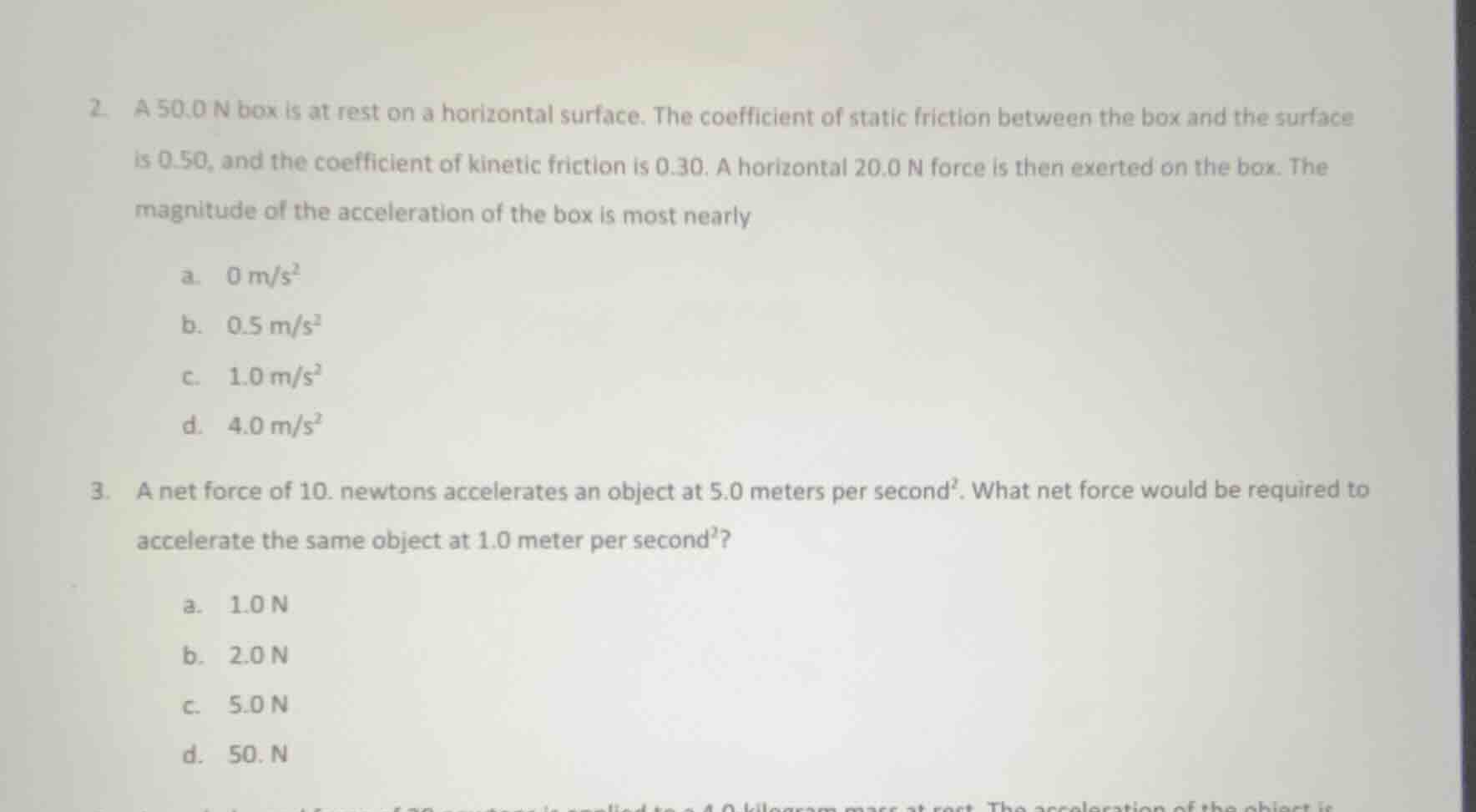
- a 50.0 n box is at rest on a horizontal surface. the coefficient of static friction between the box and the surface is 0.50, and the coefficient of kinetic friction is 0.30. a horizontal 20.0 n force is then exerted on the box. the magnitude of the acceleration of the box is most nearly
a. 0 m/s²
b. 0.5 m/s²
c. 1.0 m/s²
d. 4.0 m/s²
- a net force of 10. newtons accelerates an object at 5.0 meters per second². what net force would be required to accelerate the same object at 1.0 meter per second²?
a. 1.0 n
b. 2.0 n
c. 5.0 n
d. 50. n
Question 2
Step1: Calculate maximum static friction
The formula for static friction is \( F_{s,\text{max}}=\mu_s F_N \). The normal force \( F_N \) equals the weight of the box, so \( F_N = 50.0\ N \). Then \( F_{s,\text{max}} = 0.50\times50.0 = 25.0\ N \).
Step2: Compare applied force with static friction
The applied horizontal force is \( 20.0\ N \), which is less than \( F_{s,\text{max}} = 25.0\ N \). So the box remains at rest, and acceleration \( a = 0\ m/s^2 \).
Step1: Find mass using \( F = ma \)
Given \( F = 10\ N \), \( a = 5.0\ m/s^2 \), from \( m=\frac{F}{a} \), we get \( m=\frac{10}{5.0}=2\ kg \).
Step2: Calculate new force for \( a = 1.0\ m/s^2 \)
Using \( F = ma \) again, with \( m = 2\ kg \), \( a = 1.0\ m/s^2 \), so \( F = 2\times1.0 = 2.0\ N \).

Snap & solve any problem in the app
Get step-by-step solutions on Sovi AI
Photo-based solutions with guided steps
Explore more problems and detailed explanations
a. \( 0\ m/s^2 \)