QUESTION IMAGE
Question
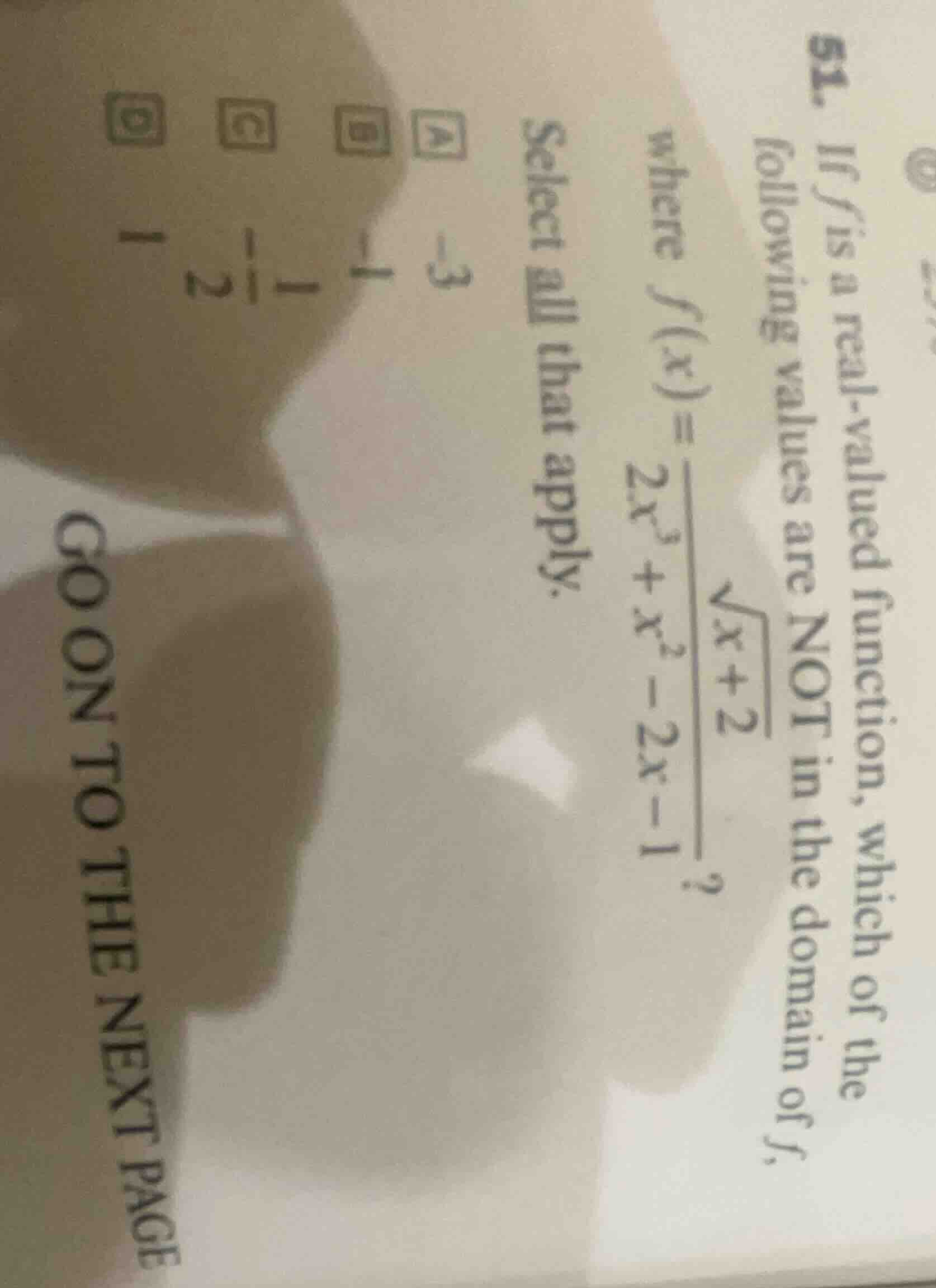
- if f is a real - valued function, which of the following values are not in the domain of f, where ( f(x)=\frac{sqrt{x + 2}}{2x^{3}+x^{2}-2x - 1})? select all that apply.
a - 3
b - 1
c (\frac{1}{2})
d 1
go on to the next page
To determine the values not in the domain of \( f(x)=\frac{\sqrt{x + 2}}{2x^{3}+x^{2}-2x - 1}\), we need to consider two things: the radicand of the square root (must be non - negative) and the denominator (cannot be zero).
Step 1: Analyze the square root
For the square root \(\sqrt{x + 2}\), we need \(x+2\geq0\), which gives \(x\geq - 2\).
Step 2: Analyze the denominator
First, we factor the denominator \(2x^{3}+x^{2}-2x - 1\).
We can group the terms:
\((2x^{3}+x^{2})+(-2x - 1)=x^{2}(2x + 1)-1(2x + 1)=(x^{2}-1)(2x + 1)=(x - 1)(x + 1)(2x+1)\)
We set the denominator equal to zero: \((x - 1)(x + 1)(2x + 1)=0\)
Solving for \(x\), we get \(x=1\), \(x=-1\) or \(x =-\frac{1}{2}\)
Now we check the given options:
- Option A: \(x=-3\). Since for the square root, \(x\geq - 2\), and \(-3<-2\), so \(x = - 3\) is not in the domain.
- Option B: \(x=-1\). The denominator is zero when \(x=-1\), so \(x=-1\) is not in the domain.
- Option C: \(x =-\frac{1}{2}\). The denominator is zero when \(x=-\frac{1}{2}\), so \(x =-\frac{1}{2}\) is not in the domain.
- Option D: \(x = 1\). The denominator is zero when \(x = 1\), so \(x=1\) is not in the domain. Wait, but let's re - check the square root condition for each:
- For \(x=-3\): \(\sqrt{-3 + 2}=\sqrt{-1}\) is not a real number, so \(x=-3\) is out.
- For \(x=-1\): The denominator is zero, so out.
- For \(x=-\frac{1}{2}\): The denominator is zero, so out.
- For \(x = 1\): The denominator is zero, but also, when \(x = 1\), the square root \(\sqrt{1 + 2}=\sqrt{3}\) is real, but the denominator is zero, so \(x = 1\) is out. But wait, the options are A: - 3, B: - 1, C: \(-\frac{1}{2}\), D:1.
Wait, let's re - evaluate:
- For the square root: \(x\geq - 2\), so \(x=-3\) (since \(-3<-2\)) is not in the domain.
- For the denominator: \(x
eq1\), \(x
eq - 1\), \(x
eq-\frac{1}{2}\)
So the values not in the domain are \(x=-3\) (because of the square root), \(x=-1\) (denominator zero), \(x=-\frac{1}{2}\) (denominator zero), \(x = 1\) (denominator zero). But let's check the original function's domain requirements again. The domain of \(f(x)\) is all real numbers \(x\) such that \(x\geq - 2\) and \(x
eq-\frac{1}{2}\), \(x
eq - 1\), \(x
eq1\). So:
- \(x=-3\): Does not satisfy \(x\geq - 2\), so not in domain.
- \(x=-1\): Denominator zero, not in domain.
- \(x=-\frac{1}{2}\): Denominator zero, not in domain.
- \(x = 1\): Denominator zero, not in domain.
But let's check the options:
- A: - 3 (not in domain because \(x<-2\))
- B: - 1 (denominator zero)
- C: \(-\frac{1}{2}\) (denominator zero)
- D:1 (denominator zero)
Wait, but maybe I made a mistake in the square root. The square root is \(\sqrt{x + 2}\), so \(x+2\geq0\implies x\geq - 2\). So \(x=-3\) is invalid because of the square root, and \(x=-1\), \(x =-\frac{1}{2}\), \(x = 1\) are invalid because of the denominator.
So the values not in the domain are A. - 3, B. - 1, C. \(-\frac{1}{2}\), D.1? Wait, no, let's check the problem statement again. The problem says "which of the following values are NOT in the domain of \(f\)". Let's check each option:
- For \(x=-3\): \(\sqrt{-3 + 2}=\sqrt{-1}\) is not a real number, so \(x=-3\) is not in the domain (since \(f\) is a real - valued function).
- For \(x=-1\): Denominator \(2(-1)^{3}+(-1)^{2}-2(-1)-1=-2 + 1 + 2-1 = 0\), so \(x=-1\) is not in the domain.
- For \(x=-\frac{1}{2}\): Denominator \(2(-\frac{1}{2})^{3}+(-\frac{1}{2})^{2}-2(-\frac{1}{2})-1=2(-\frac{1}{8})+\frac{1}{4}+1 - 1=-\frac{1}{4}+\frac{1}{4}=0\), so \(x =-\frac{1}{2}\) is not in the domain.
- For \(x = 1\): Denominator \(2(1)^{3}…

Snap & solve any problem in the app
Get step-by-step solutions on Sovi AI
Photo-based solutions with guided steps
Explore more problems and detailed explanations
A. - 3, B. - 1, C. \(\frac{1}{2}\) (wait, no, C is \(-\frac{1}{2}\)), D. 1. Wait, the options are:
A. - 3
B. - 1
C. \(-\frac{1}{2}\)
D. 1
So the values not in the domain are A, B, C, D? But let's re - check the square root for \(x=-1\): \(\sqrt{-1 + 2}=\sqrt{1}=1\), which is real, but the denominator is zero. For \(x =-\frac{1}{2}\): \(\sqrt{-\frac{1}{2}+2}=\sqrt{\frac{3}{2}}\) is real, but denominator is zero. For \(x = 1\): \(\sqrt{1 + 2}=\sqrt{3}\) is real, but denominator is zero. For \(x=-3\): \(\sqrt{-3 + 2}\) is not real. So all of A, B, C, D are not in the domain? But maybe there is a mistake. Wait, the problem says "select all that apply".
Wait, let's re - calculate the denominator:
\(2x^{3}+x^{2}-2x - 1\)
Let's use rational root theorem. Possible rational roots are \(\pm1,\pm\frac{1}{2}\)
For \(x = 1\): \(2(1)^{3}+(1)^{2}-2(1)-1=2 + 1-2 - 1=0\), so \(x - 1\) is a factor.
Dividing \(2x^{3}+x^{2}-2x - 1\) by \(x - 1\) (using polynomial long division or synthetic division). Using synthetic division for \(x = 1\):
Coefficients: 2, 1, - 2, - 1
Bring down 2. Multiply by 1: 2. Add to next coefficient: 1+2 = 3. Multiply by 1: 3. Add to next coefficient: - 2+3 = 1. Multiply by 1: 1. Add to last coefficient: - 1 + 1=0. So the quotient is \(2x^{2}+3x + 1\). Then \(2x^{2}+3x + 1=(2x + 1)(x + 1)\). So the denominator factors as \((x - 1)(2x + 1)(x + 1)\), which matches our earlier factoring.
So the domain is \(x\geq - 2\) and \(x
eq - 1\), \(x
eq-\frac{1}{2}\), \(x
eq1\)
So:
- \(x=-3\): \(x<-2\), not in domain.
- \(x=-1\): denominator zero, not in domain.
- \(x =-\frac{1}{2}\): denominator zero, not in domain.
- \(x = 1\): denominator zero, not in domain.
So all of A, B, C, D are not in the domain. But maybe the problem has a typo, or I made a mistake. Wait, the options are A. - 3, B. - 1, C. \(-\frac{1}{2}\), D. 1. So the answer is A, B, C, D. But let's check the original problem's options again. The user provided the options as A. - 3, B. - 1, C. \(-\frac{1}{2}\), D. 1. So we select all of them? But maybe I made a mistake in the square root for \(x=-1\). \(\sqrt{-1 + 2}=\sqrt{1}=1\), which is real, but the denominator is zero, so \(x=-1\) is not in the domain. For \(x =-\frac{1}{2}\), \(\sqrt{-\frac{1}{2}+2}=\sqrt{\frac{3}{2}}\) is real, but denominator is zero. For \(x = 1\), \(\sqrt{1 + 2}=\sqrt{3}\) is real, but denominator is zero. For \(x=-3\), square root is not real. So all four options are not in the domain. But maybe the problem expects A, B, C, D?
Wait, but let's check the problem statement again. The function is \(f(x)=\frac{\sqrt{x + 2}}{2x^{3}+x^{2}-2x - 1}\). So domain is \(x\geq - 2\) and \(2x^{3}+x^{2}-2x - 1
eq0\). So:
- \(x=-3\): \(x<-2\) → not in domain.
- \(x=-1\): denominator zero → not in domain.
- \(x =-\frac{1}{2}\): denominator zero → not in domain.
- \(x = 1\): denominator zero → not in domain.
So the answer is A, B, C, D. But maybe there is a mistake. Alternatively, maybe the denominator was factored wrong. Let's re - factor \(2x^{3}+x^{2}-2x - 1\):
\(2x^{3}+x^{2}-2x - 1=x^{2}(2x + 1)-1(2x + 1)=(x^{2}-1)(2x + 1)=(x - 1)(x + 1)(2x + 1)\), which is correct.
So the values not in the domain are A, B, C, D.