QUESTION IMAGE
Question
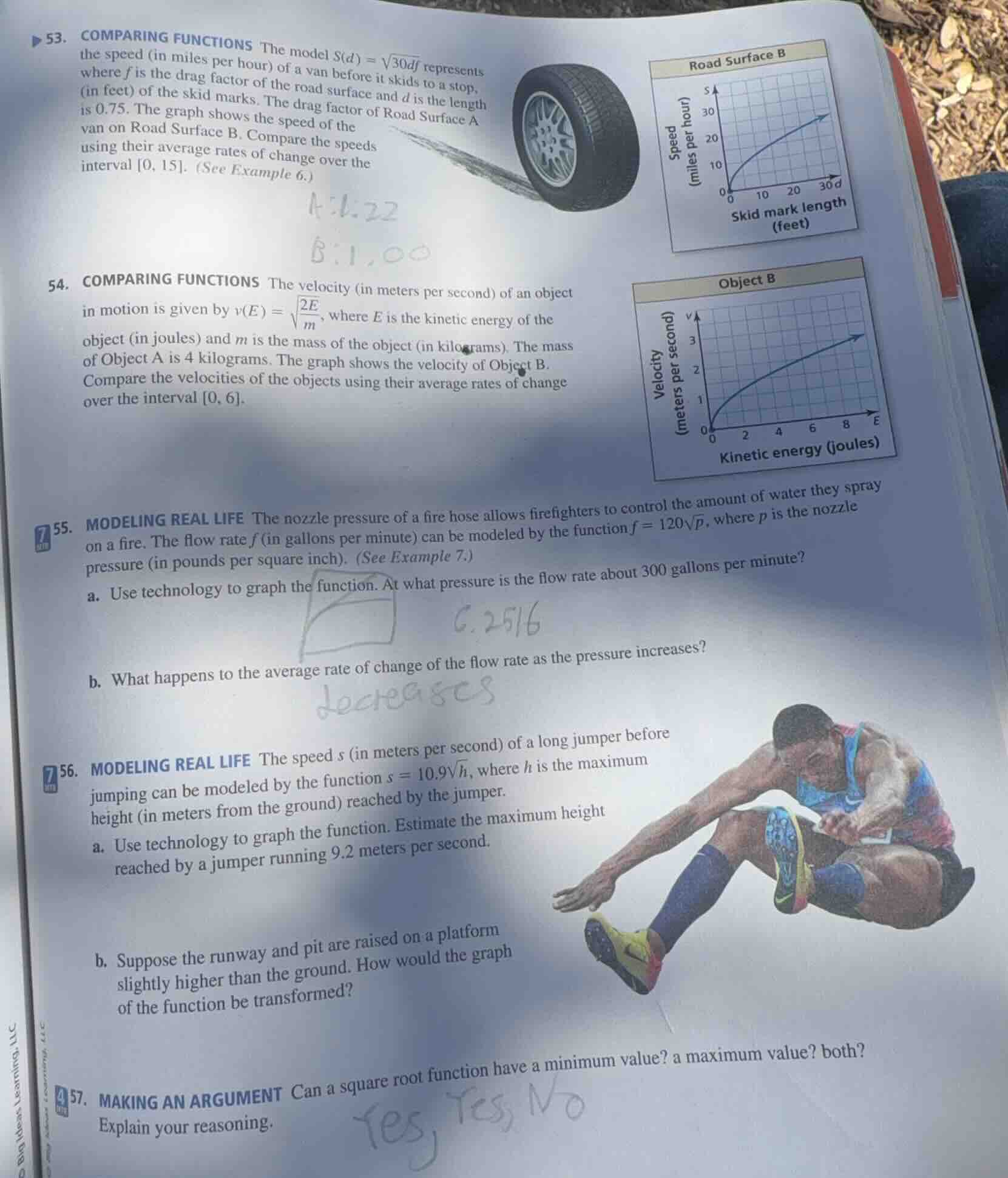
- comparing functions the model $s(d) = \sqrt{30df}$ represents the speed (in miles per hour) of a van before it skids to a stop, where $f$ is the drag factor of the road surface and $d$ is the length (in feet) of the skid marks. the drag factor of road surface a is 0.75. the graph shows the speed of the van on road surface b. compare the speeds using their average rates of change over the interval $0, 15$. (see example 6.)
- comparing functions the velocity (in meters per second) of an object in motion is given by $v(e) = \sqrt{\frac{2e}{m}}$, where $e$ is the kinetic energy of the object (in joules) and $m$ is the mass of the object (in kilograms). the mass of object a is 4 kilograms. the graph shows the velocity of object b. compare the velocities of the objects using their average rates of change over the interval $0, 6$.
- modeling real life the nozzle pressure of a fire hose allows firefighters to control the amount of water they spray on a fire. the flow rate $f$ (in gallons per minute) can be modeled by the function $f = 120\sqrt{p}$, where $p$ is the nozzle pressure (in pounds per square inch). (see example 7.)
a. use technology to graph the function. at what pressure is the flow rate about 300 gallons per minute?
b. what happens to the average rate of change of the flow rate as the pressure increases?
- modeling real life the speed $s$ (in meters per second) of a long jumper before jumping can be modeled by the function $s = 10.9\sqrt{h}$, where $h$ is the maximum height (in meters from the ground) reached by the jumper.
a. use technology to graph the function. estimate the maximum height reached by a jumper running 9.2 meters per second.
b. suppose the runway and pit are raised on a platform slightly higher than the ground. how would the graph of the function be transformed?
- making an argument can a square root function have a minimum value? a maximum value? both? explain your reasoning.
Problem 53
Step1: Define Road Surface A function
Substitute $f=0.75$ into $S(d)=\sqrt{30df}$:
$S_A(d)=\sqrt{30d\times0.75}=\sqrt{22.5d}$
Step2: Find $S_A(0)$ and $S_A(15)$
$S_A(0)=\sqrt{22.5\times0}=0$
$S_A(15)=\sqrt{22.5\times15}=\sqrt{337.5}\approx18.37$
Step3: Calculate A's average rate
$\text{Rate}_A=\frac{S_A(15)-S_A(0)}{15-0}=\frac{18.37-0}{15}\approx1.22$
Step4: Get Road Surface B values
From graph: $S_B(0)=0$, $S_B(15)=15$
Step5: Calculate B's average rate
$\text{Rate}_B=\frac{15-0}{15-0}=1.00$
Step6: Compare the two rates
$1.22>1.00$, so A's rate is higher.
Step1: Define Object A's velocity function
Substitute $m=4$ into $v(E)=\sqrt{\frac{2E}{m}}$:
$v_A(E)=\sqrt{\frac{2E}{4}}=\sqrt{\frac{E}{2}}$
Step2: Find $v_A(0)$ and $v_A(6)$
$v_A(0)=\sqrt{\frac{0}{2}}=0$
$v_A(6)=\sqrt{\frac{6}{2}}=\sqrt{3}\approx1.73$
Step3: Calculate A's average rate
$\text{Rate}_A=\frac{v_A(6)-v_A(0)}{6-0}=\frac{1.73-0}{6}\approx0.29$
Step4: Get Object B values
From graph: $v_B(0)=0$, $v_B(6)=2$
Step5: Calculate B's average rate
$\text{Rate}_B=\frac{2-0}{6-0}\approx0.33$
Step6: Compare the two rates
$0.33>0.29$, so B's rate is higher.
Part a
Step1: Set up the equation
Set $f=300$, solve $300=120\sqrt{p}$
Step2: Isolate the square root
$\sqrt{p}=\frac{300}{120}=2.5$
Step3: Solve for p
Square both sides: $p=2.5^2=6.25$
Part b
Step1: Analyze square root function behavior
The function $f(p)=120\sqrt{p}$ is a square root function, whose slope decreases as $p$ increases.
Step2: Relate slope to average rate
Average rate of change equals the slope between two points, so it decreases as pressure rises.

Snap & solve any problem in the app
Get step-by-step solutions on Sovi AI
Photo-based solutions with guided steps
Explore more problems and detailed explanations
The average rate of change of speed for Road Surface A is ~1.22 mph per foot, and for Road Surface B is 1.00 mph per foot. Road Surface A has a higher average rate of change over [0,15].
---