QUESTION IMAGE
Question
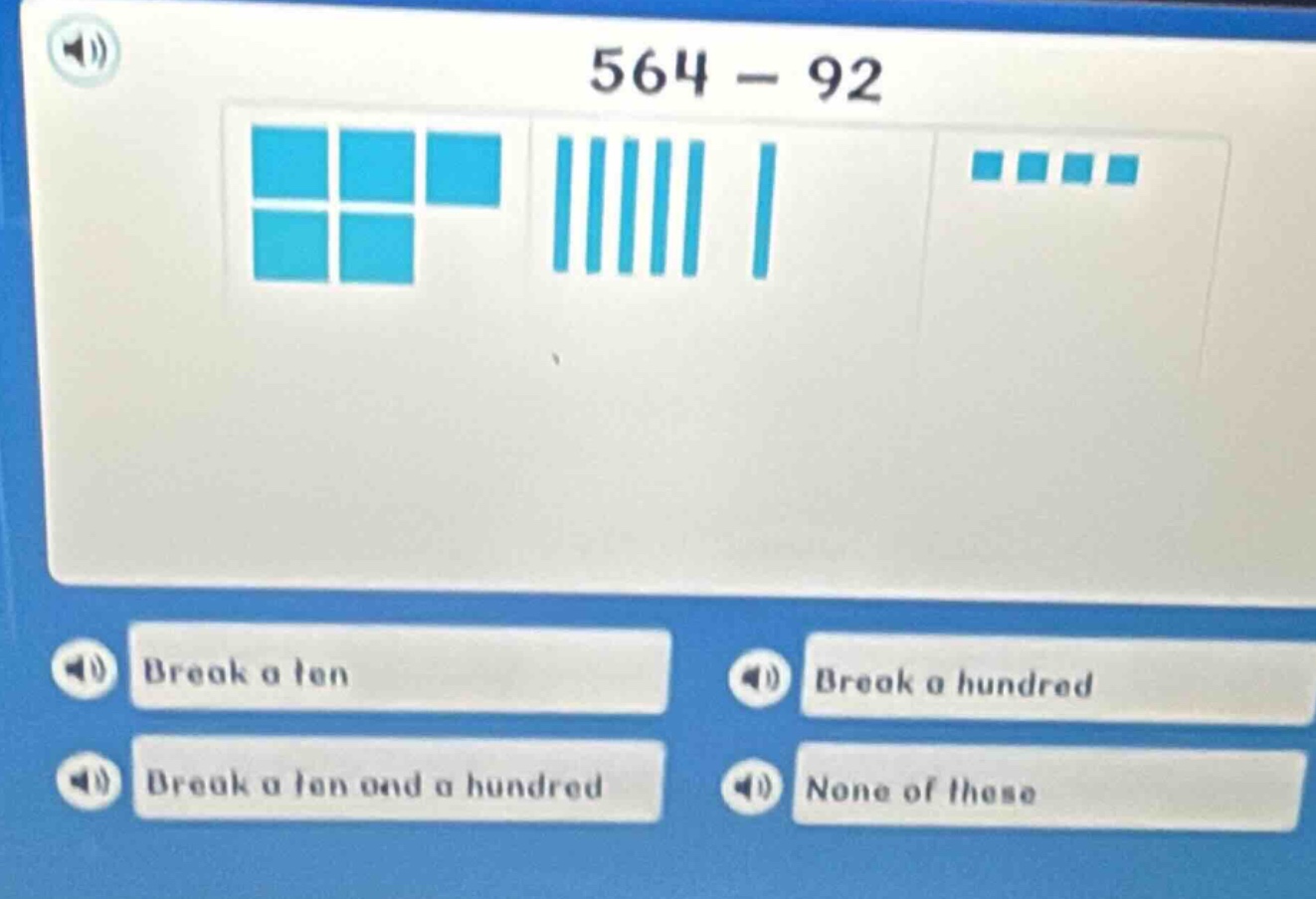
564 - 92
break a ten
break a hundred
break a ten and a hundred
none of these
Step1: Analyze the subtraction \(564 - 92\)
We can break down the numbers by place value. \(564\) has \(5\) hundreds, \(6\) tens, and \(4\) ones. \(92\) has \(9\) tens and \(2\) ones. To subtract the tens place, we have \(6\) tens and we need to subtract \(9\) tens, which is not possible directly. Also, for the hundreds place, we might need to adjust. But first, let's look at the visual representation (though we can also do it numerically). Let's perform the subtraction:
First, subtract the ones place: \(4 - 2 = 2\). Then the tens place: \(6 - 9\) is not possible, so we need to borrow from the hundreds place. The hundreds place has \(5\), so we borrow \(1\) hundred (which is \(10\) tens) to the tens place. Now the tens place becomes \(6 + 10 = 16\) tens. But wait, we also need to check if we need to borrow a ten? Wait, no, when we borrow a hundred (which is \(10\) tens), that's breaking a hundred. But also, in the tens place, after borrowing a hundred (10 tens), we have \(16\) tens, and we need to subtract \(9\) tens, which is fine. But wait, the ones place was okay. Wait, maybe the visual is representing the digits: the first group (squares) as hundreds, the middle (lines) as tens, the last (small squares) as ones. So original number: 5 hundreds (maybe 5 squares? Wait, the first group has 5 squares? Wait, the first group: 2x2 +1, so 5 squares (hundreds place: 5), middle: 6 lines (tens place: 6), last: 4 small squares (ones place: 4). So 564. Now we need to subtract 92 (9 tens and 2 ones). So to subtract 9 tens from 6 tens, we need to borrow 1 hundred (which is 10 tens) to the tens place, making the tens place 6 + 10 = 16 tens. That's breaking a hundred (since we take 1 from the hundreds place). But also, do we need to break a ten? Wait, the ones place is 4 - 2 = 2, which is fine. So we only need to break a hundred? Wait, no, wait: 564 - 92. Let's do the subtraction:
\(564 - 92 = (500 + 60 + 4) - (90 + 2) = 500 + (60 - 90) + (4 - 2) = 500 - 30 + 2\). To compute \(60 - 90\), we need to borrow from the hundreds place: \(500\) becomes \(400\), and \(60\) becomes \(60 + 100 = 160\) (wait, no, 1 hundred is 10 tens, so 5 hundreds = 4 hundreds + 10 tens. So 4 hundreds, 16 tens, 4 ones. Then subtract 9 tens and 2 ones: 16 tens - 9 tens = 7 tens, 4 ones - 2 ones = 2 ones, 4 hundreds. So the result is 472. So in this process, we broke a hundred (borrowed 1 hundred to make 10 tens) and we didn't need to break a ten (since the ones place was okay). Wait, but the options are: Break a ten, Break a hundred, Break a ten and a hundred, None of these. Wait, maybe I misread the visual. Wait, the middle group (tens place) has 6 lines, and we need to subtract 9 lines (tens). So 6 - 9: we need to borrow 1 hundred (10 tens) to make it 16 - 9 = 7. So that's breaking a hundred. But also, is there a ten to break? The ones place is 4 - 2 = 2, which is fine. So we only break a hundred? Wait, but the option "Break a hundred" is there. Wait, but maybe the visual is different. Wait, maybe the first group is hundreds (5), middle is tens (6), last is ones (4). So 5 6 4. Subtract 9 2. So tens place: 6 - 9, need to borrow 1 from hundreds (5 becomes 4, 6 becomes 16). So that's breaking a hundred. So the correct option is "Break a hundred"? Wait, no, wait: 564 - 92. Let's do the subtraction step by step:
- Ones place: 4 - 2 = 2 (no borrowing needed here).
- Tens place: 6 - 9. Since 6 < 9, we need to borrow 1 from the hundreds place. The hundreds place has 5, so we take 1 from 5, making it 4, and add 10 to the tens place. Now the tens place is 6 + 10 = 16.
- Now…

Snap & solve any problem in the app
Get step-by-step solutions on Sovi AI
Photo-based solutions with guided steps
Explore more problems and detailed explanations
Break a hundred