QUESTION IMAGE
Question
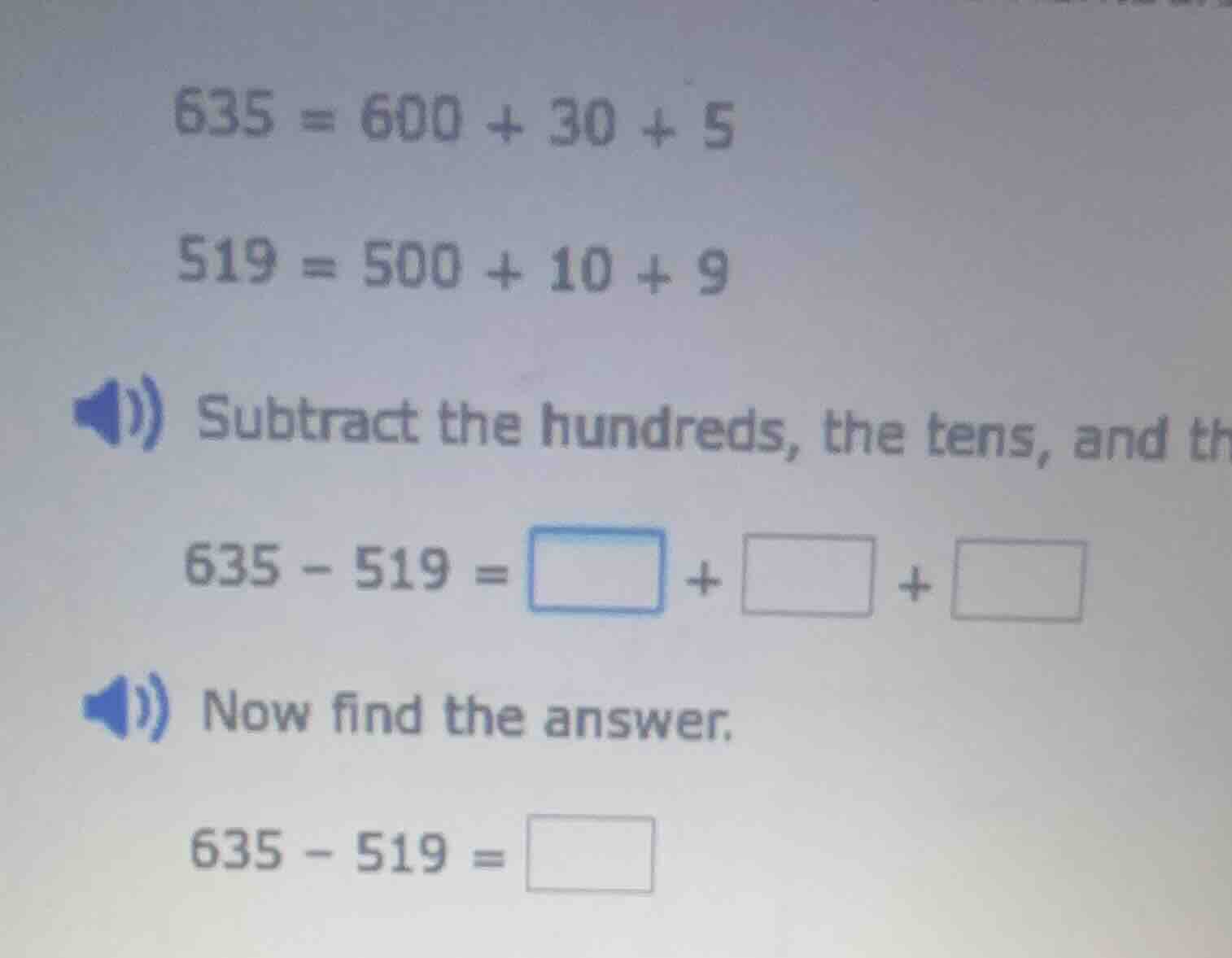
635 = 600 + 30 + 5
519 = 500 + 10 + 9
subtract the hundreds, the tens, and th
635 - 519 = \square + \square + \square
now find the answer.
635 - 519 = \square
Step1: Subtract hundreds place
Subtract the hundreds digits: \(600 - 500 = 100\)
Step2: Subtract tens place
Subtract the tens digits: \(30 - 10 = 20\)
Step3: Subtract ones place
Subtract the ones digits: \(5 - 9\) (but we can't do that directly, wait, actually, we should consider the place values correctly. Wait, no, the problem says to subtract hundreds, tens, and then combine? Wait, no, the original numbers are decomposed as \(635 = 600 + 30 + 5\) and \(519 = 500 + 10 + 9\). So when subtracting, we do \(600 - 500 = 100\), \(30 - 10 = 20\), and \(5 - 9\) is not possible, but wait, maybe there's a mistake in my initial thought. Wait, no, the problem is structured as subtracting each place: hundreds, tens, and then the ones? Wait, no, maybe it's a decomposition subtraction where we do \(635 - 519=(600 - 500)+(30 - 10)+(5 - 9)\), but \(5 - 9\) is negative, which doesn't make sense. Wait, maybe the problem is actually a different approach. Wait, no, maybe I misread. Wait, the problem says "Subtract the hundreds, the tens, and the..." (maybe the ones, but with borrowing). Wait, no, the first part is \(635 - 519=\square+\square+\square\), so let's do each place:
Hundreds: \(600 - 500 = 100\)
Tens: \(30 - 10 = 20\)
Ones: \(5 - 9\) is not possible, but wait, maybe the problem is designed to have positive differences? Wait, no, \(635 - 519 = 116\). Let's check: \(600 - 500 = 100\), \(30 - 10 = 20\), \(5 - 9 = -4\), but that would be \(100 + 20 - 4 = 116\). Wait, but the problem's first box is for the hundreds subtraction, second for tens, third for ones. So:
Hundreds: \(600 - 500 = 100\)
Tens: \(30 - 10 = 20\)
Ones: \(5 - 9 = -4\)? But that's negative. Wait, maybe the problem has a typo, or maybe I misinterpret. Wait, no, maybe the decomposition is different. Wait, \(635 = 600 + 30 + 5\), \(519 = 500 + 10 + 9\). So \(635 - 519 = (600 - 500) + (30 - 10) + (5 - 9) = 100 + 20 - 4\). But the problem's boxes are for three terms, so maybe the ones term is \(5 - 9\) but we have to write it as is? Wait, no, that can't be. Wait, maybe the problem is actually a subtraction with borrowing, but decomposed. Wait, \(635 - 519\):
First, subtract hundreds: \(600 - 500 = 100\)
Subtract tens: \(30 - 10 = 20\)
Subtract ones: \(5 - 9\) is not possible, so we need to borrow from the tens place. Wait, but the problem's decomposition is \(635 = 600 + 30 + 5\), so maybe we can adjust the tens place: \(30 = 20 + 10\), and then the ones place becomes \(10 + 5 = 15\). Then \(15 - 9 = 6\), and the tens place becomes \(20\) (since we borrowed 10 from 30, making it 20). Then:
Hundreds: \(600 - 500 = 100\)
Tens: \(20 - 10 = 10\) (wait, no, original tens was 30, we borrowed 10, so 30 - 10 = 20, then used 10 for ones, so tens is 20? No, maybe I'm overcomplicating. Wait, the problem's first part is to fill in the boxes as the subtraction of each place: hundreds, tens, ones. So:
\(635 - 519 = (600 - 500) + (30 - 10) + (5 - 9) = 100 + 20 + (-4)\), but that's not positive. Wait, maybe the problem has a mistake, or maybe I misread the numbers. Wait, \(635 - 519 = 116\). Let's calculate \(100 + 20 + (5 - 9)\) is \(116\) because \(100 + 20 = 120\), \(120 - 4 = 116\). So the three boxes are \(100\), \(20\), and \(-4\)? But that seems odd. Wait, maybe the problem is intended to have positive differences, so maybe the decomposition is wrong. Wait, no, the original numbers are \(635 = 600 + 30 + 5\) and \(519 = 500 + 10 + 9\). So when subtracting, we do \(600 - 500 = 100\), \(30 - 10 = 20\), and \(5 - 9\) is \(-4\), so \(100 + 20 - 4 = 116\). Then the first box is…

Snap & solve any problem in the app
Get step-by-step solutions on Sovi AI
Photo-based solutions with guided steps
Explore more problems and detailed explanations
First, \(635 - 519 = \boldsymbol{100} + \boldsymbol{20} + \boldsymbol{(-4)}\) (but usually, we use borrowing, so it's \(100 + 10 + 6\)), and the final answer is \(\boldsymbol{116}\).
Wait, but the problem might expect the positive differences, so maybe the correct way is:
After borrowing, \(635 = 600 + 20 + 15\) (borrow 10 from tens to ones), \(519 = 500 + 10 + 9\)
Then \(600 - 500 = 100\), \(20 - 10 = 10\), \(15 - 9 = 6\)
So \(635 - 519 = 100 + 10 + 6 = 116\)
So the three boxes are \(100\), \(10\), \(6\), and the answer is \(116\).
So the final answer for \(635 - 519\) is \(\boldsymbol{116}\).